Maritime Security Managing risks associated with stowaways and rescued people at sea

Stowaways are an ongoing issue for the security of ships and the safety of crew members, as well as incurring substantial associated costs for shipowners and insurers. Worldwide, information about stowaways is incomplete and incidents are under-recorded, but the financial cost per incident is known to be rising, costing the industry millions of US dollars every year. In recent years, increasing global migration by sea has meant that encountering people in difficulty in small or overcrowded boats has become more likely for seafarers in many parts of the world.
Examples of the ‘irregular’ movement of people at sea include scenarios ranging from a single stowaway hidden on a cargo ship to hundreds of people representing mixed groups, crammed into a large open boat. Stowaways and people rescued at sea, once on board a ‘host’ ship, are all essentially unauthorised people who present some common security risks, as well as specific challenges and responsibilities.
Disembarking and repatriating stowaways can be a complex and lengthy procedure, so the emphasis for merchant shipping must be on preventing stowaways accessing ships in the first place.
Stowaways can occur anywhere and embark from any port, but there are regions of the world where the problem is more common, and ports where the risk of acquiring stowaways is known to be higher. However, new stowaway trends continue to emerge, and it is important that shipping interests keep themselves informed of developments. For example, several very similar incidents were recorded on routes between Africa and the Canary Islands between 2020 and 2023, in which stowaways hid in the open rudder trunks of cargo ships. Ferries and RoRo freighters on short sea passage routes in Europe have also seen increasing stowaway activity.
Meanwhile, the phenomenon of mass migration by sea shows no signs of resolution and seafarers continue to encounter people in distress at sea on migration routes around the world. Often their boats are overcrowded, inadequate for the sea conditions, poorly provisioned and lacking in basic safety equipment. ‘Irregular’ migrants are those that travel by unauthorised or illegal routes, although they may include genuine refugees and the victims of human trafficking. In the Mediterranean, although the overall total of irregular crossings has decreased since a peak in 2015, the numbers using some routes have risen, dependent on local factors that vary from year to year.
People set sail from the north and west coasts of Africa, Lebanon and Turkey, heading mainly for Italy, Spain and Greece, with smaller numbers travelling onward to other parts of Europe.
While the Mediterranean situation continues to involve the largest numbers, other irregular migrant sea routes are also significant, including those used by displaced Rohingya leaving Bangladesh and people trying to enter the United States from the Caribbean and Mexico. Many thousands travel to Yemen from the Horn of Africa, mainly in search of work in the Arabian Peninsula, often returning by the same sea route. The UK Home Office reported that an estimated 29,437 people arrived in the UK in 2023, having crossed the English Channel in 602 small boats. In 2024, numbers had already exceeded that annual total by 26 October. All these journeys are dangerous, with those attempting them often getting into difficulty at sea, and many thousands have died over the years.
Inevitably, with so many willing to risk sea crossings in precarious circumstances, seafarers will sometimes be faced with stowaways or called upon to assist people in distress. Whether rescued from a sinking boat or having boarded covertly, those on-board ships at sea who are not authorised passengers or part of the crew can be a challenge for seafarers, but one that cannot always be avoided. The UN Convention on the Law of the Sea (UNCLOS) requires Masters to assist people in distress at sea, except when doing so would expose their own ship, crew or passengers to serious danger. This obligation is also reflected in the SOLAS and SAR Conventions. However, merchant vessels are generally unsuitable for taking care of large groups of people who may be distressed and unfamiliar with ships, creating a situation for which the crew feel unprepared. Those rescued may rely completely on the ship and its crew for their survival, and this puts a burden of responsibility on seafarers to manage them safely and securely until they can be transferred.
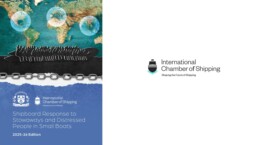
The newly released ICS/Witherby publication ‘Shipboard Response to Stowaways and Distressed People in Small Boats – 2025-26 Edition’ aims to advise the owners, officers and crew of merchant ships on how best to deal with people encountered at sea in these difficult circumstances. It covers security and safety procedures, as well as how to ensure compliance with international regulations.
It also includes information on current trends, key concepts and new developments. Practical guidance on legal obligations, responsibilities and industry best practice is provided, with reference to recent case studies. Bridge cards that summarise the key points are also available as a handy quick reference aid for the ship’s bridge team. In addition to officers and crew, the publication may also be of interest to other groups involved, such as NGOs, P&I Clubs, governments and other various regulatory authorities.



Related News.

Greece has the most to lose from delays in shipping’s green transition, new analysis finds
UCL and WWF Greece report finds the IMO Net-Zero Framework offers Greek ship owners the clarity they need, and the best protection against a…

Snow Land joins Cool Carriers as the world’s first reefer with a gate rudder, a new chapter for sustainable and efficient reefer shipping
Cool Carriers, the world’s largest operator of specialised reefer vessels, took delivery of Snow Land from Kitanihon Shipbuilding in Japan on 12…

IBIA launches Marine Energy Outlook Survey as Annual Convention in New York
IBIA - The International Bunker Industry Association officially launched its Marine Energy Outlook Survey during the IBIA Annual Convention in New…

Why did ITF staff vote to strike again?
Staff at the International Transport Workers’ Federation (ITF) headquarters in London have voted to give their union a strike mandate. According to…

Nearly half of maritime crew tickets booked a week ahead are cancelled
Two new C Teleport reports show when maritime and aircrew teams book crew flights, how often they cancel, and what late booking costs, with a…

Kpler completes $1.5bn+ Sixth Street investment and continues accelerating growth
Investment backs Kpler's bold ambition to shape the future of global trade intelligence. Kpler, a leading provider of global physical trade…

How SAL and DNV are strengthening heavy-lift shipping
From classification and newbuilding support to operational tools and advisory expertise, SAL and DNV have been collaborating for decades. The…

PSA Singapore breaks ground on Tuas Port Phase Two to strengthen Global Trade Connectivity
PSA Singapore marked the groundbreaking of Tuas Port Phase Two, a significant step in the development of the world’s largest fully automated…

 …

BIFA welcomes UK–EU trade progress and calls for clarity on implementation
The British International Freight Association (BIFA) has welcomed progress made at today's UK–EU Summit in Brussels, highlighting the potential…
Subscribe to our newsletter!
if you dont want to swim alone in the ocean of news, sign up for the newsletter, and you will receive daily all the important news of world shipping!
