South Korea to demonstrate 100km transmission on ‘Quantum Internet’ early next year
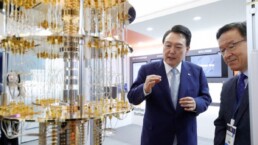

Securing Proprietary Technology to Join Global Competition
The Ministry of Science and ICT and the Electronics and Telecommunications Research Institute (ETRI) have recently secured quantum cryptography communication technology that enables 100km wired communication using “entangled photons” and plan to demonstrate it early next year. It is reported that the demonstration is likely to be linked with the launch ceremony of the “Quantum Strategy Committee,” the national quantum technology policy control tower, expected early next year.
Quantum cryptography communication using entangled photons is considered an advanced technology compared to the current “single photon” method developed by mobile carriers and is regarded as a fundamental technology necessary for realizing the quantum internet. The single photon method applies the “quantum superposition” phenomenon, where information cannot be viewed from the outside and is destroyed if hacking is attempted, to fundamentally block hacking attempts. The entangled photon method, in addition to this, applies the “quantum entanglement” phenomenon, which allows instantaneous information transmission over long distances, significantly increasing data transmission speed.
ETRI has secured wired transmission technology for a 100km section, including a 16km section in a real environment with significant noise, with over 90% reliability. An ETRI official emphasized, “100km is the longest distance in the country and matches the performance of advanced countries like the United States and China.”
The demonstration of the quantum internet’s fundamental technology early next year signals the full-scale operation of the “Quantum Korea” strategy to preempt quantum technology, which even advanced countries have not yet fully secured. The government plans to initiate a large-scale research and development (R&D) project worth several hundred billion won for long-distance quantum internet verification and big tech-level quantum computer development through an exemption from the preliminary feasibility study. Simultaneously, it aims to actively foster the quantum industry through the launch of the national control tower and the full implementation of the Quantum Technology Industry Act.
The 100km quantum cryptography communication technology using entangled photons is expected to be advanced through the “Quantum Science and Technology Flagship Project,” a large-scale project worth several hundred billion won starting next year. The government plans to develop an “entanglement purification quantum repeater,” a facility that can realize long-distance quantum internet by connecting various communication sections by 2032 and conduct verification for initial internet commercialization. Unlike current communication, quantum cryptography communication cannot freely amplify signals, resulting in shorter transmission distances. Therefore, quantum repeaters will be a key infrastructure for realizing nationwide long-distance internet, according to industry explanations.
The advantages of the quantum internet are largely possible due to the two quantum principles of ‘quantum superposition’ and ‘quantum entanglement.’ Quantum superposition allows a photon, the quantum information unit, to simultaneously hold information of 0 and 1. This allows information to be compressed and transmitted faster than current digital information, which can only display 0 or 1. Additionally, the quantum superposition state is randomly destroyed if it is affected by external influences before the recipient checks the information through a “quantum key,” fundamentally blocking hacking and eavesdropping attempts.
On the other hand, quantum entanglement is a phenomenon where the states of two photons are interconnected, allowing instantaneous information transmission even over long distances. If one photon has a state of 0, the other will automatically have a state of 1, even if it is far away. This phenomenon is known as “quantum teleportation.” Utilizing photon pairs with this quantum entanglement relationship, or entangled photons, for information transmission can not only increase communication speed but also directly transmit quantum information processed by quantum computers without a separate conversion process, offering compatibility advantages. However, due to the high implementation difficulty, such as the need for an ultra-low temperature environment to minimize external influences, it is still considered an early-stage technology even in advanced countries. For instance, in May, researchers at Harvard University in the United States succeeded in transmitting entangled photons over a 35km section in a complex urban environment, indicating significant technological advancements.
Through the first large-scale quantum R&D project, the Quantum Science and Technology Flagship Project, the government plans to secure three major quantum technologies: quantum internet, quantum computers, and quantum sensors. In the field of quantum computers, it aims to develop 1,000-qubit technology by 2032. A qubit is a quantum information unit that simultaneously holds information of 0 and 1, and 1,000 qubits match the performance of global big tech companies like Google and IBM. The Korea Research Institute of Standards and Science has developed a 20-qubit domestic quantum computer and plans to commercialize it as a cloud service soon, while Yonsei University introduced IBM’s 127-qubit high-performance quantum computer for the first time in the country this month. Quantum sensors also aim for up to 100 times more precise performance than existing sensors, such as ultra-precise diagnostic quantum magnetic resonance imaging (MRI).
The government also plans to launch the Quantum Strategy Committee, a quantum policy control tower composed of up to 20 members, including the prime minister, officials from eight ministries, and private experts, by the end of this year or early next year. The committee will be responsible for the comprehensive quantum plan, the basic and development plans for quantum clusters, and the coordination of important government policies. The Ministry of Science and ICT, the Ministry of National Defense, the Ministry of Foreign Affairs, and the National Intelligence Service will participate to devise response measures for the impact on national security and defense. The Quantum Technology Industry Act, which took effect last month, includes government support regulations for establishing the comprehensive quantum plan, building research and industrial hubs, creating an ecosystem, and fostering talent, including the operation of the committee.
The government’s full-scale engagement in fostering the quantum field is driven by a sense of urgency that the golden time for technological preemption is running out. According to the Ministry of Science and ICT’s “Advanced Bio, Artificial Intelligence (AI), and Quantum Global R&D Strategic Roadmap,” South Korea’s quantum technology level is the lowest among the 12 major countries, including the United States, China, the United Kingdom, Germany, and Japan. South Korea’s scores, reflecting papers, patents, and expert qualitative evaluations, were the lowest among the 12 countries, with 2.3 points in quantum computing, 2.9 points in quantum communication, and 2.9 points in quantum sensing. This is significantly lower than the United States, which scored 100 points in quantum computing and 84.8 points in quantum communication, and China, which scored 82.5 points in quantum communication.
Source : Businesskorea



Related News.
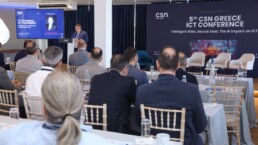
Intelligent Skies, Secure Seas: Navigating Connectivity, Cyber Resilience, and AI Liability at the 5th CSN Greece ICT Conference
The 5th CSN Greece ICT Conference, held on 19th November 2026 at the Ploes Floating Venue in Paleo Faliro, Athens, successfully convened maritime…

EU moves to ban tankers insured in Russia, repair services at Russian refineries
EU targets Russian-insured tankers, refineries Von der Leyen announces 22nd sanctions package All 27 member states must approve new…

IMO tackling fraudulent registries together
Strong national systems and international information sharing are crucial to tackling fraudulent registries and fraudulent ship registration…
Open letter on freedom of navigation and the protection of seafarers
Dear High Representative Kallas, Dear Foreign Affairs Ministers, European Shipowners | ECSA, BIMCO, the Cruise Lines International Association…

Davies Turner warns of Rising Asia-UK Container Disruption and European Port Congestion
Davies Turner, one of the UK’s largest independent freight forwarding and logistics companies, says that disruption to container shipments from Asia…

Disruptions still dominate tanker market outlook
"This year, tanker markets have been affected by disruption to transits through the Strait of Hormuz, the Houthi blockade of Saudi Arabian Red Sea…

Panama’s President called on to match COP31 Heroism with action at shipping climate talks
As a series of crucial meetings tasked with cutting greenhouse gas emissions from global shipping takes place this week and next, environmental NGOs…

Trafigura appoints Helio Cumbi as Executive Director, Mozambique
Trafigura has appointed Helio Cumbi as Executive Director, Mozambique, and Business Development Lead for East and Southern Africa Oil. Helio is a…

“K” LINE holds FY2026 Global Dry Bulk Meeting
Kawasaki Kisen Kaisha, announces that it held a global meeting for its dry bulk business at the company’s head office on November 9 and 10. The…
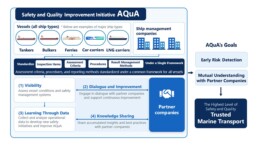
MOL launches ‘AQuA’ safety and quality improvement initiative
Standardizing Group-wide Safety and Quality Assessment Criteria to Enhance Vessel Safety and Quality Mitsui O.S.K. Lines, announced the launch of…
Subscribe to our newsletter!
if you dont want to swim alone in the ocean of news, sign up for the newsletter, and you will receive daily all the important news of world shipping!
