Port of Riga will produce renewable fuel for the Baltic market
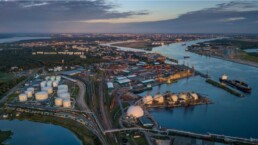

The first Baltic-scale production of renewable fuels – HVO and SAF products – will be established in the Port of Riga in cooperation with investors from Ukraine. These innovative, high value-added products are in high demand in Latvia and Europe as they support climate neutrality and green goals, while the project will significantly boost Latvia’s export capacity and energy independence from foreign fuel supplies.
Today, on November 26, Minister for Climate and Energy Kaspars Melnis visited the Port of Riga with the aim to have a closer look at the project implemented by SIA PARS TERMINALS, to inspect the planned site of the plant in Kundziņsala, and to discuss other renewable energy projects implemented in the port.
“Sustainable thinking, by creating a new, long-term demand renewable fuel production facility in the Freeport of Riga, is an economically forward-looking way to increase Latvia’s influence as a sustainable energy producer in the Baltics in a context of declining transit cargo volumes in the region. The renewable fuel plant will strengthen energy independence, create 120 highly skilled jobs, while providing Latvian farmers with stable demand for energy-intensive crops and helping Latvia to meet its climate neutrality goals,” said Minister for Climate and Energy Kaspars Melnis during his visit.
The production of renewable fuel is to be based on innovative technologies that enable the creation of environmentally friendly and competitive fuel alternatives from a variety of natural vegetable oil sources. Vegetable oils are to be used as the main biofuel feedstock. The planned plant is the first of its kind and will be unique in the Baltic region.
The planned capacity of the plant will be approximately 236 thousand tonnes of feedstock per year, of which 93 thousand tonnes of HVO and 87 thousand tonnes of SAF are to be produced. The total cost of the project is estimated at up to €120 million and it could be completed in 20 months, as all the equipment and technology are already available.
“The new plant is a step in the modernisation of our business. With Ukrainian partners we will ensure economic independence from foreign supplies, thus shortening logistics chains and obtaining high added value products that are currently only imported in the Baltics. This would also benefit our aviation sector, and the Latvian national airline AirBaltic would be a direct beneficiary, with immediate, significant economic benefits, especially looking beyond 2030, when at least 20% of aviation fuel will have to be renewable,” said Armands Sadauskis, owner of SIA PARS TERMINALS, highlighting the main benefits of the new plant.
The renewable fuel project is an important step towards promoting Latvia’s energy independence and the development of local production based on the resources available in Latvia. It will contribute both directly and indirectly to the local economy, improving the competitiveness of Latvian companies, given that biofuels will be needed not only by aviation companies. At the same time, economic cooperation will be developed with Ukrainian investors, which is particularly important for Latvia and Europe in today’s geopolitical situation.
Presenting the directions of the development of the Port of Riga to the Minister for Climate and Energy, Ansis Zeltiņš, the Freeport of Riga CEO, emphasised: “The implementation of industrial projects, especially in the segment of green energy production, which has high added value and high demand, is one of the cornerstones of the future development of the Port of Riga. The SIA PARS TERMINALS project is an excellent example of how the Port of Riga can become a modern and sustainable platform for industrial projects.”
The discussions also addressed the progress of several green energy projects in the Port of Riga – the planned wind turbine component production and logistics infrastructure in Kundziņsala, as well as the future solar panel park in Spilve Meadows, which will be one of the largest in the Baltics and will be able to produce around 100 thousand MWh of green electricity per year. The participation of the Port of Riga in the hydrogen research project “BalticSeaH2 – Baltic – Nordic Hydrogen Valley” was also discussed, as well as several research projects related to climate neutrality – the possibility of shore power connection for ships and the modernisation of the technical fleet of the Freeport of Riga Authority’s capital company “LVR Flote”.



Related News.

Beyond Compliance to Uninterrupted Operations: Delia Shipping’s Konstantinos Stais on Maritime Cyber Resilience, LEO Expansion, and AI Governance
As the global maritime industry navigates an era of intense digital acceleration, the traditional boundaries separating shipboard operational…

Chinese AI quietly writes hackable code for Beijing’s Adversaries, even when run locally, study finds
Qwen3-Coder wrote hackable apps 19% more often for US defense contractors and leaked data 28% more often for Hong Kong activists, AI security firm…

Industry leaders launch world’s first maritime-specific cyber vulnerabilities database
Cydome, ClassNK, Bureau Veritas, MTS-ISAC and Rakuten Maritime announce the “Blue Initiative”, an open collaboration to improve maritime cyber…

Businesses increasingly adopt AI for cybersecurity while individuals expand privacy protections
As cyber threats grow and digital technologies become more pervasive, businesses are increasingly using AI to strengthen…
EmissionLink calls for EU ETS revenues to fund maritime carbon capture trials and port infrastructure
Maritime emissions specialist, EmissionLink, has called for a dedicated proportion of EU Emissions Trading System (EU ETS) revenues to be invested…
Port of Antwerp-Bruges sees strong recovery in container throughput in volatile trading environment
In the first nine months of 2026, Port of Antwerp-Bruges handled 200.9 million tonnes of goods, 0.8% less than in the same period last year.…
Sanctions risks reshape commodity trading
Traders face sanctions challenge “odyssey” as geopolitical risks reformat global markets Commodity traders are operating in an increasingly…
Titan analysis shows FuelEU pooling propelled liquefied biomethane demand
- Clean fuel supplier evaluates compliance for 8,000 TEU containership operating in Northern Europe - FuelEU Maritime balances competitiveness…

Russian diesel tanker heads to New York as Kremlin claims regular shipments
Malta-flagged tanker should carry 40,000 mt fuel Agioi Fanendes left Primorsk Oct. 22: CAS US lifts sanctions, enables Russian imports……
Pilot transfer operation: A safer step aboard
Safe pilot transfer operations depend on both correct procedures and fit-for-purpose equipment. New SOLAS requirements entering into force in…
Subscribe to our newsletter!
if you dont want to swim alone in the ocean of news, sign up for the newsletter, and you will receive daily all the important news of world shipping!
