AEDs are a must have on ships
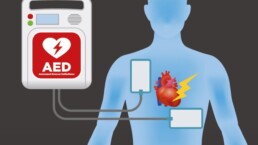

West’s position on AEDs is that every ship should have at least one AED onboard. A lack of defibrillators is putting seafarers’ lives at risk, with limited medical facilities onboard most ships and a lack of experienced medical personnel. AEDs have shown that they increase the survival rates of cardiac arrest patients, giving them a greater chance of making it to the hospital to receive the emergency medical care they desperately need.
Up to 450,000 people die each year in the United States due to cardiac arrest. Estimates suggest as many as 4 million people die globally from cardiac arrest each year. A cardiac arrest is a medical emergency and 9/10 people who experience one die outside of hospital within minutes without receiving any medical or first aid assistance. This means it could easily happen to a crew member onboard a vessel.
When someone collapses due to a cardiac arrest, treating the patient immediately with cardiopulmonary resuscitation (CPR) and using an automated external defibrillator (AED) can save their life. St. Johns Ambulance Australia states that for individuals who do not receive CPR and early defibrillation, there is only a 5% chance of them surviving. Furthermore, every minute that an AED is not used, their chances of survival decrease by 10%.
With the combination of CPR and the use of an AED, the chances of survival jump up to 70%.
However, at present, there is no statutory requirement under international or national legislation for ships to carry defibrillators. Accordingly, it is a matter for individual operators to decide whether to include a defibrillator with the medical stores.
What is an AED?
An AED is a defibrillator. They are battery-powered, lightweight and portable devices. Defibrillation is when a controlled electric shock is delivered safely in attempts to restore the heart’s normal rhythm. The unit will decide whether a shock is required. The shock, sent through the adhesive electrode pads attached to the person’s chest, will be done only after it analyses the heart rhythm. The shock disrupts the chaotic rhythm and allows the heart’s normal pumping rhythm to return. It should be noted that anyone can use an AED to help someone who is having a cardiac arrest.
The importance of CPR and AED being used together
It is vital to use CPR and defibrillation to maximise the chances of the patient surviving. Defibrillation only focuses on restoring the heart’s normal rhythm; it does not restart the heart. CPR is done to keep blood pumping through the heart and around the body, in particular, to give the brain oxygen, to keep the patient alive until further medical help arrives.
What to do when someone is experiencing a cardiac arrest, and you have an AED onboard?
- First, call for help or tell someone to call for a medical evacuation, as this is a medical emergency. The casualty will have a better chance of survival if they can perform a medical evacuation or deviation as soon as possible. If two rescuers are present, one should get the AED while the other performs CPR.
- You should then start CPR immediately; our REACT poster has more information on this.
- Turn on the AED.
- Follow the voice prompts
- All clothing must be removed from the casualty’s chest. The AED has scissors to cut the clothing. If the individual is wearing a bra, this needs to be cut off and removed entirely as any metal will disrupt the electrical current of the AED’s shock. Apply the electrode pads. The pads will have images of where to place them on the chest area. Follow these instructions.
- Place electrode pads on the chest.
- When the AED performs the assessment, clear the area around the person, as touching the casualty while the machine reads the person’s heart could result in a faulty reading.
- Always listen to the voice prompts, as this will tell you how and when to give a shock if one is required to restore the heart rhythm to normal.
- Once the shock has been delivered, return to CPR if the device prompts you to do so.
Training
AEDs are simple to operate and can be used by anyone with no prior training. However, training can help the crew ensure they are familiar with the device and enable them to act confidently and quickly should they ever encounter a person who has experienced a cardiac arrest.
It is therefore essential to recognise the signs and symptoms of cardiac arrest for both males and females, as females can have different symptoms; please see our REACT poster for more details. Overall, if they have collapsed, are unresponsive, and not breathing, it is most likely a cardiac arrest, and bystanders should act immediately, regardless of the person’s sex. Should crew members feel shy or embarrassed about exposing breasts as they may worry that their actions are seen to be inappropriate, remember AEDs save lives and, the more time that passes without action decreases the casualty’s chance of survival.



Related News.

OL Shipping Group in Tokyo: Capt. Eberhard Koch calls for realistic solutions to Maritime Decarbonisation
An intensive and engaging couple of days in Tokyo brought together leading figures from the international maritime community, providing a valuable…

Regatta for Peace one of the largest ever in Cyprus
Cyprus will host the first European stop on a global sailing journey leading up to the 2027 America’s Cup in Naples. More than 120 sailors…
The propulsion technology powering the marine energy transition
The marine industry is under increasing pressure to future-proof fleets, balancing the need to reduce emissions and improve efficiency. Propulsion…

Signal Ocean acquires Lgmar
Signal Ocean announced the acquisition of Lgmar, the Athens-based company behind Telix, a maritime email and communication platform in daily use…

Canada clean power push challenged by interprovincial grid limits, says GlobalData
Canada is entering a pivotal phase of power-sector expansion as federal tax credits, the phase-out of coal-fired generation, and accelerating…

Maritime safety depends on human factors and leadership, not procedures alone
Interim survey findings point to a gap between seafarers’ perceptions of risk and injury data Seafarers may misjudge when and where they are most at…

New BIMCO contracts tackle ship recycling and energy-saving retrofits
BIMCO adopted two new contractual solutions designed to help you manage important operational and regulatory challenges: the revised…
Stena Line to acquire vessel and make changes to its network
Stena Line has reached an agreement to acquire the RoRo vessel Somerset from CLdN. Subject to closure and transfer, the vessel would begin operating…

DORIC WEEKLY INSIGHT 16 OCTOBER 2026
Please find below the DORIC Market Insight for the week ending 16th October 2026. Weekly Report 16.10.2026

Important information for port clients and freight carriers effective November 1, a new traffic overpass and port checkpoint will open for traffic to the Port of Riga on Kundziņsala
Starting November 1 of this year, a new traffic overpass connecting Tvaika Street to Kundziņsala will open to facilitate traffic to and from the Port…
Subscribe to our newsletter!
if you dont want to swim alone in the ocean of news, sign up for the newsletter, and you will receive daily all the important news of world shipping!
