Safety, alternative fuels as cargo and technologies for the future of the maritime industry lead discussion at ABS North America regional committee meeting
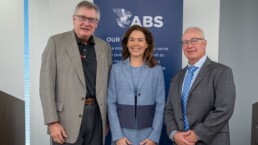

Maritime industry leaders from the U.S. and Canada traveled to ABS’ World Headquarters to discuss the latest marine market trends in the emerging ammonia, hydrogen and carbon economies, offshore renewables and nuclear energy.
Cutting-edge academic research, technology and sustainability initiatives were also highlighted at the annual ABS North America Regional Committee.
“We believe there is a high correlation between organizations who embrace safety and high performance,” said Christopher J. Wiernicki, ABS Chairman and CEO.
“Going forward, there will be a new equation for sustainable safety which has systems thinking, well trained people and percentage usage of digital in the numerator, representing capacity and capability. Demand is in the denominator, representing the complexity of an evolving decarbonization trajectory and rapidly changing technology environment. Our future safety protection frontier is defined as the place where capacity and capability equal demand. Safety is becoming more synonymous with cybersecurity and reliability.”
Committee members heard how ABS has secured the number one position in global orderbook share and grown the existing ABS-classed fleet to 298 million gross tons, with more than 11,500 assets.
Special guest Helen Currie, Chief Economist for ConocoPhillips, provided insight into economic indicators affecting the global oil and gas markets.
“The shipping industry is really the tip of the spear as waterborne trade will remain a large, vital link connecting energy producers with consumers. The global energy mix will continue to rely on oil and natural gas for the foreseeable future, and decarbonization objectives will continue to shape policies and influence energy markets,” said Currie.
Members also heard from Dr. Themistoklis Sapsis, the William I. Koch Professor of Mechanical and Ocean Engineering and the Director of the Center for Ocean Engineering at MIT, who presented information about cutting-edge research aimed at the maritime industry.
He said: “Our goal is to provide in-depth research to inform the commercial shipping industry on which applications affecting manufacturing, alternative fuels and cybersecurity are the most meaningful and which ones have the broadest impact to economics, environment and human health. We know that there is not one single solution for everything. We are looking at different vessel sizes, types and routes to discover what makes the most sense to optimize vessel operations in the future.”
Committee members also heard how new vessel orders show an increase in dual-fuel readiness in comparison to conventional fuels, with the majority of new builds designed to be LNG-ready followed by methanol and ammonia. Regarding alternative fuels, pricing and availability, rather than technology, will dictate which fuel becomes a leading player and when.
“These meetings provide an important venue to connect with colleagues to discuss insights, solutions and strategies to help navigate the ever-evolving maritime industry. I appreciate our partners at ABS for their commitment to safety and their collaboration, service and support,” said Captain Christopher Bulera, ABS North America Regional Committee Chairman and President Polar Tankers, ConocoPhillips Global Marine.



Related News.

Greece has the most to lose from delays in shipping’s green transition, new analysis finds
UCL and WWF Greece report finds the IMO Net-Zero Framework offers Greek ship owners the clarity they need, and the best protection against a…

Snow Land joins Cool Carriers as the world’s first reefer with a gate rudder, a new chapter for sustainable and efficient reefer shipping
Cool Carriers, the world’s largest operator of specialised reefer vessels, took delivery of Snow Land from Kitanihon Shipbuilding in Japan on 12…

IBIA launches Marine Energy Outlook Survey as Annual Convention in New York
IBIA - The International Bunker Industry Association officially launched its Marine Energy Outlook Survey during the IBIA Annual Convention in New…

Why did ITF staff vote to strike again?
Staff at the International Transport Workers’ Federation (ITF) headquarters in London have voted to give their union a strike mandate. According to…

Nearly half of maritime crew tickets booked a week ahead are cancelled
Two new C Teleport reports show when maritime and aircrew teams book crew flights, how often they cancel, and what late booking costs, with a…

Kpler completes $1.5bn+ Sixth Street investment and continues accelerating growth
Investment backs Kpler's bold ambition to shape the future of global trade intelligence. Kpler, a leading provider of global physical trade…

How SAL and DNV are strengthening heavy-lift shipping
From classification and newbuilding support to operational tools and advisory expertise, SAL and DNV have been collaborating for decades. The…

PSA Singapore breaks ground on Tuas Port Phase Two to strengthen Global Trade Connectivity
PSA Singapore marked the groundbreaking of Tuas Port Phase Two, a significant step in the development of the world’s largest fully automated…

 …

BIFA welcomes UK–EU trade progress and calls for clarity on implementation
The British International Freight Association (BIFA) has welcomed progress made at today's UK–EU Summit in Brussels, highlighting the potential…
Subscribe to our newsletter!
if you dont want to swim alone in the ocean of news, sign up for the newsletter, and you will receive daily all the important news of world shipping!
