Hapag-Lloyd orders 24 new container ships

- Ships will feature liquefied gas dual-fuel propulsion and be ammonia-ready
- Deliveries between 2027 and 2029
- Investment volume of roughly USD 4 billion
- Rolf Habben Jansen: “We will continue to modernize and decarbonize our fleet.”
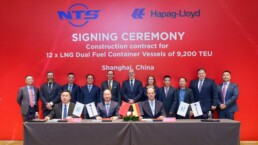
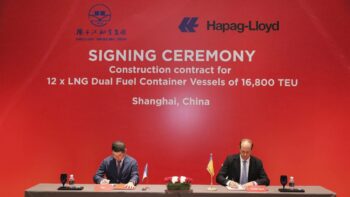
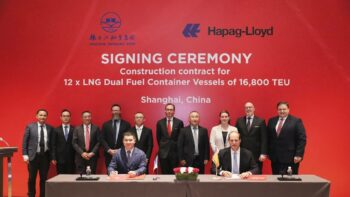
Hapag-Lloyd has signed two contracts with two Chinese shipyards for a total of 24 new container ships. Of these, 12 newbuildings – each with a capacity of 16,800 TEU – will be built by Yangzijiang Shipbuilding Group. These units will be used to expand the capacity of services that are already in place. An additional 12 ships, each with a capacity of 9,200 TEU, have been ordered from New Times Shipbuilding Company Ltd. and will replace older units in the Hapag-Lloyd fleet that will be nearing the end of their service life in this decade.
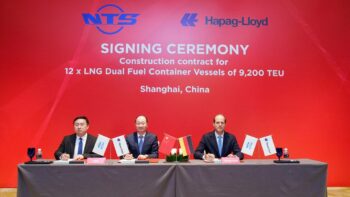
All of the newbuildings will be equipped with state-of-the-art low emission high pressure liquefied gas dual-fuel engines that are extremely fuel-efficient. In addition, these vessels can be operated using biomethane, which can reduce CO2e emissions by up to 95% compared to conventional propulsion systems. The new ships will also be ammonia-ready. Hapag-Lloyd will take delivery of the new vessels between 2027 and 2029. The newbuildings will have a combined capacity of 312,000 TEU and involve a combined investment volume of around USD four billion. A long-term financing of USD three billion has already been committed.
“This investment is one of the largest in the recent history of Hapag-Lloyd, and it represents a significant milestone for our company as it pursues the goals of its Strategy 2030, such as to grow while also modernizing and decarbonizing our fleet. Operating a fleet of more efficient vessels will also enhance our competitive position, and thanks to the increase in capacity, we will continue to offer our customers a global, high-quality product,” said Rolf Habben Jansen, CEO of Hapag-Lloyd AG.
Hapag-Lloyd is fully committed to the 1.5-degree target of the Paris Agreement. By 2030, the absolute greenhouse gas emissions of the company’s fleet operations are to be reduced by around one third compared to 2022 – in what will be another step toward net-zero fleet operation by 2045. This ambitious goal will be achieved by investing in modern, efficient newbuildings, slow steaming, fleet modernization and the use of new propulsion technologies and alternative fuels, which will allow customers to benefit from multiple green transport options at the same time. Considering the recent investment decision announced on April 16 of this year to retrofit five vessels to methanol propulsion, this investment is another step in Hapag-Lloyd’s efforts to prepare itself for a multifuel future and to drive the decarbonization of the liner shipping industry.
Hapag-Lloyd controls 287 modern container ships with a total transport capacity of 2.2 million TEU. This makes the company one of the world’s leading liner shipping companies. In addition, it operates the largest fleet sailing under the German flag.



Related News.

Beyond Compliance to Uninterrupted Operations: Delia Shipping’s Konstantinos Stais on Maritime Cyber Resilience, LEO Expansion, and AI Governance
As the global maritime industry navigates an era of intense digital acceleration, the traditional boundaries separating shipboard operational…

Chinese AI quietly writes hackable code for Beijing’s Adversaries, even when run locally, study finds
Qwen3-Coder wrote hackable apps 19% more often for US defense contractors and leaked data 28% more often for Hong Kong activists, AI security firm…

Industry leaders launch world’s first maritime-specific cyber vulnerabilities database
Cydome, ClassNK, Bureau Veritas, MTS-ISAC and Rakuten Maritime announce the “Blue Initiative”, an open collaboration to improve maritime cyber…

Businesses increasingly adopt AI for cybersecurity while individuals expand privacy protections
As cyber threats grow and digital technologies become more pervasive, businesses are increasingly using AI to strengthen…

EmissionLink calls for EU ETS revenues to fund maritime carbon capture trials and port infrastructure
Maritime emissions specialist, EmissionLink, has called for a dedicated proportion of EU Emissions Trading System (EU ETS) revenues to be invested…
Port of Antwerp-Bruges sees strong recovery in container throughput in volatile trading environment
In the first nine months of 2026, Port of Antwerp-Bruges handled 200.9 million tonnes of goods, 0.8% less than in the same period last year.…

Sanctions risks reshape commodity trading
Traders face sanctions challenge “odyssey” as geopolitical risks reformat global markets Commodity traders are operating in an increasingly…
Titan analysis shows FuelEU pooling propelled liquefied biomethane demand
- Clean fuel supplier evaluates compliance for 8,000 TEU containership operating in Northern Europe - FuelEU Maritime balances competitiveness…
Russian diesel tanker heads to New York as Kremlin claims regular shipments
Malta-flagged tanker should carry 40,000 mt fuel Agioi Fanendes left Primorsk Oct. 22: CAS US lifts sanctions, enables Russian imports……
Pilot transfer operation: A safer step aboard
Safe pilot transfer operations depend on both correct procedures and fit-for-purpose equipment. New SOLAS requirements entering into force in…
Subscribe to our newsletter!
if you dont want to swim alone in the ocean of news, sign up for the newsletter, and you will receive daily all the important news of world shipping!
