Japanese Consortium produces design concept for eco-friendly VLCC
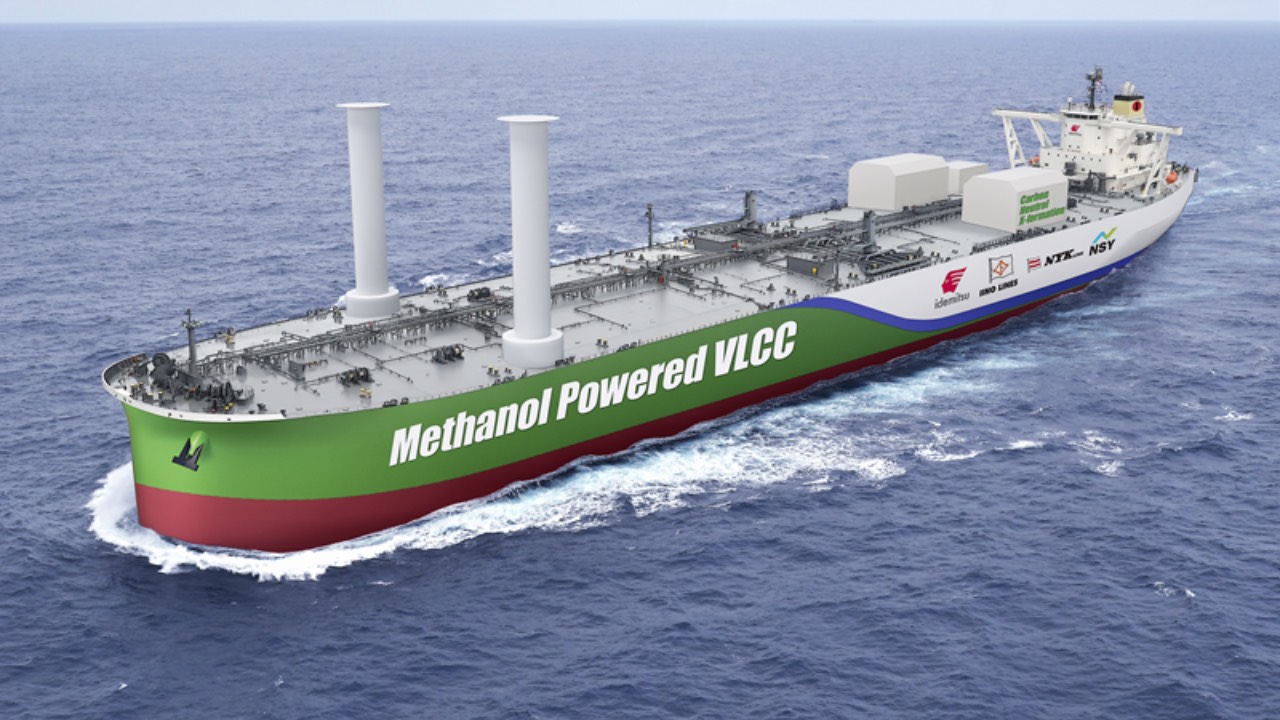

Idemitsu Tanker IINO Kaiun Kaisha, , Nippon Yusen Kabushiki Kaisha , and Nihon Shipyard are pleased to announce that the consortium the companies established on 26 January 2024 for the joint research and development of an eco-friendly very large crude oil carrier has produced a design concept for Japan’s first Malacca Max type VLCC to use methanol as alternative fuel (hereafter, the “Vessel”).

Principal Particulars of Vessel
| Length Overall | Max 339.5 m |
| Breadth | 60.0 m |
| Depth | 28.6 m |
| Scantling Draught | 21.0 m |
| Deadweight at Scantling Draught | Approx. 309,400 t |
| Fuel | Methanol and heavy oil |
| Others | Equipped with a shaft generator Able to equip with a Rotor Sail wind propulsion system |
To provide power while sailing, the Vessel will be equipped with a shaft generator and the latest dual-fuel main engine that can use methanol and heavy oil as fuel. A wind propulsion system will be optional.
As a result, the Vessel can achieve a CO2 reduction of more than 40% compared to the reference line against the Energy Efficiency Design Index (EEDI) regulation , clearing Phase 3 (reduction of more than 30% compared to the reference line), which will apply from 2025.
Methanol is expected to contribute to the International Maritime Organization’s (IMO) greenhouse gas (GHG) emission reduction strategy by reducing CO2 emissions by approximately 15% compared to the use of conventional fuel oil. In addition, the use of green methanol, such as bio-methanol produced from biomass and synthetic methanol (e-methanol) produced using hydrogen from renewable energy sources and captured CO2, makes it possible to reduce CO2 emissions to net zero.

Image of the Vessel’s CO2 emissions reduction
The four companies, which play a leading role in Japan-based energy transportation, will conduct further studies based on the design concept in order to achieve the international shipping goal of becoming carbon neutrality by 2050. Furthermore, the companies will aim for strategically phased shipbuilding orders for this next-generation eco-friendly VLCC and allocate vessels to crude-oil transport for Japanese refineries as soon as possible.



Related News.
ISLAND OIL: Unveiling of the Sculpture “Cyprus’s Journey Through the Ages” in Protaras – A Tribute and Landmark to Cyprus’s Historical Memory and Cultural Heritage
In a modest ceremony marked by a moving atmosphere, the sculpture “Cyprus’s Journey Through the Ages”, created by acclaimed Cypriot sculptor…
World Maritime Day 2026 from Policy to Practice – powering Maritime Excellence
Global regulations will deliver safer, more resilient shipping when they are implemented worldwide. The international maritime community marks…

Diana Shipping announces Time Charter Contract for m/v DSI Polaris with Dai An Ocean Shipping
Diana Shipping , a global shipping company specializing in the ownership and bareboat charter-in of dry bulk vessels, announced that, through a…

Chief Economists Expect Global Economy to Stabilize, but Fiscal Constraints, Rising Living Costs and AI Investment Uncertainty Threaten Growth
The global economy is stabilizing, but the fiscal support that cushioned successive shocks since 2020 is unlikely to play the same role in the year…
V. welcomes its new graduate cohort as programme expands across the group
Twelve graduates from nine nationalities join 11th year of V.’s expanded international management programme. V., the global ship manager and marine…

From Policy to Practice: Why Seafarers Are the Key to Maritime Excellence
The shipping industry is no stranger to regulation. Seafarers and ship operators work within a vast framework of international conventions, national…

Intermodal Report – Week 38 2026
Please find below the Intermodal market report for week 38 2026. Intermodal Report Week 38 2026 Market Insight By Nikos Tagoulis, Head of…

Allied – Weekly Market Review – Week 38
Please find below the Allied Weekly Report for Week 38 | 2026 ALLIED - Weekly Market Report- Week 38

Record year on the Northeast Passage but Arctic shipping remains very limited
In 2025, a record 103 transit voyages were made via the Northeast Passage. However, this is still equivalent to only around a day and a half of…

[xclusiv] S&P Report 21th September 2026
Please find below the [xclusiv] latest Weekly S&P Report [xclusiv] 2026_09_21 Market Commentary: VLCCs: Freight Boom Reprices the Fleet The VLCC…
Subscribe to our newsletter!
if you dont want to swim alone in the ocean of news, sign up for the newsletter, and you will receive daily all the important news of world shipping!
