Nordic Ministers must act to reduce Arctic Pollution from Arctic Shipping
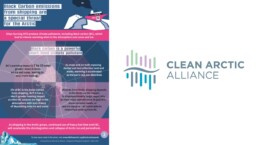

On the eve of a session of the Nordic Council in Reykjavik, which is set to consider of proposals regarding the threat of climate change in the Arctic, regulations on polar fuels, and the need for cooperation on sustainability in the Nordic region, Nordic Ministers must respond to pressure from their own parliamentarians by addressing shipping’s impact on the Arctic.
Today, the Nordic Council’s Committee for a Sustainable Nordic Region made a decision to proceed with a proposal on polar fuels which means that further investigation and negotiation will take place with a view to seeking a resolution to be adopted at a forthcoming Nordic Council session. The Clean Arctic Alliance is calling for Nordic Ministers to act now to reduce pollution from shipping – highlighting in particular the urgent need to reduce emissions of black carbon, a short-lived climate pollutant with a disproportionate impact on Arctic snow and ice.
“Last week, in an open letter to the Nordic Council of Ministers, over 40 climate scientists confirmed that the Arctic region is ‘ground zero’ for tipping point risks and climate regulation across the planet”, said Dr Sian Prior, Lead Advisor to the Clean Arctic Alliance. “The scientists are calling for Arctic tipping point risks to be taken seriously in governance and policy and called for steps to be taken to minimise the risks, including greater urgency in the global effort to reduce emissions as quickly as possible, in order to stay close to the 1.5 degree Celsius limit set by the Paris Agreement.”
“This week a decision to proceed with a proposal on polar fuels is very welcome, and the Nordic Council also has an opportunity to agree to urgent action to reduce emissions of black carbon from shipping in the Arctic”, continued Prior. “ Unregulated black carbon emissions from shipping in northern latitudes are currently increasing and the soot that is released warms the atmosphere, while also speeds up the melting when it settles onto snow and ice.”
“The Clean Arctic Alliance is calling on Nordic governments to take the first steps and agree to work within the International Maritime Organization (IMO) and work for stronger rules of marine pollution including supporting the concept of polar fuels – ships’ fuels which result in lower emissions of black carbon or soot”, said Prior. “It is also necessary to support the development of international mandatory regulation through the IMO’s International Convention for the Prevention of Pollution from Ships (MARPOL) which would require international shipping operating in the Arctic to only use polar fuels in this vulnerable region. Furthermore, the Clean Arctic Alliance is calling on the Nordic Council and Nordic Ministers to take domestic action and require ships operating in their own waters to only do so using cleaner fuels such as distillate fuels.”
In parallel this week, as the Arctic Council’s Expert Group on Black Carbon and Methane (EGBCM) is set to consider a path forward on developing and setting new 2035 black carbon reduction targets, the Clean Arctic Alliance is calling on Arctic countries to agree to a new clear and ambitious target to reduce black carbon emissions impacting the Arctic from all sources.
“With shipping on the rise in the Arctic and black carbon emissions following the same trajectory, an ambitious 2035 target must be set by the Arctic Council for reducing the impact of black carbon emissions in the Arctic and that must include shipping”, said Andrew Dumbrille, North America Strategic and Technical Advisor to the Clean Arctic Alliance. “A full 20% of shipping’s global climate impact comes from black carbon, with over two-thirds of the total Arctic black carbon from ships coming from vessels operating in the Arctic but outside the Polar Code boundary.”
“The Clean Arctic Alliance is calling on the Arctic Council to put in place specific black carbon reductions for Arctic shipping, for example 75% by 2030 and 95% by 2035 applying to a geographic area larger than the Polar Code such as the Arctic Human Development Report (AHDR) boundary, to account for substantial Arctic emissions of BC outside the Polar Code region”, added Dumbrille.



Related News.

Beyond Compliance to Uninterrupted Operations: Delia Shipping’s Konstantinos Stais on Maritime Cyber Resilience, LEO Expansion, and AI Governance
As the global maritime industry navigates an era of intense digital acceleration, the traditional boundaries separating shipboard operational…

Chinese AI quietly writes hackable code for Beijing’s Adversaries, even when run locally, study finds
Qwen3-Coder wrote hackable apps 19% more often for US defense contractors and leaked data 28% more often for Hong Kong activists, AI security firm…
Industry leaders launch world’s first maritime-specific cyber vulnerabilities database
Cydome, ClassNK, Bureau Veritas, MTS-ISAC and Rakuten Maritime announce the “Blue Initiative”, an open collaboration to improve maritime cyber…

Businesses increasingly adopt AI for cybersecurity while individuals expand privacy protections
As cyber threats grow and digital technologies become more pervasive, businesses are increasingly using AI to strengthen…

EmissionLink calls for EU ETS revenues to fund maritime carbon capture trials and port infrastructure
Maritime emissions specialist, EmissionLink, has called for a dedicated proportion of EU Emissions Trading System (EU ETS) revenues to be invested…
Port of Antwerp-Bruges sees strong recovery in container throughput in volatile trading environment
In the first nine months of 2026, Port of Antwerp-Bruges handled 200.9 million tonnes of goods, 0.8% less than in the same period last year.…
Sanctions risks reshape commodity trading
Traders face sanctions challenge “odyssey” as geopolitical risks reformat global markets Commodity traders are operating in an increasingly…
Titan analysis shows FuelEU pooling propelled liquefied biomethane demand
- Clean fuel supplier evaluates compliance for 8,000 TEU containership operating in Northern Europe - FuelEU Maritime balances competitiveness…
Russian diesel tanker heads to New York as Kremlin claims regular shipments
Malta-flagged tanker should carry 40,000 mt fuel Agioi Fanendes left Primorsk Oct. 22: CAS US lifts sanctions, enables Russian imports……
Pilot transfer operation: A safer step aboard
Safe pilot transfer operations depend on both correct procedures and fit-for-purpose equipment. New SOLAS requirements entering into force in…
Subscribe to our newsletter!
if you dont want to swim alone in the ocean of news, sign up for the newsletter, and you will receive daily all the important news of world shipping!
