ABS explores the potential of nuclear technology on LNG carriers
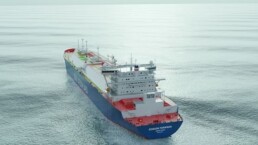

ABS released its latest report into the potential of advanced nuclear technology for maritime applications, with a study of a small modular reactor on a standard liquefied natural gas carrier.
The transformational impact of a high-temperature, gas-cooled reactor on the design, operation and emissions of a 145,000m3 LNG carrier design was modeled by ABS and Herbert Engineering Corporation . The study is designed to help industry better understand the feasibility and safety implications of nuclear propulsion and to support future development projects.
The study provides ABS and the industry important information on heat and energy management, shielding, weight distribution, and other design features for an LNG carrier with nuclear propulsion. This will assist the identification of design issues that will inform future Rules development. The study also found the HTGR technology allowed faster transit speeds and offers zero-emission operations. There would also be no requirement to refuel, although the HTGR technology would need replacing approximately every six years.
“While this technology is well understood on land, adapting it for marine application is in its infancy. However, this study and the other research we have carried out clearly highlight its significant potential to address not only shipping’s emissions challenge but to deliver a range of other operational advantages to the industry. ABS is committed to helping the industry evaluate its suitability for use in a range of use cases and LNG carriers is just one of a range of potential applications we are exploring,” said Patrick Ryan, ABS Senior Vice President and Chief Technology Officer.
The study shows a nuclear propelled LNG carrier would have specific design features, with reactors placed at the rear of the vessel and batteries forward of the location occupied by fuel tanks on current vessels and a reinforced hull. Given design constraints, the HTGR technology would only be suitable for larger LNG carriers.
The report is the latest in a succession of initiatives from ABS designed to address challenges to the adoption of nuclear technology at sea. Earlier this month, ABS launched the industry’s first comprehensive rules for floating nuclear power plants at a forum for nuclear industry leaders held jointly with Idaho National Laboratory (INL).
Held at ABS’ world headquarters in Texas, the event saw presentations on the latest reactor technologies from leading companies and publication of a detailed study from ABS and HEC modeling the design, operation and emissions of a floating nuclear power plant.
The U.S. Department of Energy (DOE) has awarded ABS a contract to research barriers to the adoption of advanced nuclear propulsion on commercial vessels.



Related News.

Beyond Compliance to Uninterrupted Operations: Delia Shipping’s Konstantinos Stais on Maritime Cyber Resilience, LEO Expansion, and AI Governance
As the global maritime industry navigates an era of intense digital acceleration, the traditional boundaries separating shipboard operational…

Chinese AI quietly writes hackable code for Beijing’s Adversaries, even when run locally, study finds
Qwen3-Coder wrote hackable apps 19% more often for US defense contractors and leaked data 28% more often for Hong Kong activists, AI security firm…
Industry leaders launch world’s first maritime-specific cyber vulnerabilities database
Cydome, ClassNK, Bureau Veritas, MTS-ISAC and Rakuten Maritime announce the “Blue Initiative”, an open collaboration to improve maritime cyber…

Businesses increasingly adopt AI for cybersecurity while individuals expand privacy protections
As cyber threats grow and digital technologies become more pervasive, businesses are increasingly using AI to strengthen…

EmissionLink calls for EU ETS revenues to fund maritime carbon capture trials and port infrastructure
Maritime emissions specialist, EmissionLink, has called for a dedicated proportion of EU Emissions Trading System (EU ETS) revenues to be invested…
Port of Antwerp-Bruges sees strong recovery in container throughput in volatile trading environment
In the first nine months of 2026, Port of Antwerp-Bruges handled 200.9 million tonnes of goods, 0.8% less than in the same period last year.…
Sanctions risks reshape commodity trading
Traders face sanctions challenge “odyssey” as geopolitical risks reformat global markets Commodity traders are operating in an increasingly…
Titan analysis shows FuelEU pooling propelled liquefied biomethane demand
- Clean fuel supplier evaluates compliance for 8,000 TEU containership operating in Northern Europe - FuelEU Maritime balances competitiveness…
Russian diesel tanker heads to New York as Kremlin claims regular shipments
Malta-flagged tanker should carry 40,000 mt fuel Agioi Fanendes left Primorsk Oct. 22: CAS US lifts sanctions, enables Russian imports……
Pilot transfer operation: A safer step aboard
Safe pilot transfer operations depend on both correct procedures and fit-for-purpose equipment. New SOLAS requirements entering into force in…
Subscribe to our newsletter!
if you dont want to swim alone in the ocean of news, sign up for the newsletter, and you will receive daily all the important news of world shipping!
