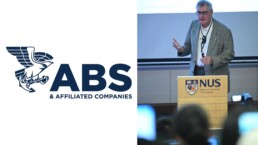

AI Will Drive Shipping to be Safer and More Efficient, While Making the Human Element Increasingly Key, Says Christopher J. Wiernicki in Singapore Lectur
“Maritime 5.0 will be defined by the ever-expanding capabilities of artificial intelligence, driving our complex industry to be safer, more efficient and more optimized, while emphasizing the increasing importance of the humans in the loop.”
That was the message from Christopher J. Wiernicki, ABS Chairman and CEO, as he delivered the guest lecture for the National University Singapore’s Master of Science in Maritime Technology and Management program.
In a wide-ranging lecture detailing how maritime moves and shapes the world as well as exploring the challenges and disruptive technologies driving rapid change in shipping, he explained how the industry is an interconnected system of systems.
“The maritime industry is a vast, interconnected web held together by complex relationships. If even one area of the logistical chain runs into challenges, the situation can cascade and affect the entire network. We’ve seen this with the pandemic, geopolitical situations, evolving regulations, and even new technologies,” said Wiernicki.
He explained that shipping is now undergoing a transformation shaped by innovations in naval architecture, green technology and digital technology, all enabling a new industrial revolution.
“To navigate Maritime 5.0, we must be mindful of the key variables in the global maritime shaping equation such as innovation and technology and how safety is now more than just compliance. It is now synonymous with security, reliability, collective relationships and people,” said Wiernicki.
He explained that embracing a fully digital operating model will fundamentally alter the nature of safety.
“Safety going forward will not be defined as just the absence of accidents but as the new equation of capacity and capability over demand,” he said. “The new equation has systems thinking, well trained people and percentage usage of digital in the numerator representing capacity and capability. Demand is in the denominator representing the complexity of an evolving decarbonization trajectory and rapidly changing technology environment. Our future safety protection frontier is defined as the place where capacity and capability equal demand. Safety is becoming more synonymous with cybersecurity and reliability.”
Wiernicki concluded, “To solve these equations, we must have a convergent mindset, which is two mindsets coming together. On one hand, you have the intersection of technical feasibility, economic viability and social responsibility. On the other is the intersection of national economic, energy and security strategies. With the right mindset, and by monitoring our progress, we can be ready for Maritime 5.0.”



Related News.
Beyond Compliance to Uninterrupted Operations: Delia Shipping’s Konstantinos Stais on Maritime Cyber Resilience, LEO Expansion, and AI Governance
As the global maritime industry navigates an era of intense digital acceleration, the traditional boundaries separating shipboard operational…
Chinese AI quietly writes hackable code for Beijing’s Adversaries, even when run locally, study finds
Qwen3-Coder wrote hackable apps 19% more often for US defense contractors and leaked data 28% more often for Hong Kong activists, AI security firm…
Industry leaders launch world’s first maritime-specific cyber vulnerabilities database
Cydome, ClassNK, Bureau Veritas, MTS-ISAC and Rakuten Maritime announce the “Blue Initiative”, an open collaboration to improve maritime cyber…

Businesses increasingly adopt AI for cybersecurity while individuals expand privacy protections
As cyber threats grow and digital technologies become more pervasive, businesses are increasingly using AI to strengthen…
EmissionLink calls for EU ETS revenues to fund maritime carbon capture trials and port infrastructure
Maritime emissions specialist, EmissionLink, has called for a dedicated proportion of EU Emissions Trading System (EU ETS) revenues to be invested…
Port of Antwerp-Bruges sees strong recovery in container throughput in volatile trading environment
In the first nine months of 2026, Port of Antwerp-Bruges handled 200.9 million tonnes of goods, 0.8% less than in the same period last year.…
Sanctions risks reshape commodity trading
Traders face sanctions challenge “odyssey” as geopolitical risks reformat global markets Commodity traders are operating in an increasingly…
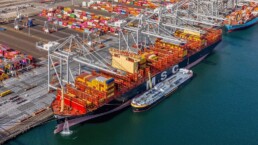
Titan analysis shows FuelEU pooling propelled liquefied biomethane demand
- Clean fuel supplier evaluates compliance for 8,000 TEU containership operating in Northern Europe - FuelEU Maritime balances competitiveness…
Russian diesel tanker heads to New York as Kremlin claims regular shipments
Malta-flagged tanker should carry 40,000 mt fuel Agioi Fanendes left Primorsk Oct. 22: CAS US lifts sanctions, enables Russian imports……
Pilot transfer operation: A safer step aboard
Safe pilot transfer operations depend on both correct procedures and fit-for-purpose equipment. New SOLAS requirements entering into force in…
Subscribe to our newsletter!
if you dont want to swim alone in the ocean of news, sign up for the newsletter, and you will receive daily all the important news of world shipping!
