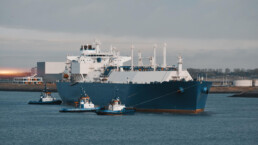

The LNG shadow fleet to move blacklisted Russian LNG is expected to expand amid growing clandestine activities, such as the resale of older LNG carriers to shell companies in the second-hand market, ship-to-ship cargo transfers in undisclosed locations and hard-to-track monetary and commercial transactions.
The roughly nine LNG carriers sanctioned by the US so far are likely just the beginning of a larger fleet expected to emerge in the coming years to transport more Russian LNG as western sanctions continue to tighten, according to sanctions experts.
Recent focus has been on ships associated with the sanctioned Arctic LNG 2 project, but importers of Russian LNG, such as utilities in Japan, have been bracing for a much broader crackdown on Russian LNG exports. Meanwhile, the EU has been mulling phasing out Russian fossil fuel imports by 2027, potentially leaving more molecules stranded.
“The LNG shadow fleet will grow. I believe estimates of its size needed to meet the full production capacity of Arctic LNG 2 are 16. This is not far off the nine it currently has in the shadow fleet,” Byron McKinney, director for trade finance and compliance solutions at S&P Global Market Intelligence, said.
“It will grow because Russia is not going to shut in its LNG production; it will actively seek and find new buyers, and this means sanctions have to be constantly monitored, identified and then evaded by Russia.”
McKinney expects repercussions to also be constant, with frequent additions of these shadow fleet ships and their owners to sanctions lists, movement of sanctioned ships and their owners across multiple locations and new company names to attempt evasion.
“I understand that to date, most of the dark fleet vessels have been oil tankers. The fact that we are now seeing LNG carriers placed on the sanctions list suggests that there may be further dark fleet vessels engaged in trades involving sanctioned cargo that have not yet been placed on the sanctions lists,” Karnan Thirupathy, partner with Kennedys Legal Solutions, said.
He said that parties involved in LNG trading — such as buyers, sellers, charterers, financing banks and insurers — need to be more vigilant when running sanctions compliance checks to ensure that ships are not engaged in sanctioned activities and to avoid the risk of breaching sanctions regulations.
“They will also need to consider if their contracts/charter parties properly provide for how to deal with a situation where a dark fleet vessel has inadvertently become involved,” Thirupathy, who specializes in sanctions evasion, added.
Compliance risks
A larger portion of the LNG fleet, beyond the sanctioned ships, is already deemed risky.
Around 56 LNG carriers are currently classified as “severe,” according to compliance assessment data of ships compiled by S&P Global Maritime Intelligence Risk Suite in September. This “severe” designation represents the highest risk level, which includes sanctioned status of a ship or its owners and other deceptive shipping practices.
Of the 56 LNG carriers, 18 are directly under one or more sanctions lists, including the nine LNG carriers blacklisted by the US Office of Foreign Assets Control in August/September: Asya Energy, Everest Energy, Pioneer, North Air, North Mountain, North Sky, North Way, New Energy and Mulan, along with associated ship management companies Ocean Speedstar Solutions and White Fox Ship Management.
At least eight of the 18 LNG carriers are owned by Russia’s largest shipping company, Sovcomflot, or its subsidiary, SCF Gas Carriers. These entities were included in the EU’s 14th sanctions package in June, which prohibited around 27 ships, including oil and LNG tankers, from accessing EU ports and receiving marine services. The package also banned transshipment of Russian LNG via EU ports. Three of the 18 LNG carriers under construction came under US sanctions in June.
Among the ships marked as “severe” but not on sanctions lists, many are still owned or operated by national oil companies, state-owned shipping companies and mainstream shipping companies, S&P Global data showed, highlighting trading risks.
To scrap or not to scrap
A growing portion of the LNG fleet consists of aging steam turbine carriers that are likely to come under some form of emissions restrictions in the coming years, pushing shipowners to sell them for scrap. While many of these ships are expected to end up in the expanding shadow fleet, recent transactions have raised concerns about whether sales to unverified shell companies constitute a violation of sanctions.
Thirupathy said that standard ship sale contracts for scrapping contain a clause stating that the ship is being sold for scrap and will not be traded, but buyers can instead buy on sale and purchase terms, taking delivery at an agreed port and then sailing the ship for its final voyage for demolition.
“A vessel can also be sold/resold and change hands a number of times after the initial sale from the original owner,” he added.
Thirupathy also said that if a contract specifies that a ship sold for scrapping cannot be traded, buyers would be in breach of the contract if they do so. However, once the payment is made, sellers may not have any incentive to sue the buyers, and even if they choose to pursue legal action, they might not be entitled to substantial damages.
“Also, if the vessel is resold or used for trade where the clause says it will be scrapped, it doesn’t necessarily mean that the vessel will be used for sanctions evasion,” he added.
Source: Platts



Related News.

Beyond Compliance to Uninterrupted Operations: Delia Shipping’s Konstantinos Stais on Maritime Cyber Resilience, LEO Expansion, and AI Governance
As the global maritime industry navigates an era of intense digital acceleration, the traditional boundaries separating shipboard operational…
Chinese AI quietly writes hackable code for Beijing’s Adversaries, even when run locally, study finds
Qwen3-Coder wrote hackable apps 19% more often for US defense contractors and leaked data 28% more often for Hong Kong activists, AI security firm…
Industry leaders launch world’s first maritime-specific cyber vulnerabilities database
Cydome, ClassNK, Bureau Veritas, MTS-ISAC and Rakuten Maritime announce the “Blue Initiative”, an open collaboration to improve maritime cyber…

Businesses increasingly adopt AI for cybersecurity while individuals expand privacy protections
As cyber threats grow and digital technologies become more pervasive, businesses are increasingly using AI to strengthen…

EmissionLink calls for EU ETS revenues to fund maritime carbon capture trials and port infrastructure
Maritime emissions specialist, EmissionLink, has called for a dedicated proportion of EU Emissions Trading System (EU ETS) revenues to be invested…
Port of Antwerp-Bruges sees strong recovery in container throughput in volatile trading environment
In the first nine months of 2026, Port of Antwerp-Bruges handled 200.9 million tonnes of goods, 0.8% less than in the same period last year.…
Sanctions risks reshape commodity trading
Traders face sanctions challenge “odyssey” as geopolitical risks reformat global markets Commodity traders are operating in an increasingly…
Titan analysis shows FuelEU pooling propelled liquefied biomethane demand
- Clean fuel supplier evaluates compliance for 8,000 TEU containership operating in Northern Europe - FuelEU Maritime balances competitiveness…
Russian diesel tanker heads to New York as Kremlin claims regular shipments
Malta-flagged tanker should carry 40,000 mt fuel Agioi Fanendes left Primorsk Oct. 22: CAS US lifts sanctions, enables Russian imports……
Pilot transfer operation: A safer step aboard
Safe pilot transfer operations depend on both correct procedures and fit-for-purpose equipment. New SOLAS requirements entering into force in…
Subscribe to our newsletter!
if you dont want to swim alone in the ocean of news, sign up for the newsletter, and you will receive daily all the important news of world shipping!
