Significant advancements in ship readiness are driving maritime industry’s transition to zero-carbon fuels
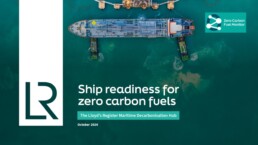

The latest update from the Zero Carbon Fuel Monitor shows substantial advancements in the state of ship readiness for new fuels and technologies over the last year.
Lloyd’s Register Maritime Decarbonisation Hub’s Zero Carbon Fuel Monitor has highlighted rapid technological advances in handling, storing, and using alternative fuels onboard vessels that are enabling the maritime industry’s transition to zero carbon fuels.
The latest ZCFM update focuses on the final stage of the fuel supply chain – the ship – and offers valuable insights into the readiness of current vessels for various fuel types including ammonia, biofuels (FAME and HVO), hydrogen, liquefied methane, and methanol
The report found that technology readiness levels for all reviewed fuels have increased over the past year. It identified 31 vessels in the existing fleet and orderbook capable of using ammonia, along with over 400 “ammonia ready” vessels, mainly in gas and bulk carrier segments. It also noted 315 methanol-capable vessels, with nearly 500 more classified as “methanol ready” and 78 hydrogen-capable vessels, primarily used in coastal and short-sea shipping.
The analysis also indicates a rise in commercial trials and applications, boosting the investment readiness levels (IRLs) within the ship supply chain stage. Community readiness levels (CRLs) are increasing, driven by growing awareness of the urgency to meet the International Maritime Organisation’s (IMO) 2030 interim target of achieving 5% of vessels running on low-to-zero carbon fuels.
While the report acknowledges progress, it also highlights areas needing further development and investment, such as improved safety protocols and crew training for handling alternative fuels, as well as challenges related to investment due to uncertainties in the supply chain, including fuel availability, port infrastructure, and regulatory frameworks.
Amelia Hipwell, Decarbonisation Innovation Manager in the LR Maritime Decarbonisation Hub, said: “The Zero Carbon Fuel Monitor offers a valuable overview of current vessel readiness for various fuel types, providing a clear perspective on the potential of these fuels to transform the shipping industry.
“With ongoing advancements in fuel handling, storage, and propulsion capabilities, the maritime sector is taking important steps toward the widespread adoption of zero-carbon fuels. While challenges remain, Lloyd’s Register’s Maritime Decarbonisation Hub is committed to supporting the maritime industry’s safe and sustainable adoption of zero and near-zero carbon fuels.”



Related News.

Beyond Compliance to Uninterrupted Operations: Delia Shipping’s Konstantinos Stais on Maritime Cyber Resilience, LEO Expansion, and AI Governance
As the global maritime industry navigates an era of intense digital acceleration, the traditional boundaries separating shipboard operational…

Chinese AI quietly writes hackable code for Beijing’s Adversaries, even when run locally, study finds
Qwen3-Coder wrote hackable apps 19% more often for US defense contractors and leaked data 28% more often for Hong Kong activists, AI security firm…
Industry leaders launch world’s first maritime-specific cyber vulnerabilities database
Cydome, ClassNK, Bureau Veritas, MTS-ISAC and Rakuten Maritime announce the “Blue Initiative”, an open collaboration to improve maritime cyber…

Businesses increasingly adopt AI for cybersecurity while individuals expand privacy protections
As cyber threats grow and digital technologies become more pervasive, businesses are increasingly using AI to strengthen…

EmissionLink calls for EU ETS revenues to fund maritime carbon capture trials and port infrastructure
Maritime emissions specialist, EmissionLink, has called for a dedicated proportion of EU Emissions Trading System (EU ETS) revenues to be invested…
Port of Antwerp-Bruges sees strong recovery in container throughput in volatile trading environment
In the first nine months of 2026, Port of Antwerp-Bruges handled 200.9 million tonnes of goods, 0.8% less than in the same period last year.…
Sanctions risks reshape commodity trading
Traders face sanctions challenge “odyssey” as geopolitical risks reformat global markets Commodity traders are operating in an increasingly…
Titan analysis shows FuelEU pooling propelled liquefied biomethane demand
- Clean fuel supplier evaluates compliance for 8,000 TEU containership operating in Northern Europe - FuelEU Maritime balances competitiveness…

Russian diesel tanker heads to New York as Kremlin claims regular shipments
Malta-flagged tanker should carry 40,000 mt fuel Agioi Fanendes left Primorsk Oct. 22: CAS US lifts sanctions, enables Russian imports……
Pilot transfer operation: A safer step aboard
Safe pilot transfer operations depend on both correct procedures and fit-for-purpose equipment. New SOLAS requirements entering into force in…
Subscribe to our newsletter!
if you dont want to swim alone in the ocean of news, sign up for the newsletter, and you will receive daily all the important news of world shipping!
