5 ways satellites can be used for good
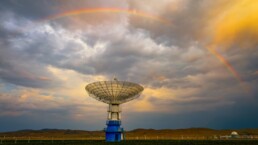

Space-based connectivity is foundational to societ
Many international organizations, like the United Nations, envision a world where connectivity eventually becomes a human right.
Satellites are the foundational infrastructure for ensuring global safety, a lifeline after a natural disaster, a tool for conservation and decarbonization and of course, a vital key to enabling connectivity across the globe.
Here are a few ways satellite communication benefits us and the world.
1. Enhances global safety


Satellites enhance safety and operational efficiency across maritime, aviation, defense, and other industries.
- Play a pivotal role in mitigating safety risks through the enhancement of the Global Maritime Distress and Safety System (GMDSS) – the main source of truth for all maritime data
- Provide real-time weather information to improve communication between pilots and air traffic control, enabling safer skies for all
- Support coordination between government and defense forces to respond swiftly during critical operations and crisis situations
2. Supports disaster relief

Satellite connectivity is key to coordinating disaster relief efforts and enabling the access and dissemination of information during and after a natural disaster.
- Enables first responders and rescue organizations to communicate when infrastructure is down or destroyed
- Mobilizes quickly, virtually anywhere, anytime, to provide real-time connectivity
- Enhances situational awareness and facilitates medical treatment
- Connects those displaced and affected by disaster with family and loved ones.
3. Enables decarbonization solutions

Cutting down on carbon emissions is the critical challenge of our time, and satellite technology is making a significant contribution to tackling climate change from high above the Earth.
- Helps optimize flight routes and minimize delays which lowers airline’s carbon footprint
- Minimizes shipping fuel consumption and emissions with real-time tracking, weather updates and efficient fleet management
- Reduces energy waste, promotes renewable energy integration, and creates more sustainable energy systems with IoT and smart grid technologies
4. Bridges the digital divide

Nearly half the world still doesn’t have reliable access to high-quality, affordable internet. By bringing connectivity to where it’s need most, advancing satellite technology can change lives by:
- Providing better access to healthcare
- Fostering education, new ideas and creativity
- Unlocking economic opportunity and spur job growth
- Supporting mental health through human connection
Maintaining the backbone of society

As the demand for satellite connectivity continues to skyrocket across the planet, the industry will continue to flourish. With that comes unprecedented challenges, like managing space debris, ensuring equitable access to space and spectrum usage – all of which are issues that are deeply concerning for us and generations to come.
Our recent Viasat: Beyond space competition winner, Ash Goldsmith, had a profound metaphor for the current situation we are in. He pointed out that we’ve essentially reached an inflection point where satellite debris are becoming to space what plastics are to the planet.
Plastics, once hailed as a revolutionary technology, are now known to cause severe environmental damage. In fact, even the tiniest of pieces of plastic can be found in the human body. What’s worse is that we were aware of the potential harms of plastic use in the 1960s but went on to use the material at an exponential rate over the subsequent decades.
Currently, we are aware of the importance of space sustainability and the worrying overuse of space which could lead to an even greater increase in space debris, potentially even rendering some orbits unusable, yet by the end of this decade it is estimated 100,000 satellites will be launched.
I feel we are in the 1960s of plastic production, but in satellites. So do we really want, in however many years’ time, another group of people all saying we should have done something better?
It’s becoming more evident to industry experts and young people alike that ignoring these threats puts us at immediate risk of potentially impeding scientific research, exploration, climate monitoring, security, communications, digital inclusion, and various commercial, defense, and civic uses.
We are always collaborating with industries and governments globally to establish thoughtful regulations and policies. Through this work, our goal is to ensure that space continues to be safe and accessible to everyone – for the good of all down here on Earth.



Related News.

Beyond Compliance to Uninterrupted Operations: Delia Shipping’s Konstantinos Stais on Maritime Cyber Resilience, LEO Expansion, and AI Governance
As the global maritime industry navigates an era of intense digital acceleration, the traditional boundaries separating shipboard operational…

Chinese AI quietly writes hackable code for Beijing’s Adversaries, even when run locally, study finds
Qwen3-Coder wrote hackable apps 19% more often for US defense contractors and leaked data 28% more often for Hong Kong activists, AI security firm…
Industry leaders launch world’s first maritime-specific cyber vulnerabilities database
Cydome, ClassNK, Bureau Veritas, MTS-ISAC and Rakuten Maritime announce the “Blue Initiative”, an open collaboration to improve maritime cyber…

Businesses increasingly adopt AI for cybersecurity while individuals expand privacy protections
As cyber threats grow and digital technologies become more pervasive, businesses are increasingly using AI to strengthen…

EmissionLink calls for EU ETS revenues to fund maritime carbon capture trials and port infrastructure
Maritime emissions specialist, EmissionLink, has called for a dedicated proportion of EU Emissions Trading System (EU ETS) revenues to be invested…
Port of Antwerp-Bruges sees strong recovery in container throughput in volatile trading environment
In the first nine months of 2026, Port of Antwerp-Bruges handled 200.9 million tonnes of goods, 0.8% less than in the same period last year.…

Sanctions risks reshape commodity trading
Traders face sanctions challenge “odyssey” as geopolitical risks reformat global markets Commodity traders are operating in an increasingly…
Titan analysis shows FuelEU pooling propelled liquefied biomethane demand
- Clean fuel supplier evaluates compliance for 8,000 TEU containership operating in Northern Europe - FuelEU Maritime balances competitiveness…

Russian diesel tanker heads to New York as Kremlin claims regular shipments
Malta-flagged tanker should carry 40,000 mt fuel Agioi Fanendes left Primorsk Oct. 22: CAS US lifts sanctions, enables Russian imports……
Pilot transfer operation: A safer step aboard
Safe pilot transfer operations depend on both correct procedures and fit-for-purpose equipment. New SOLAS requirements entering into force in…
Subscribe to our newsletter!
if you dont want to swim alone in the ocean of news, sign up for the newsletter, and you will receive daily all the important news of world shipping!
