

The IMO is expected to advance negotiations on what could be the world’s first universal carbon price (e.g. a levy) on a global polluter. This policy sees consistent, growing support among the IMO’s 175 member states.
Governments agreed under the IMO’s 2023 Revised Strategy that shipping needs a ‘GHG emission pricing mechanism’, and to adopt it in 2025. The September/October talks hope to get clarity on the design of the future policy, including crucial questions about the price and revenue distribution. At the last talks in March 2024, a clear majority of countries favoured this mechanism to be in the form of a levy.
Carbon pricing on shipping is essential to help close the price gap between fossil fuels and green energy, and generate revenues for an equitable transition. An influential report by UNCTAD found that a levy is necessary to lower the impacts of shipping decarbonisation on global GDP growth, and to promote global economic equality.
The policy is negotiated as part of a ‘basket’ of various measures, as an ‘economic measure’, intended to deliver agreed emission cuts in an equitable way: 30% by 2030, 80% by 2040, to reach zero by 2050. The basket also includes a green fuel standard (GFS), a ‘technical measure’, aimed at further incentivising the use of zero-emission energy on ships.
MEPC 82 will also open the revision process of the IMO’s existing framework for energy efficiency (Carbon Intensity Indicators, or CII), whose ambition needs to be increased to deliver the agreed emission reduction before 2030.
Experts agree that achieving the IMO’s climate commitments will require all three components: an ambitious and equitable levy of at least $150/tonne GHG; a strong fuel standard, and an improved energy efficiency of vessels.
MEPC 82 will also be the first-ever IMO summit attended by a delegation of climate youth advocates from vulnerable Global South countries, calling for a strong and equitable GHG levy. They will participate in a panel discussion, meet with the IMO Secretary General, and will be available for interviews and comments during the talks.
Civil society and NGO statements ahead of the negotiations:
Ana Laranjeira, Senior Manager, Opportunity Green, said: “Currently, ISWG-GHG 17 and MEPC 82 are the only meetings scheduled before the Spring meetings, and critical decisions related to the measures are still yet to be made. Delegations have put forward detailed proposals […]. While these proposals demonstrate growing support for a GHG levy on all lifecycle emissions from ships, many unanswered questions remain, including on how a pricing mechanism will work, how the revenues will be managed, and how they should be disbursed.[…] The way these revenues are distributed will have a direct impact on the nature of shipping’s decarbonisation and on whether the IMO fulfils its commitment to secure a just and equitable transition.”
Blánaid Sheeran, Project Officer at Opportunity Green, said: “[…] For too long, frontline countries and communities have been fighting the most negative impacts of climate change with a lack of funding to help them do so. According to the Polluter Pays Principle, the emitter should bear the cost of their pollution. For this reason, we must ensure any revenues generated from a shipping levy are distributed fairly, so that no one is left behind.”
Delaine McCullough, President, Clean Shipping Coalition, said: “The IMO has only six years left to peak and reduce shipping emissions, as promised in its GHG Strategy last year. This is still achievable, and governments have all the tools they need right in front of them: maximizing energy efficiency of vessels, an equitable GHG levy of at least $150/tonne of emissions, and an energy/fuels standard that drives the uptake of onboard wind and solar propulsion and investment in scalable zero-emission fuels. Countries must focus the upcoming meeting on designing these short and mid-term measures in an ambitious and complementary way, in order to transform shipping from a climate laggard into a champion, while also ensuring equality and protection for the most vulnerable.”
Sandra Chiri, International Outreach Manager – Shipping Emissions, Ocean Conservancy, said: “When the IMO adopted its 2023 GHG Strategy that enshrined a historic commitment to eliminate international shipping’s greenhouse gas emissions by 2050, we knew that our work was just beginning. As 2024 continues to break global temperature records, the urgency and consequence of the next round of the IMO climate negotiations cannot be overstated. If we are going to avoid catastrophic climate breakdown, IMO member states must prioritize designing an unprecedented package of binding short- and mid-term policies that immediately cut emissions and put the shipping industry on track to full decarbonization. Ocean Conservancy will be on the ground working with our partners to ensure the policies set are ambitious and equitable, ensuring that no one gets left behind in this transition.”
Anais Rios, Shipping Policy Officer, Seas At Risk, said: “Wind technology is available now and can be fitted on most vessels. Hybrid ships that use both fuels and wind, through appropriate scheduling, route choices and weather forecasting, can take advantage of the strong winds that are prevalent on the high seas around the globe. We urge the IMO to adopt a high levy, allowing vulnerable countries to take advantage of the revenues to decarbonise their shipping industry and reduce the effects of climate change. Wise choices need to be made to reach the IMO’s goals and deliver its decarbonisation strategy, and we must focus on technologies that are clean, readily available, and that make practical sense.”
H.E. Albon Ishoda, Marshall Islands Special Envoy for Maritime Decarbonization, said: “As we prepare now for the MEPC 82 and ISWG 17, the urgency to finalize our carbon pricing mechanisms and economic policies has never been greater. Our task now is to ensure that our strategies not only drive down emissions but also safeguard the interests of the most vulnerable nations. It’s imperative that we act decisively to turn our commitments into tangible results, fostering both climate justice and sustainable growth for all.”
Some highlights from country submissions to ISWG-GHG-17:
Belize and Pacific SIDS (Ref. ISWG-GHG 17/2/13 and 17/2/14): propose a framework for the collection and distribution of revenue from their long-standing levy proposal of $150/tonne of GHG, investing the revenue in green and equitable energy transition, prioritising SIDS and LDCs.
The EU & Japan (Ref. ISWG-GHG 17/2/2): put a dollar figure, for the first time-ever, on the levy: $100/tonne of GHG; and back a revenue distribution that supports the uptake of green fuels and an equitable transition, prioritising SIDS and LDCs. Note: Japan previously proposed a levy starting at $56/tonne of CO2, prioritising revenue investments in maritime only.
Caribbean SIDS (Ref. ISWG-GHG 17/2/18 and ISWG-GHG 17/2/14): Call for the adoption of a levy based on the “polluter pays” principle, with revenue distribution focusing on green energy transition and resilience-building, prioritising SIDS and LDCs.
Source: Opportunity Green, Seas At Risk, Ocean Conservancy, Clean Shipping Coalition



Related News.
Global study finds Cyprus ranks SEVENTH and set for $1.1 billion AI GDP boost
Cyprus beats India and New Zealand to come SEVENTH in major AI study – with potential €1.1 billion GDP boost and youth jobs opportunity Some 86% of…
Global shipping’s trillion dollar climate bill according to Zero Carbon Analytics
A new study by Zero Carbon Analytics finds that emissions from international shipping cost the global economy around USD 963 billion between 1990…

Keeping Children Safe Online at Sea Seafy® earns friendly WiFi Certification across 26 vessels
Seafy becomes Friendly WiFi’s first partner in the maritime sector, helping protect kids from harmful content online. Friendly WiFi is delighted…

ShipManager joins Star Information Systems to accelerate the maritime industry’s transition to cloud
CFARER, a DNV Company selects Star Information Systems as the longterm home for ShipManager and its cloud future Star Information Systems (Star)…

Seafarer experience must shape maritime technology, initial STEER Project report finds
New research finds technology can shift rather than remove risk as The Nautical Institute, with support from Lloyd’s Register Foundation, calls for…
New LR service targets cargo disruption when trade routes fail
New LR Advisory service helps ports, governments and logistics operators respond to disruption, protect critical cargo flows and strengthen trade…

DORIC WEEKLY INSIGHT 06 NOVEMBER 2026
Please find below the DORIC Market Insight for the week ending 06th November 2026. Weekly Report 06.11.2026
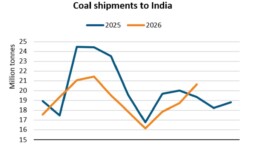
BIMCO Shipping Number of the Week
Coal shipments to India drop 7%, but limited recovery may lie ahead "Between January and October, coal shipments to India dropped 7% y/y due to the…
Hapag-Lloyd marks 20 years in South Africa and targets further growth
South Africa has become a cornerstone of Hapag-Lloyd's business in Africa Hapag-Lloyd surpasses 1 million TEU in Africa for the first time in its…
Subscribe to our newsletter!
if you dont want to swim alone in the ocean of news, sign up for the newsletter, and you will receive daily all the important news of world shipping!
