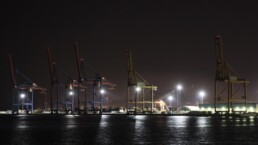

Determined to thwart the automating of their jobs, about 45,000 dockworkers along the U.S. East and Gulf Coasts are threatening to strike on Oct. 1, a move that would shut down ports that handle about half the nation’s cargo from ships.
The International Longshoremen’s Union is demanding significantly higher wages and a total ban on the automation of cranes, gates and container movements that are used in the loading or loading of freight at 36 U.S. ports. Whenever and however the dispute is resolved, it’s likely to affect how freight moves in and out of the United States for years to come.
If a strike were resolved within a few weeks, consumers probably wouldn’t notice any major shortages of retail goods. But a strike that persists for more than a month would likely cause a shortage of some consumer products, although most holiday retail goods have already arrived from overseas.
A prolonged strike would almost certainly hurt the U.S. economy. Even a brief strike would cause disruptions. Heavier vehicular traffic would be likely at key points around the country as cargo was diverted to West Coast ports, where workers belong to a different union not involved in the strike. And once the longshoremen’s union eventually returned to work, a ship backlog would likely result. For every day of a port strike, experts say it takes four to six days to clear it up.
“I think everyone’s a bit nervous about it,” said Mia Ginter, director of North America ocean shipping for C.H. Robinson, a logistics firm. “The rhetoric this time with the ILA is at a level we haven’t seen before.”
The longshoremen’s union and the United States Maritime Alliance, which represents the ports, haven’t met to negotiate since June, when the union said it suspended national talks to first complete local port agreements. No further national contract talks have been scheduled.
Harold Daggett, the union president, warned earlier this month that the longshoremen stood ready to strike once their contract expires on Sept. 30.
“We are very far apart,” Daggett said. “Mark my words, we’ll shut them down Oct. 1 if we don’t get the kind of wages we deserve.”
Top-scale port workers now earn a base pay of $39 an hour, or just over $81,000 a year. But with overtime and other benefits, some can make in excess of $200,000 annually. Neither the union nor the ports would discuss pay levels. But a 2019-2020 report by the Waterfront Commission, which oversees New York Harbor, said about a third of the longshoremen based there made $200,000 or more.
Daggett contends, though, that higher-paid longshoremen work up to 100 hours a week, most of it overtime, and sacrifice much of their family time in doing so.
The Maritime Alliance has said it’s committed to resuming talks and avoiding the first national longshoremen’s strike since 1977. It has accused the union of having already decided in advance to walk off the job.
“We need to sit down and negotiate a new agreement that avoids an unnecessary and costly strike that will be detrimental to both sides,” the alliance said in a statement.
In the case of a short-lived strike, industry experts say consumers wouldn’t likely notice shortages of store goods during the holiday shopping season. Most retailers had goods transported ahead of the usual pre-holiday shipping season, and they’re already stored in warehouses.
“It would be an inconvenience, but it’s not going to be ‘Santa’s not showing up,’ ” said Jonathan Chappell, senior managing director of transportation at Evercore ISI, an investment research firm.
Imports to ports are up 10% this year over 2023 on the East Coast and 20% on the West Coast, indicating that some freight was shipped in anticipation of a strike, said Ben Nolan, a transportation analyst with Stifel.
The longshoreman’s union, Nolan suggested, commands some leverage going into a presidential election, with memories still fresh of jammed ports and clogged supply chains that followed the pandemic recession. Unions also have drawn support this year from political candidates who have been courting the labor vote.
“If ever there was a time that labor can get what they want,” Nolan said, “it’s right now.”
If a strike were to extend beyond a month or so, spot shortages of goods could develop. Some manufacturers could run short of parts, notably in the auto and pharmaceutical industries, which generally don’t stock large parts inventories. Exports of autos and other goods that move through the East Coast also could be affected.
Most analysts don’t expect President Joe Biden to intervene, as he and Congress did to head off a railroad strike in 2022, at least not before the Nov. 5 presidential election. Robinson, of the logistics firm C.H. Robinson, noted that the administration cannot legally impose a contract on the dockworkers before a strike. But if a strike were deemed to endanger national health or safety, Ginter said, Biden could, under the Taft-Hartley Act, seek a court order for an 80-day cooling-off period. This would suspend the strike.
Analysts say the union’s initial demands included a 77% pay raise over the course of a six-year contract. Daggett, the union president, said sizable pay raises would make up for the inflation spike of the past few years.
And he said it would give workers a share of the billions the companies have earned, especially during the pandemic. Copenhagen-based Maersk, among the world’s largest container shipping companies, made more than $50 billion in profits over the past four years. Earnings, though, dropped substantially in 2023 as pandemic-era consumer demand eased and brought sky-high freight rates back down.
Daggett said the union members expect to be waging their biggest fight — against the automation of job functions at ports — well into the future.
“We do not believe that robotics should take over a human being’s job,” he said. “Especially a human being that’s historically performed that job.”
As an example, he pointed to a gate that automatically processes trucks without union labor at the port in Mobile, Alabama. The gate has been in place since 2008.
The Maritime Alliance has said it offered, as part of a new contract, to keep current provisions that bar fully automated terminals and block the use of semi-automated equipment without an agreement from both sides on protecting human jobs.
Experts say it’s not altogether clear whether automation would lead to layoffs.
A 2022 study by the Economic Roundtable of Los Angeles that was funded by the West Coast dockworkers union found that automation cost 572 jobs each year in 2020 and 2021 at partially automated terminals at the ports of Long Beach and Los Angeles.
But another study that same year by a professor at the University of California, Berkeley, that was commissioned by port operators and shippers concluded that between 2015, when Los Angeles-area ports adopted some automation, and 2021, paid hours for port union members grew 11.2%.
At the huge Port of Rotterdam, one of the world’s most automated ports, union workers pushed for early-retirement packages and work-time reductions as a means to preserve jobs. And in the end, mechanization didn’t cause significant job losses, a researcher from Erasmus University in the Netherlands found. Still, he predicted that automation could cut port jobs by 25% in the future.
U.S. ports trail their counterparts in Asia and Europe in the use of automation. Analysts note that most U.S. ports take longer to unload container ships than do those in Asia and Europe and suggest that without more automation, they could become even less competitive. Shippers might send more cargo to Mexican or Canadian ports and then on to the U.S. by rail or truck, said Eleftherios Iakovou, associate director of supply chain resilience at Texas A&M University.
He suggested that the two sides discuss the use of automation to augment the functions of human workers rather than to displace them.
Any final reckoning over automation, though, remains a long way off. For shippers to abandon U.S. ports, Mexican ports would have to become more efficient at the same time that U.S. ports became “prohibitively inefficient,” said Stifel’s Nolan.
“I do think there’s some validity to it, but it’s not a this-decade kind of issue,” he said.
In the meantime, if there is a strike, analysts say West Coast ports could pick up at least some additional freight that might be diverted from Eastern ports, especially from Asia. But they couldn’t handle it all. Neither could the U.S. rail system.
“The East Coast has grown a lot,” Nolan said. “There’s just no way to get around it.”
Source: AP



Related News.

Global study finds Cyprus ranks SEVENTH and set for $1.1 billion AI GDP boost
Cyprus beats India and New Zealand to come SEVENTH in major AI study – with potential €1.1 billion GDP boost and youth jobs opportunity Some 86% of…

Global shipping’s trillion dollar climate bill according to Zero Carbon Analytics
A new study by Zero Carbon Analytics finds that emissions from international shipping cost the global economy around USD 963 billion between 1990…

Keeping Children Safe Online at Sea Seafy® earns friendly WiFi Certification across 26 vessels
Seafy becomes Friendly WiFi’s first partner in the maritime sector, helping protect kids from harmful content online. Friendly WiFi is delighted…

ShipManager joins Star Information Systems to accelerate the maritime industry’s transition to cloud
CFARER, a DNV Company selects Star Information Systems as the longterm home for ShipManager and its cloud future Star Information Systems (Star)…

Seafarer experience must shape maritime technology, initial STEER Project report finds
New research finds technology can shift rather than remove risk as The Nautical Institute, with support from Lloyd’s Register Foundation, calls for…

New LR service targets cargo disruption when trade routes fail
New LR Advisory service helps ports, governments and logistics operators respond to disruption, protect critical cargo flows and strengthen trade…

DORIC WEEKLY INSIGHT 06 NOVEMBER 2026
Please find below the DORIC Market Insight for the week ending 06th November 2026. Weekly Report 06.11.2026
BIMCO Shipping Number of the Week
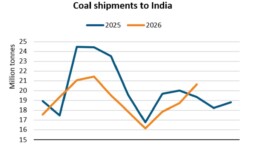
Coal shipments to India drop 7%, but limited recovery may lie ahead "Between January and October, coal shipments to India dropped 7% y/y due to the…
Hapag-Lloyd marks 20 years in South Africa and targets further growth
South Africa has become a cornerstone of Hapag-Lloyd's business in Africa Hapag-Lloyd surpasses 1 million TEU in Africa for the first time in its…
Subscribe to our newsletter!
if you dont want to swim alone in the ocean of news, sign up for the newsletter, and you will receive daily all the important news of world shipping!
