New white paper from Survitec urges reform of methanol fire safety guidelines
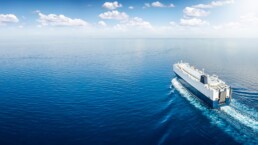

Global Survival Technology solutions provider Survitec has welcomed new guidance from classification society DNV on the fire safety arrangements for methanol-fuelled vessels but advises that more work is required before ships running on methanol can be completely fire-safe.
Findings from a Survitec study carried out earlier this year and published in the White Paper ‘Do we need new fire safety standards for methanol?’, distributed to industry for the first time at the SMM trade fair in Hamburg, Germany, confirmed existing fire-fighting methods are insufficient for methanol.
“Current water mist-based Local Application Firefighting (LAFF) arrangements, for example, had no effect on a methanol fire even after five minutes of continuous operation,” said Michał Sadzyński, Product Manager, Water Mist Systems, Survitec.”
The safety study conducted by Survitec found two factors were key to putting out a methanol engine room fire: the volume of water released under pressure and the discharge pattern of the water. This required adjustments to the water pump supply and the water mist nozzle’s spacing and placement height to achieve the right coverage to completely extinguish the fire.
“While the LAFF system is a localised first-response system that focuses on the most likely source of a fire, generally the engine, a gas-based Total Flooding solution – CO2 or Survitec 1230 Clean Agent – will also be required to cover the entirety of the machinery space,” said Sadzyński.
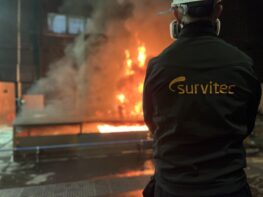
The firefighting foam typically used to extinguish bilge hydrocarbon fires was also found to be inadequate, even alcohol-resistant foams using conventional nozzles and water:foam ratios, leading Survitec to develop new nozzles and attachments.
These nozzle adaptors aspirate the foam, allowing it to expand within the space and to extinguish methanol, diesel, heptane and lubrication oil fires. Trials of the new nozzle also confirmed that fluorine-free alcohol-resistant foam was just as effective with the new adaptor for methanol fires as standard AFFF alcohol-resistant foams.
Maciej Nieścioruk, Product Manager, Foam and Clean Agent Systems, Survitec, said: “DNV-RU-SHIP Pt.6 provides additional guidance on the Total Flooding, Bilge Foam and Local Fire Fighting requirements for engines running on methanol. This helps clarify international guidelines under IMO’s MSC.1/Circ.1621, which many ship operators have found confusing. However, we still believe more needs to be done.”
A particular issue of concern is that international guidelines do not provide clear test protocols for alcohol-based fires. These are required, says Survitec, because the firefighting systems, foams and nozzle configurations used for hydrocarbon fires are ineffective in extinguishing alcohol-based fuel fires. As a result, system arrangements must be adapted to work for methanol fire, with system performance then tested and verified in the lab.
“Local Application Firefighting systems are not covered at all in the IMO rules, and there is no mention of any fire safety adjustments being required for the safe use of methanol (CH3OH) as a marine fuel, although some classification societies like DNV, are starting to specify additional requirements,” Nieścioruk said.
“In practice, this means that firefighting measures for methanol will largely be based on those that exist for hydrocarbon fuels, which we now know will not put out a methanol fire,” he said.
The tests carried out at the RISE Fire Research Laboratory, Trondheim, Norway, one of the world’s largest research organisations on fire, showed that for Category A Machinery Spaces, three separate systems are required to protect the ship and crew from methanol-fuelled engine fires.
The Survitec fire safety team has since been working to raise awareness of the key challenges surrounding methanol fire safety and share their findings from the safety study. They are already discussing with other class societies and shipyards how to develop comprehensive requirements covering all vessel types.
“We encourage all stakeholders to come together to address methanol’s unique fire risks and create clear standards, new testing protocols and updated safety rules for methanol to ensure we keep our vessels – and most importantly – our crews, safe”, says Sadzyński.



Related News.
Navigating the Multi-Orbit Era: In Conversation with Intellian’s Jon Harrison at SMM 2026
At SMM 2026 in Hamburg, the rapid evolution of maritime satellite communications took centre stage. Across the exhibition halls, discussions among…
Cyprus ports need joint energy and investment strategy, shipping agents chief says
Cyprus needs a coordinated strategy for shipping, energy and environmental protection to support port investment and modernisation, Cyprus shipping…

MASO Public Affairs introduces MASO Regulatory Intelligence
A new subscription service helping businesses understand what is changing and what it means for them MASO Public Affairs introduces MASO Regulatory…
Anglo-Eastern helps turn CMBTECH’s ammonia ambition into an operational reality
From early feasibility study and risk-based design to newbuilding supervision, crew readiness and technical management, Anglo-Eastern drew on its…

Escalation of attacks threatens to derail recovery in Middle East oil exports
World oil demand is forecast to fall by 2.5 mb/d y-o-y in 4Q26 and 2.6 mb/d on average in 2026. As the Iran war manifests itself through restricted…
New study finds shipping pays twice its share to EU ETS earmarked revenues should triple to help build market for sustainable fuels and technologies
Shipping is responsible for around 10% of EU ETS emissions but pays almost 20% of the ETS bill. Unlike other sectors, it has never received free…
MSARC strengthens maritime mass rescue readiness through training and national live exercise off Dakar, Senegal
Joint MSARC–FHAS programme combines three days of SAR training with a national multi-agency live exercise The Maritime Search and Rescue Council ,…
Sogese report deliveries are still being delayed as container freight rates fluctuate
FOR IMPORTERS Spot rates into the Mediterranean are back at January levels, Far East to Europe reliability sits at pandemic lows, and nearly…
Glencore begins trading on Australian Securities Exchange
Glencore has begun trading on the Australian Securities Exchange under the ASX code GLC. Gary Nagle, Glencore’s CEO, said it was an exciting day for…
BIMCO Shipping Number of the Week
Suez Canal container ship transits exceed 50% of pre-disruption levels "During the first two weeks of October, weekly container ship capacity…
Subscribe to our newsletter!
if you dont want to swim alone in the ocean of news, sign up for the newsletter, and you will receive daily all the important news of world shipping!
