Active grain handling season has started at the Port of Riga


With the start of this year’s active grain handling season, the Port of Riga terminals began receiving and loading grain cargo of local origin at the end of July and the beginning of August. So far, more than 10 vessels with rapeseed and 3 bulk carriers with wheat have left the port berths with the new harvest on board. Riga port terminals are actively receiving grain from both Latvian and Lithuanian farmers. Given the expectations of Latvian farmers for the new harvest, the Port of Riga is not expecting a record high, but still a significant volume of agricultural exports this year.
According to the port terminals the grain handling season has started relatively early this summer. “This year the rapeseed harvest started in mid-July in Latvia and even earlier in Lithuania – in the beginning of July, and in the last week of July the first ship with this year’s rapeseed harvest has been already dispatched from our terminal. Currently we have received and loaded on board around 30,000 tonnes of rapeseed from Latvia and Lithuania, as well as small quantities from Ukraine,” said Jānis Lapiņš, Commercial Director of WT Terminal.
The first ship of the new wheat harvest has already been loaded at the “Osta Lejasvoleri” terminal in early August. “This year’s season has started dynamically. We have already received 100 000 tonnes of agricultural products – wheat and rapeseed in our warehouses. Most of it is produced by Latvian grain growers, but we are also receiving shipments from Lithuania. The biggest advantage of our terminal is its location on the left bank of the River Daugava, which makes it easily accessible from the largest grain-growing region – Zemgale – as well as for farmers in Lithuania,” said Ivo Buliņš, Chief Financial Officer of “Osta Lejasvoleri”.
This season, 15 terminals are ready to receive and handle grain in the Port of Riga – one in two of the operating stevedores. Competition between terminals in the Port of Riga in the grain handling segment has always existed, but it has intensified in recent years as new players have entered the agricultural product handling segment. Terminals that are losing certain types of cargo due to the geopolitical crisis and sanctions are trying to reorient towards other more promising cargo groups, including agricultural cargo.
Port operators admit that competition is promoting faster growth of the port terminals and, at the same time, of the port as a whole. Companies are building new and up-to-date infrastructure for handling agricultural products, developing modern grain warehouses, investing in technology and equipment to make the companies and the port more efficient and competitive.
“Long before the geopolitical turmoil, WT Terminal had identified the handling of agricultural products as one of the key priorities for the company’s development. Two years ago, we started building and commissioned a new closed dry bulk warehouse for the storage and handling of grain crops. We can see that our strategy has been sound, and our investments have been successful. We can receive and load more agricultural products onto vessels at the same time. The terminal is now optimised, and the volume of transhipments is increasing at the same time,” added Jānis Lapiņš.
Today, big tonnage vessels, with hold capacity of around 60,000 tonnes of grain, are already the standard for grain transport. To operate such vessels efficiently, sufficient grain storage capacity is needed at the port terminals. Therefore, companies are increasingly building new warehouses to store agricultural products during the busy season.
“As the transhipment of agricultural products is a key priority for “Osta Lejasvoleri”, over the past few years we have focused on developing the infrastructure required for this cargo. We have commissioned three new grain warehouses and we plan to commission a fourth this year. The terminal will then have a total grain storage capacity of 55,000 tonnes, which is suitable for handling large vessels. Targeted expansion of storage capacity has enabled us to become one of the leaders in the agricultural product handling segment in the Port of Riga,” commented Ivo Buliņš.
Agricultural cargo, along with containerized and timber cargo, was identified as a priority cargo type for the Port of Riga in 2017, when the port’s 10-year development programme was being drawn. According to the statistics of recent years this long-term strategy has been correct – energy transit cargo (coal and oil products) has almost completely left the port, while all other segments, including agricultural cargo, are developing successfully – in compliance with market volumes and cyclical conditions. The grain cargo segment grew by 15% last year and the Port of Riga handled almost half (46%) of all agricultural product cargo shipped from Latvian ports.



Related News.

Global study finds Cyprus ranks SEVENTH and set for $1.1 billion AI GDP boost
Cyprus beats India and New Zealand to come SEVENTH in major AI study – with potential €1.1 billion GDP boost and youth jobs opportunity Some 86% of…

Global shipping’s trillion dollar climate bill according to Zero Carbon Analytics
A new study by Zero Carbon Analytics finds that emissions from international shipping cost the global economy around USD 963 billion between 1990…

Keeping Children Safe Online at Sea Seafy® earns friendly WiFi Certification across 26 vessels
Seafy becomes Friendly WiFi’s first partner in the maritime sector, helping protect kids from harmful content online. Friendly WiFi is delighted…

ShipManager joins Star Information Systems to accelerate the maritime industry’s transition to cloud
CFARER, a DNV Company selects Star Information Systems as the longterm home for ShipManager and its cloud future Star Information Systems (Star)…

Seafarer experience must shape maritime technology, initial STEER Project report finds
New research finds technology can shift rather than remove risk as The Nautical Institute, with support from Lloyd’s Register Foundation, calls for…

New LR service targets cargo disruption when trade routes fail
New LR Advisory service helps ports, governments and logistics operators respond to disruption, protect critical cargo flows and strengthen trade…

DORIC WEEKLY INSIGHT 06 NOVEMBER 2026
Please find below the DORIC Market Insight for the week ending 06th November 2026. Weekly Report 06.11.2026
BIMCO Shipping Number of the Week
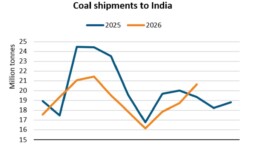
Coal shipments to India drop 7%, but limited recovery may lie ahead "Between January and October, coal shipments to India dropped 7% y/y due to the…

Hapag-Lloyd marks 20 years in South Africa and targets further growth
South Africa has become a cornerstone of Hapag-Lloyd's business in Africa Hapag-Lloyd surpasses 1 million TEU in Africa for the first time in its…
Subscribe to our newsletter!
if you dont want to swim alone in the ocean of news, sign up for the newsletter, and you will receive daily all the important news of world shipping!
