UK-based carbon capture startup bound for growth

There is growing acceptance that onboard carbon capture (OCC) is likely to form a component in shipping’s mandate to achieve net-zero GHG emissions by 2050, many of the technologies being explored also have significant energy requirements that could increase fuel consumption by as much as 45%, according to a 2022 study by the Maersk McKinney Moller Center for Zero Carbon Shipping.
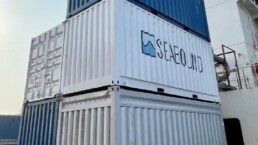
One company that believes it may have found the answer is UK-based startup Seabound, which has developed a passive containerised OCC system using calcium oxide – otherwise known as quicklime – with a recent pilot project indicating it could reduce CO2 emissions by nearly 80%. The company is backed by several ship operators – among them Eastern Pacific Shipping – as well as private equity financing and has also benefited from funding from the UK government’s Clean Maritime Demonstration Competition.
Seabound is now aiming to commercialise the technology with a target of installation onboard 1,000 ships by the end of this decade. Alisha Fredriksson, Seabound’s CEO and co-founder, says the idea of developing an onboard carbon capture solution arose during Covid when, like many others, she found herself with a lot of time on her hands.

Alisha Fredriksson, Seabound co-founder and CEO
She tells TNA: “I reached a point where I just couldn’t stop thinking about the climate crisis and was trying to figure out what I could do to have a big impact on mitigating that. I became interested in these hard-to-abate sectors, because of my experience working with another startup making e-fuel for shipping.
“As we looked into it we had two insights: one that the e-fuel industry that’s trying to make methanol is struggling to access captured CO2 for methanol production, creating this ironic bottleneck. That’s when we thought about whether we could capture the CO2 on board the vessels themselves and sell that for methanol production and eventually facilitate a circular fuel system?”
While Seabound’s system could be used on methanol-fuelled ships the larger market is those powered by conventional fuels, with around 50,000 vessels incompatible with any of the alternatives currently in development. Fredriksson explains that her team explored a number of land-based technologies developed for power plants to determine which might be effectively adapted for sea, building models to compare and contrast.
“Typically onboard carbon capture uses an amine-based system, essentially miniaturising the system that’s used on land and transferring it on board. But you have a lot of complicated equipment with a large footprint, high CAPEX and high energy consumption to first separate the CO2, then compress and liquefy it. It’s also difficult to scale because ports don’t have CO2 handling facilities. So owners are rightly worried they’ll be stranded with captured CO2 on board.”
Instead Seabound opted to decouple the process. Calcium oxide, supplied in the form of small pebbles, requires no compression or liquefaction, instead capturing the CO2 from exhaust gas and storing it as calcium carbonate. When the ship arrives at a port with the requisite facilities, the CO2 is released through heating in a kiln and transformed back into calcium oxide for reuse. The captured CO2 can be sold for methanol production or sequestration, depending on the location.
In April this year, Seabound demonstrated a containerised version of the technology on board Lomar Shipping’s 3,200TEU boxship Sounion Trader. Fredriksson says the solution is completely scalable – i.e. multiple units could be installed – comprising around one to two percent of the vessel’s overall cargo capacity. Retrofitting a vessel would be largely a matter of installing the pipework for the exhaust gas processing.
Seabound isn’t expecting shipowners to become limestone traders so will offer a full logistics service coupled with the OCC equipment. Initially the focus will be on higher traffic ports that serve as bunkering hubs or on significant trade routes.
Although much of the publicity is around the technology’s carbon-capturing potential, Fredriksson was also keen to highlight a secondary benefit; the Seabound system also captures sulphur with 90% efficiency, potentially negating the need for scrubbers. With further development it is hoped to raise this close to the theoretical maximum of 95%.
As a small company, Fredrickson is confident Seabound can maintain a competitive edge over some of the larger companies exploring carbon capture, noting how much it has achieved in just a few years.
“We’re just much nimbler than they are, and I think there are a lot of potential process improvements for our technology as well, like making the calcium oxide more reactant. If we can provide exemplary service, and get better at providing that, we have a lead,” she concludes.
Source: Royal Institute of Naval Architects



Related News.
RINA’s Hellenic Technical Committee puts energy-efficient newbuilding design and AI in focus
Project Mermaid, battery integration and practical AI applications highlight opportunities for more efficient ship design and fleet operations…
From mine to market – NORDEN connects Comilog’s manganese ore with global markets
NORDEN’s dedicated transhipment operation in Gabon, run under a long term contract with long-standing customer Comilog, has loaded more than 54…
Oldendorff reflags two capesize vessels to Germany
Oldendorff Carriers is reflagging two of its Capesize bulk carriers to Germany, underlining the company’s long standing ties to the country and its…
AskChief surpasses 100-vessel milestone in under a year and opens its specialised maritime AI to the wider market
Putting each company’s own knowledge to work for maritime Technical and HSQE teams. AskChief, Specialised AI for maritime Technical and HSQE…

Dalian Maritime University’s Yu Jiajia receive 2027 IMO Gender Equality Award
From the bridge to the classroom, Ms Yu has helped build a more inclusive maritime sector in China, serving as a role model for the global maritime…
“K” LINE releases video update on forecasts for FY2026 and progress of the medium-term management plan
Kawasaki Kisen Kaisha, has released a video on its official website explaining its forecasts for FY2026 and progress of its Medium-Term Management…
 …
MOL and MOL CAREER sign 3-way deal with Nagasaki Prefecture to promote recruitment and retention of foreign workers
Mitsui O.S.K. Lines, and MOL CAREER, have entered into a tripartite partnership agreement with Nagasaki Prefecture to promote the revitalization of…
Hapag-Lloyd completes acquisition of 25% stake in APM Terminals Maasvlakte II
Transaction successfully completed following antitrust approval Investment strengthens Hapag-Lloyd’s terminal portfolio and position in Rotterdam…
11th chainPORT annual meeting at Tanger Med Focuses on scaling AI in ports
Representatives from leading ports around the world gathered in Tangier, Morocco, on 29 and 30 October for the 11th chainPORT Annual Meeting, hosted…
Subscribe to our newsletter!
if you dont want to swim alone in the ocean of news, sign up for the newsletter, and you will receive daily all the important news of world shipping!
