



Despite the rapid expansion of renewables, the huge growth of electricity demand in key economies indicates the world’s consumption of coal will stay largely stable this year and next
Global coal demand is set to remain broadly unchanged in both 2024 and 2025 as surging electricity demand in some major economies offsets the impacts of a gradual recovery in hydropower and the rapid expansion of solar and wind, according to the IEA’s latest update on coal market trends worldwide.
The world’s use of coal rose by 2.6% in 2023 to reach an all-time high, driven by strong growth in China and India, the two largest coal consumers globally, the IEA’s Coal Mid-Year Update finds. While coal demand grew in both the electricity and industrial sectors, the main driver was the use of coal to fill the gap created by low hydropower output and rapidly rising electricity demand.
In China, which accounts for more than half of global coal consumption, electricity generation from hydropower has been recovering in 2024 from last year’s exceptionally low levels. This, alongside the continued rapid deployment of solar and wind, is significantly slowing down the growth in coal use in 2024. But another major annual increase in China’s electricity demand, forecast at 6.5% in 2024, makes a decline in the country’s coal consumption unlikely. In India, coal demand growth is set to decelerate in the second half of 2024 as weather conditions return to seasonal averages. In the first half of the year, India’s coal consumption rose sharply as a result of low hydropower output and a massive increase in electricity demand due to extreme heatwaves and strong economic growth.
Coal demand in Europe is continuing on the downward trend that began in the late 2000s, largely due to emissions reduction efforts in power generation. After having fallen by more than 25% in 2023, coal power generation in the European Union is forecast to drop by almost as much again this year. Coal use has also been contracting significantly in the United States in recent years, but stronger electricity demand and less switching from coal to natural gas threaten to slow this trend in 2024. Japan and Korea continue to reduce their reliance on coal, although at a slower pace than Europe.
“Our analysis shows that global coal demand is likely to remain broadly flat through 2025, based on today’s policy settings and market trends,” said Keisuke Sadamori, IEA Director of Energy Markets and Security. “The continued rapid deployment of solar and wind, combined with the recovery of hydropower in China, is putting significant pressure on coal use. But the electricity sector is the main driver of global coal demand, and electricity consumption is growing very strongly in several major economies. Without such rapid growth in electricity demand, we would be seeing a decline in global coal use this year. And the structural trends at work mean that global coal demand is set to reach a turning point and start declining soon.”
On the supply side, global coal production is expected to decrease slightly in 2024 after steady growth the year before. In 2024, coal production in China is moderating after two years of staggering growth. In India, the push to boost coal production continues, with a supply increase of around 10% expected in 2024. In advanced economies, coal production is in decline, broadly reflecting demand.
The report finds that trade volumes are at the highest levels ever seen despite the collapse of imports in Europe and the decline in imports in Northeast Asia (Japan, Korea and Chinese Taipei) since 2017. However, other countries are stepping in to take up available supply. In 2024, Vietnam is set to become the fifth largest coal importer, surpassing Chinese Taipei. Imports to China and India remain at all-time highs.
Despite declining domestic production in China in the first half of this year, tighter sanctions on Russian producers and disruptions in a few exporting countries, the global coal market is well supplied, according to the report. With more stable natural gas prices than in recent years, coal prices remained range-bound in the first half of 2024. They have returned to levels last seen before the global energy crisis but remain elevated due to inflationary pressures.
Related News.
November 9, 2026
Global study finds Cyprus ranks SEVENTH and set for $1.1 billion AI GDP boost
Cyprus beats India and New Zealand to come SEVENTH in major AI study – with potential €1.1 billion GDP boost and youth jobs opportunity Some 86% of…

November 9, 2026
Global shipping’s trillion dollar climate bill according to Zero Carbon Analytics
A new study by Zero Carbon Analytics finds that emissions from international shipping cost the global economy around USD 963 billion between 1990…

November 9, 2026
Keeping Children Safe Online at Sea Seafy® earns friendly WiFi Certification across 26 vessels
Seafy becomes Friendly WiFi’s first partner in the maritime sector, helping protect kids from harmful content online. Friendly WiFi is delighted…

November 9, 2026
MarinePALS keeps seafarers’ mental wellbeing results private from employers
MarinePALS has launched ‘MyMood’, a mental wellbeing self-check that enables seafarers to consider whether they need support without their individual…
November 9, 2026
ShipManager joins Star Information Systems to accelerate the maritime industry’s transition to cloud
CFARER, a DNV Company selects Star Information Systems as the longterm home for ShipManager and its cloud future Star Information Systems (Star)…

November 9, 2026
Seafarer experience must shape maritime technology, initial STEER Project report finds
New research finds technology can shift rather than remove risk as The Nautical Institute, with support from Lloyd’s Register Foundation, calls for…

November 9, 2026
New LR service targets cargo disruption when trade routes fail
New LR Advisory service helps ports, governments and logistics operators respond to disruption, protect critical cargo flows and strengthen trade…

November 9, 2026
DORIC WEEKLY INSIGHT 06 NOVEMBER 2026
Please find below the DORIC Market Insight for the week ending 06th November 2026. Weekly Report 06.11.2026
November 9, 2026
BIMCO Shipping Number of the Week
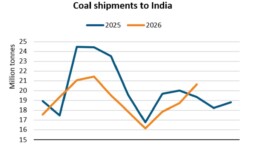
Coal shipments to India drop 7%, but limited recovery may lie ahead "Between January and October, coal shipments to India dropped 7% y/y due to the…

November 9, 2026
Hapag-Lloyd marks 20 years in South Africa and targets further growth
South Africa has become a cornerstone of Hapag-Lloyd's business in Africa Hapag-Lloyd surpasses 1 million TEU in Africa for the first time in its…
Subscribe to our newsletter!
if you dont want to swim alone in the ocean of news, sign up for the newsletter, and you will receive daily all the important news of world shipping!
Design & Development by P.KAN.DESIGNER
© 2026 Cyprus Shipping News. All rights reserved
Design & Development by P.KAN.DESIGNER
© 2026 Cyprus Shipping News. All rights reserved


