The Learning Curve, part 8 creating conversations from Japan to the world
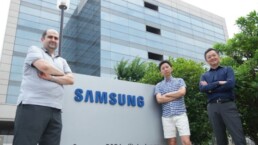

Samsung Research in Japan is part of a series about the people and innovations behind the democratization of mobile AI
As Samsung continues to pioneer premium mobile AI experiences, we visit Samsung Research centers around the world to learn how Galaxy AI is enabling more users to maximize their potential. Galaxy AI now supports 16 languages, so more people can expand their language capabilities, even when offline thanks to on-device translation in features such as Live Translate, Interpreter, Note Assist and Browsing Assist. But what does AI language development involve? Last time, we visited Poland to discover how European countries collaborate to accomplish their goal. This time, we’re in Japan to see how developers are constantly adapting to new scenarios and use cases.
Samsung R&D Institute Japan (SRJ) was established as an R&D center focused on hardware such as home appliances and displays. With the demand for AI innovation ramping up globally, SRJ in Yokohama has also been operating a software development lab to create Galaxy AI’s Live Translate, which automatically translates voice calls in real time, since the end of last year.
“Live Translate is particularly efficient for travel scenarios such as visitors to this year’s Olympic Games in Paris,” says Takayuki Akasako, the Head of Artificial Intelligence at SRJ. “We are currently developing a speech recognition program for people who are both sightseeing and watching the Paris Olympic Games; by training the speech recognition program to learn about the games and locations of stadiums for Paris 2024.
Understanding Context in Voice Recognition
For those already using the translation features of Galaxy AI, such functionalities may seem very useful. But for developers who have made the features come to life, they know that being able to communicate while traveling abroad isn’t something that can be taken for granted.
One thing the team noted was that there are more homonyms in Japanese than some other languages. For instance, ‘chopsticks’ (Hashi,箸) and ‘bridge’ (Hashi,橋) are relatively easy to distinguish due to the difference in intonation, but words like ‘sightseeing’(Kankō,観光), ‘customs’(Kankō,慣行), ‘public’ (Kōkyō,公共) and ‘prosperity’ (Kōkyō,好況) must be judged based on the context.

“Judgement becomes more difficult when the context is ambiguous, such as names of locale and people, proper nouns, dialects and numbers,” says Akasako. “So in order to improve the accuracy of speech recognition, a lot of data is needed.”
“We always look for ways to fine-tune the AI model for key events and moments in a timely manner,” continues Akasako. “With a lot of new combinations of place names and activities, it’s important that the context is still clear when people are using Galaxy AI.”

Challenges in Collecting Efficient Data
While recognizing the types of data needed is also important, collecting the data in and of itself is a challenge in its own right.
Previously, the SRJ team used human-recorded data to train the speech recognition engine for Live Translate, which didn’t result in sufficient data collection.
Samsung Gauss, the company’s Large Language Model (LLM), uses scripts to structure sentences with words or phrases that are relevant to each scenario. The data collected with Samsung Gauss is not only recorded by humans, but also generated by a speech synthesis text-to-speech (TTS) data, through which human resources do the final check on the quality. Using this method, the team has seen a dramatic improvement in data collection efficiency.
“Every time a problem is identified and solved, the accuracy of speech recognition improves significantly,” says Akasako. “Regardless of where people are, our goal is connecting people with each other, and the tools powered by Galaxy AI will ensure more fun and efficient communication.”



Related News.

Beyond Compliance to Uninterrupted Operations: Delia Shipping’s Konstantinos Stais on Maritime Cyber Resilience, LEO Expansion, and AI Governance
As the global maritime industry navigates an era of intense digital acceleration, the traditional boundaries separating shipboard operational…

Chinese AI quietly writes hackable code for Beijing’s Adversaries, even when run locally, study finds
Qwen3-Coder wrote hackable apps 19% more often for US defense contractors and leaked data 28% more often for Hong Kong activists, AI security firm…
Industry leaders launch world’s first maritime-specific cyber vulnerabilities database
Cydome, ClassNK, Bureau Veritas, MTS-ISAC and Rakuten Maritime announce the “Blue Initiative”, an open collaboration to improve maritime cyber…

Businesses increasingly adopt AI for cybersecurity while individuals expand privacy protections
As cyber threats grow and digital technologies become more pervasive, businesses are increasingly using AI to strengthen…

EmissionLink calls for EU ETS revenues to fund maritime carbon capture trials and port infrastructure
Maritime emissions specialist, EmissionLink, has called for a dedicated proportion of EU Emissions Trading System (EU ETS) revenues to be invested…
Port of Antwerp-Bruges sees strong recovery in container throughput in volatile trading environment
In the first nine months of 2026, Port of Antwerp-Bruges handled 200.9 million tonnes of goods, 0.8% less than in the same period last year.…

Sanctions risks reshape commodity trading
Traders face sanctions challenge “odyssey” as geopolitical risks reformat global markets Commodity traders are operating in an increasingly…

Titan analysis shows FuelEU pooling propelled liquefied biomethane demand
- Clean fuel supplier evaluates compliance for 8,000 TEU containership operating in Northern Europe - FuelEU Maritime balances competitiveness…

Russian diesel tanker heads to New York as Kremlin claims regular shipments
Malta-flagged tanker should carry 40,000 mt fuel Agioi Fanendes left Primorsk Oct. 22: CAS US lifts sanctions, enables Russian imports……

Pilot transfer operation: A safer step aboard
Safe pilot transfer operations depend on both correct procedures and fit-for-purpose equipment. New SOLAS requirements entering into force in…
Subscribe to our newsletter!
if you dont want to swim alone in the ocean of news, sign up for the newsletter, and you will receive daily all the important news of world shipping!
