EU adopts 14th sanctions package against Russia

Circular issued by International Group clubs
On 24 June 2024 the EU Council adopted the 14th package of sanctions against Russia, which includes its first measures targeting Russia’s liquefied natural gas (LNG) sector, further export-related restrictions, sanctioning of vessels and new anti-circumvention measures, such as a requirement for EU companies to undertake best efforts to ensure that non-EU subsidiaries in third countries comply with EU sanctions.
These measures are contained in (i) Council Regulation 2024/1745 which amends Regulation (EU) No. 833/2014 and (ii) Council Regulation 2024/1746 which amends Regulation (EU) No. 269/2014.
Restrictions on the LNG sector
The EU has introduced its first restrictions on Russian LNG (i.e., which originates in Russia or has been exported from Russia) with the aim to prevent Russian LNG that is not consumed in the EU from entering the EU or being transported to third countries via EU ports. It also introduces reporting obligations for entities “performing unloading operations” and imports into the EU of Russian LNG to the respective competent authority of the EU member state by 26 July 2024 and every month thereafter. The following restrictions now apply:
- Reloading services of Russian LNG within EU waters for the purpose of transhipment operations to third countries, including ship-to-ship transfers (STS), ship-to-shore transfers and re-loading operations are prohibited. There is a wind down period whereby this prohibition will not apply through 26 March 2025 for contracts entered into before 25 June 2024.
- The above prohibition does not affect the import of Russian LNG into the EU, but only the re-export to third countries via the EU.
- Reloading services necessary for the bunkering of LNG fuelled vessels are exempted.
- The competent authority of an EU member state may authorise reloading services that are necessary for the transport of Russian LNG to a member state where the member state has confirmed that transhipment is used to ensure the energy supply in that member state.
- There is an exemption in respect of the provision of ‘financing or financial assistance’ (which includes insurance) if a vessel needs assistance seeking a place of refuge, for an emergency port call for reasons of maritime safety, for saving life at sea, or for the urgent prevention or mitigation of an event likely to have a serious and significant impact on human health and safety or the environment, or as a response to natural disasters.
- New investments and the provision of goods, technology, and services for the completion of LNG projects under construction in Russia, such as Arctic LNG 2 and Murmansk LNG are prohibited. There is a wind down period through 26 September 2024 for contracts entered into before 25 June 2024 This prohibition does not affect the purchase and import of LNG from Russian terminals and financial services provided to such LNG projects.
- The purchase, import or transfer of Russian LNG through LNG terminals in the EU that are not connected to the interconnected natural gas system is prohibited. There is a wind down period whereby this prohibition does not apply through 26 July 2024 for contracts entered into before 25 June 2024.
- Provision, directly or indirectly, technical assistance, brokering services, and financing or financial assistance (which includes insurance) related to the above prohibited activities.
New measures to combat sanctions circumvention
This package introduces the following anti-circumvention measures:
- EU individuals and entities are required to undertake “best efforts” to ensure that their subsidiaries in third countries do not take part in any activities that could undermine EU sanctions.
“Best efforts” is defined as comprising of all actions that are suitable and necessary to achieve the result of preventing the undermining of the restrictive measures. “Those actions can include, for example, the implementation of appropriate policies, controls and procedures to mitigate and manage risk effectively, considering factors such as the third country of establishment, the business sector and the type of activity of the legal person, entity or body that is owned or controlled by the [EU] operator. At the same time, best efforts should be understood as comprising of only actions that are feasible for the [EU] operator in view of its nature, its size and the relevant factual circumstances, in particular the degree of effective control over the legal person, entity, or body established outside the [EU]. Such circumstances include the situation where the [EU] operator, due to reasons that it did not cause itself, such as the legislation of a third country, is not able to exercise control over a legal person, entity, or body that it owns” (Article 8a and Recital (30) of EU Regulation 2024/1745). - EU operators selling military goods to third countries will need to implement due diligence mechanisms capable of identifying and assessing risks of re-exportation to Russia and mitigating such risks
- EU operators transferring industrial know-how for the production of military goods to third-country commercial counterparts will now have to include contractual provisions to ensure that such know-how will not be used for goods intended to be transported to Russia.
The wording of the sanctions regulation that targets circumvention of sanctions has been widened. It now states that “It shall be prohibited to participate, knowingly and intentionally, in activities the object or effect of which is to circumvent prohibitions in this Regulation, including by participating in such activities without deliberately seeking that object or effect but being aware that the participation may have that object or effect and accepting that possibility” (Article 12 of EU Regulation 2024/1745).
Restrictions to the financial sector
The EU has banned the use of the System for Transfer of Financial Messages (“SPFS”), a specialised financial messaging service developed by the Central Bank of Russia. EU operators will not be allowed to connect to the SPFS or equivalent specialised financial messaging services and are barred from making transactions with specifically listed entities using SPFS outside of Russia.
Transportation
The EU has introduced several measures aimed at transportation which include:
- A framework to list vessels (under Annex XLII) if they
(i) transport goods and technology used by the Russian defence and security sector,
(ii) transport Russian origin crude oil or petroleum products whilst practicing irregular and high-risk shipping practices,
(iii) support the Russian energy sector,
(iv) engage in activities which undermine or threaten Ukraine,
(v) transport goods which are subject to restrictions under EU sanctions,
(vi) facilitate or engage in the violation, circumvention or frustration of EU sanctions or
(vii) are owned, chartered, operated or used in the name of or on behalf of or for the benefit of asset freeze targets (under EU Regulation 269/2014).
The EU has designated 27 vessels to date (under Annex XLII). These vessels are subject to a port access ban and a ban on the provision of services, including the provision of insurance, chartering, management, and brokering, as well as conducting STS activities.
- There is an exemption if the sanctioned vessel is in need of assistance, seeking a place of refuge, making an emergency port call for reasons of maritime safety, for saving life at sea, for humanitarian purposes, or for the urgent prevention or mitigation of an event likely to have a serious and significant impact on human health and safety or the environment, or as a response to natural disasters.
- The EU has also widened the EU flight ban and the prohibition on transportation of goods by road.
- 61 new entities have been designated for supporting Russia’s military and industrial complex in its war against Ukraine. This includes Sovcomflot and the Volga Dnepr Group, for their involvement in the circumvention of trade restrictions and procurement of sensitive items used for example in the production of drones or providing material support for Russian military operations.
Import and export restrictions
The EU has introduced several new designations and import/export restrictions:
- The list of restricted items that could contribute to the technological enhancement of Russia’s defence and security sector has been expanded.
- The EU has introduced further restrictions on exports of goods which contribute to the enhancement of Russian industrial capabilities (e.g. chemicals, including manganese ores and compounds of rare-earths, plastics, excavating machinery, monitors, and electrical equipment), as well as further restrictions on the import of helium from Russia, which is a source of significant revenues for the regime. There are various wind down periods depending on the nature of the goods for contracts entered into before 25 June 2024.
Other measures
Articles 5ab and 11 provide a framework to protect EU operators, whereby they can claim compensation for damages caused by Russian companies linked to sanctions implementation and expropriation; and the imposition of transaction bans on Russian entities that are listed in Annex XLIII, and a procedure to recover compensation in judicial proceedings before the competent courts of an EU member state (under Article 5ab and Article 11 of EU Regulation 2024/1745).
The exemption provided for in relation to the Sakhalin-2 (Сахалин-2) Project has been extended through 28 June 2025 to ensure Japan’s energy security needs (Recital (42) of EU Regulation 2024/1745).
Trade involving Russia is subject to significant legal restrictions. Members are reminded that cover is not available for any trade that breaches applicable sanctions. Members are advised to conduct thorough due diligence throughout the trade chain on the parties, cargoes, vessels, and other service providers that are or may be involved before they engage in any trade with a high sanctions risk. Finally, Members are reminded to keep records of their due diligence investigations and findings.
All Clubs in the International Group have issued a similarly worded circular.



Related News.
Global study finds Cyprus ranks SEVENTH and set for $1.1 billion AI GDP boost
Cyprus beats India and New Zealand to come SEVENTH in major AI study – with potential €1.1 billion GDP boost and youth jobs opportunity Some 86% of…

Global shipping’s trillion dollar climate bill according to Zero Carbon Analytics
A new study by Zero Carbon Analytics finds that emissions from international shipping cost the global economy around USD 963 billion between 1990…

Keeping Children Safe Online at Sea Seafy® earns friendly WiFi Certification across 26 vessels
Seafy becomes Friendly WiFi’s first partner in the maritime sector, helping protect kids from harmful content online. Friendly WiFi is delighted…
ShipManager joins Star Information Systems to accelerate the maritime industry’s transition to cloud
CFARER, a DNV Company selects Star Information Systems as the longterm home for ShipManager and its cloud future Star Information Systems (Star)…

Seafarer experience must shape maritime technology, initial STEER Project report finds
New research finds technology can shift rather than remove risk as The Nautical Institute, with support from Lloyd’s Register Foundation, calls for…

New LR service targets cargo disruption when trade routes fail
New LR Advisory service helps ports, governments and logistics operators respond to disruption, protect critical cargo flows and strengthen trade…

DORIC WEEKLY INSIGHT 06 NOVEMBER 2026
Please find below the DORIC Market Insight for the week ending 06th November 2026. Weekly Report 06.11.2026
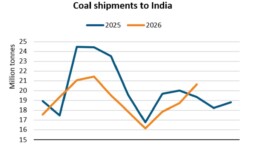
BIMCO Shipping Number of the Week
Coal shipments to India drop 7%, but limited recovery may lie ahead "Between January and October, coal shipments to India dropped 7% y/y due to the…
Hapag-Lloyd marks 20 years in South Africa and targets further growth
South Africa has become a cornerstone of Hapag-Lloyd's business in Africa Hapag-Lloyd surpasses 1 million TEU in Africa for the first time in its…
Subscribe to our newsletter!
if you dont want to swim alone in the ocean of news, sign up for the newsletter, and you will receive daily all the important news of world shipping!
