Höegh Autoliners secures fuel savings and long-term CII compliance with Accelleron and Hanwha engine part-load optimization
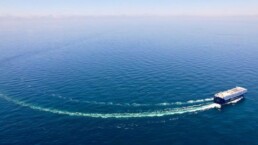

- Fuel consumption reduction of 10g/kWh on 7,850 CEU car carrier Höegh Detroit confirmed at sea trial
- Efficiency improvement to deliver sustained upgrade in vessel’s Carbon Intensity Indicator rating
- Höegh Autoliners orders Hanwha and Accelleron engine part-load optimization on further seven vessels
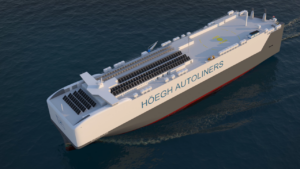
Hanwha and Accelleron have performed an engine part load optimization for Höegh Autoliners supporting long-term energy efficiency for its 7,850 CEUcar carrier Höegh Detroit. The success of the project to improve the vessel’s Carbon Intensity Indicator rating has led to an order for EPLOs on a further seven vessels owned or operated by Höegh.
At a recent sea trial, EPLO demonstrated fuel saving of 10g/kWh, equivalent to 5% of total fuel consumption. The improvement not only enables the vessel to operate in a high CII rating but also provides substantial operating cost reduction in terms of fuel costs and EU ETS expenses and reduced CO2 emissions.
Working with engine builder Hanwha Engine Co, Accelleron optimized both engine tuning and turbocharger configuration, including the installation of components more suitable to the vessel’s lower speed profile. Turbocharger nozzle rings, turbine blades and compressor wheels were all adapted, alongside various engine parameters, optimizing efficiency for a de-rated engine output of 79% of the original maximum continuous rating, tailor edged to the new propulsion upgrade. During the project, Höegh Detroit was also equipped with a new propeller that enables the vessel to reach same maximum speed as before the modifications, the only difference is the lower fuel consumption.
Sebjørn Dahl, Chief Operations Officer at Höegh Autoliners, said: “Operating with lower engine power is one of several energy efficiency measures being deployed by Höegh Autoliners as part of our commitment to being a leader in sustainable deep-sea shipping. The fuel efficiency impact of EPLO optimization on Höegh Detroit exceeded our expectations, safeguarding the vessel’s long-term energy efficiency and market value. We are confident of similar success in future EPLO projects.”
“Sustainability and emission reduction is at the core of Höegh Autoliners’ strategy. This joint project with Accelleron and Hanwha shows very good results and is an example of decarbonization in practice, said Sebjørn Dahl, COO, Höegh Autoliners.
More than 60 percent of the world’s ships of 400 gross tons (GT) or more are required to comply with IMO’s CII regulations. The energy intensity criteria are becoming stricter every year driving the decarbonization of the maritime industry. As a result, many shipping companies are investigating and implementing a series of measures to improve the efficiency of their existing fleet to ensure they remain attractive in a highly competitive market. Operating at reduced ship speeds is a common measure that directly reduces the carbon footprint of shipping; a 5% reduction in speed reduces CO2 emissions from a voyage by 10% and the required propulsion power by 15%. However, most marine engines are designed to provide optimum performance at the speed for which the ship is designed, and reduced speed often operates the engines outside of the optimum power range. EPLO adapts the turbocharger and engine settings to the new load requirements further improving efficiency and combustion quality.
Accelleron has received orders for more than 20 EPLOs to date, many for multiple sister vessels, as shipowners seek cost-effective solutions to extend compliant service life on existing vessels. EPLOs can be undertaken by Accelleron as the turnkey solution provider or in conjunction with the original engine builder.
Accelleron, Product Manager Upgrades, Matthias Reichmann, said: “The phenomenal efficiency improvement delivered for Höegh Autoliners shows that EPLO – when performed optimally and with an associated optimization of turbochargers and engine settings– is among the best and most cost-effective solutions for reducing a vessel’s carbon intensity. Accelleron’s EPLO upgrade solution delivers peace of mind for shipowners dealing with complex decarbonization demands, a simple and effective measure contributing to compliance with greenhouse gas regulation while benefitting from substantially reduced fuel costs.”



Related News.

Greece has the most to lose from delays in shipping’s green transition, new analysis finds
UCL and WWF Greece report finds the IMO Net-Zero Framework offers Greek ship owners the clarity they need, and the best protection against a…

Snow Land joins Cool Carriers as the world’s first reefer with a gate rudder, a new chapter for sustainable and efficient reefer shipping
Cool Carriers, the world’s largest operator of specialised reefer vessels, took delivery of Snow Land from Kitanihon Shipbuilding in Japan on 12…

IBIA launches Marine Energy Outlook Survey as Annual Convention in New York
IBIA - The International Bunker Industry Association officially launched its Marine Energy Outlook Survey during the IBIA Annual Convention in New…

Why did ITF staff vote to strike again?
Staff at the International Transport Workers’ Federation (ITF) headquarters in London have voted to give their union a strike mandate. According to…

Nearly half of maritime crew tickets booked a week ahead are cancelled
Two new C Teleport reports show when maritime and aircrew teams book crew flights, how often they cancel, and what late booking costs, with a…

Kpler completes $1.5bn+ Sixth Street investment and continues accelerating growth
Investment backs Kpler's bold ambition to shape the future of global trade intelligence. Kpler, a leading provider of global physical trade…

How SAL and DNV are strengthening heavy-lift shipping
From classification and newbuilding support to operational tools and advisory expertise, SAL and DNV have been collaborating for decades. The…

PSA Singapore breaks ground on Tuas Port Phase Two to strengthen Global Trade Connectivity
PSA Singapore marked the groundbreaking of Tuas Port Phase Two, a significant step in the development of the world’s largest fully automated…

 …

BIFA welcomes UK–EU trade progress and calls for clarity on implementation
The British International Freight Association (BIFA) has welcomed progress made at today's UK–EU Summit in Brussels, highlighting the potential…
Subscribe to our newsletter!
if you dont want to swim alone in the ocean of news, sign up for the newsletter, and you will receive daily all the important news of world shipping!
