When war risk becomes war reality growing insurance complexities are spelled out by Association of Average Adjusters chairman


Marine insurers and legal practitioners are grappling with unresolved challenges even two years after the outbreak of the Russia-Ukraine war. The conflict had brought chaos “not only in the lives of those in the region, but for the maritime industry trying to make sense of the shock,” said Burkhard Fischer, 2023-24 chairman of the Association of Average Adjusters, in his address to the body’s annual conference in London on May 9, 2024.
Headlining his talk When War Risk becomes War Reality, Mr Fischer spoke of implications “that may still develop further” regarding coverage of vessels trapped in Ukrainian ports. He showed in detail how the lengthy history of war risk insurance has shaped present attitudes but has left key aspects open to interpretation.
The detention in 2022 of some 70 foreign-flagged vessels in Ukrainian ports came as a surprise not only to the vessels’ owners and charterers but also to the war risk underwriters. Mr Fischer, a director of Albatross Adjusters, Limassol, and outgoing Association chairman, emphasised that despite its name, war risk cover was not designed against the risks of an actual war. Commonplace and purchased at a sometimes ridiculously low premium, it was there to cover against the legacy of war in times of peace including derelict mines, bombs, and rusting weaponry. As soon as a live war came into the equation, or even the perception of an increased regional risk, a termination clause allowed war underwriters to cancel with seven days’ notice. Reinstating the cover then came with a hefty additional premium because of the additional risks of aggression.
The situation in Ukraine was unique in that many vessels had entered that country’s waters and made fast at its ports when they were covered by the basic war risk insurance with no need to reinstate the policy with a higher premium. Being liable potentially for many CTL (constructive total loss) claims with hardly any additional premiums paid at the time of port closures was bad news for war risk underwriters. Perhaps the current low level of basic war premiums should be reconsidered, mused Mr Fischer.
If a war underwriter would take into consideration the consequences of actual wars the charge of premium would be correspondingly high. And if a war effectively became a world war, even an enormous reserve would not be adequate to meet the expected losses. This led to the concept of two premiums, the first being for the whole period of insurance, the so-called basic war cover, while an additional premium is charged for visits by the insured ship to defined areas with a high element of danger. Any insurance of risks during a world war is excluded.
Voyage charters do not usually permit shipowners to recover the additional premium from the charterers, as additional war premiums are supposed to be covered by the freight. For time charters, several law cases had clarified that, while the basic war risk premium was for the shipowner to pay, any additional premium should be paid by time charterers.
In February 2022, confusion reigned between shipowners and charterers, the latter protesting that they had never signed up to trade a vessel in a war risk area and shouldn’t be on the hook for premiums of for instance five percent of the sum insured per week. Case law was on the side of charterers.
Charter parties were cancelled based on frustration of charter, leaving owners of detained ships with a choice: don’t pay the additional premiums, meaning the war risk cover would not be reinstated; or try and negotiate the premiums down by reducing the vessel’s sum insured.
This brought the case of Scott v Copenhagen Reinsurance Co (2003) back into the limelight. That involved a British Airways aircraft stranded in Kuwait as Saddam Hussein invaded and that was later destroyed by allied bombing, still within the policy period. Given that the aircraft was destroyed after the start of the war, English courts ruled that the triggering event for the loss was the commencement of hostilities. In Ukraine similar situations arose. It was clear that cover under the detainment clause would apply if it started before cancellation. But was there still cover if the vessel was destroyed after cancellation but before a 12-month period of detainment was over? Based on the ruling on Scott v Copenhagen Re it seemed possible to argue that cover was ongoing against other war perils, such as mine and missile strikes. If so, an owner would not have to worry about additional premiums.
Another question was whether underwriters were entitled to levy an additional premium on a subject matter insured that ceased to be at the shipowner’s free disposal. “I have to admit that I was struggling to find a satisfactory answer to that question, possibly because there is none,” remarked Mr Fischer.
“With time the situation became clearer. My discussions with senior practitioners confirmed that a vessel detained in Ukraine at the outbreak of war would remain covered for a CTL claim for detainments after a period of 12 months, even with no additional premium paid, and the war risk cover effectively ceased. However, there would be no cover for other war risks.
Mr Fischer said that a war cover could provide for a ship’s loss of earnings, for 90 or even 180 days. The complexity came when that was set against a CTL claim for detainment. Under the Nordic Plan (on which most loss of hire policies are based), if the assured is entitled to claim a CTL, loss of hire payments are restricted to one month. At the time of the CTL claim, if loss of hire for more than one month had already been paid (a likely scenario), then it should be deducted from the total loss compensation.
It would only seem fair to grant the owner, who has been deprived of his vessel’s earning capacity for 12 months, the full loss of hire compensation, suggested Mr Fischer.
Is interest payable in the case of a CTL claim submitted after 12 months of detainment? “Yes – and no! In principle, the assured may claim interest from one month after sending notice of the casualty to the insurer. But crucially a sub-clause clarifies that the payment of interest is subject to the assured proving that the vessel will not be recovered. This means that in the end no interest on the CTL claim will be payable by the underwriters.”
Turning to “another reality of war, total loss settlements,” Mr Fischer mentioned that there were some interesting ones for vessels detained in Ukrainian ports. One company submitted a CTL claim for a bulk carrier in Ukraine and received settlement of the total loss sum as well as the sum insured for disbursements. The ship was sold to a German shipping company, as directed by the war underwriters, with the latter reportedly receiving about 50% of the total loss sum, the vessel’s market value exceeding the insured hull value by around 25%. Exactly how and when this vessel would return to international trade was an open question. “The last time I checked, the vessel was still berthed at Mykolaiv, and apparently this was not the only vessel detained in Ukraine sold discreetly to a cash buyer within the process of settling a total loss claim, with the proceeds going to the insurers.”
He continued: “More pressingly, what exactly is the war insurers’ role in these back-to-back deals? What we see is a financially strong party speculating that the war or at least the detention of the vessel will end soon. And that there will be no targeted attacks on blockaded ships… A vessel stuck in a Ukrainian port for another five years would be old, under-maintained, and technologically outdated.”
“What we shouldn’t forget is that cases can only be judged on their own merits and, indeed, what might seem like a similar scenario for another owner, might have subtle differences, rendering a comparison invalid.
“In a situation like Ukraine, with 70 vessels detained, we should remember that each have their own particular story and despite the overarching events we must treat them as such,” advised Mr Fischer.



Related News.

Predicting the Future or Preparing for It? Cyprus Marine Club Explores the Power of Adaptability with Natasa Pilides
In a world where uncertainty has become the new normal, is predicting the future really the best strategy, or is the ability to adapt the greater…

Greece and Egypt in talks to extend EEZ Eastwards towards Cyprus following Libya’s move on Turkish Maritime Pact
Athens and Cairo have agreed to advance bilateral consultations aimed at extending the geographical scope of their 2020 Exclusive Economic Zone (EEZ)…

Seafarers face widening competency gap as digital shipping accelerates, recent research finds
Eighty two per cent of maritime professionals surveyed say current training does not adequately prepare crews for the realities of modern,…

Wärtsilä and WinGD sign new Service Framework Agreement to ensure long-term continuity and support for the global fleet
Technology groups Wärtsilä and WinGD have entered into a new long-term Service Framework Agreement, reaffirming their shared commitment to supporting…

Seatrium and Karpowership sign contract for a series of whale class Powership Conversion and Integration Projects
Seatrium and its strategic partner, floating power leader Karpowership, have strengthened their longstanding collaboration with the award of a…

ClassNK releases Handbook Supporting Consideration of Onboard Carbon Capture “Onboard Carbon Capture Systems Implementation Framework”
Bringing together technical, infrastructure, regulatory and emissions assessment considerations across the OCCS value chain - ClassNK has released a…

HHLA lowers earnings forecast for the 2026 financial year
Based on the business development to date and updated estimates for the fourth quarter of 2026, the Executive Board of Hamburger Hafen und…
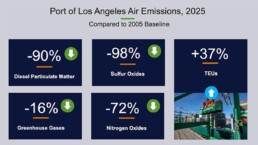
Port of Los Angeles reports lowest emissions per Container on Record
The Port of Los Angeles continued to make clean air gains in 2025, recording its lowest emissions per container on record, according to the Port's…
Drewry World Container Index – 22 Oct
WCI increased for the second consecutive week, the highest in 15 weeks. See detailed commentary below. Drewry World Container Index…
Mammoet, Port of Argentia and Argentia Capital Partner to Advance Floating Dry Dock and Marine Repair Facility
Partnership builds on Mammoet’s established presence at Port of Argentia and shared confidence in the growing market for ship repair and marine…
Subscribe to our newsletter!
if you dont want to swim alone in the ocean of news, sign up for the newsletter, and you will receive daily all the important news of world shipping!
