
Half a year since shipping’s inclusion in the European Union Emissions Trading System (EU ETS), we’re starting to see the forest for the trees. For businesses trying to fully grasp what the EU ETS means for their operations, finances and contracts, data and a proactive approach will be fundamental pillars to enable regulatory compliance, today and in the future.
For shipowners and charterers, the EU ETS is a paradigm shift in workflows and marks a step change towards greater transparency, collaboration and accountability. The transition is, nonetheless, made simpler with the help of the right digital technologies on hand.
What’s changed since the start of the EU ETS?
Shipping was officially included within the scope of the EU ETS on 1 January 2024. Since then, it has introduced new obligations around the way shipowners and charterers buy, sell and manage EU allowances (EUAs), as well as how they accurately calculate emissions. Without these insights and robust processes in play, it becomes more challenging to fully assess the costs of compliance, which is financially imprudent. Not knowing the full picture of these cost implications would be the equivalent of trying to read with the light off.
Therefore, the biggest immediate change for shipping companies since the start of EU ETS is building a strategy to manage the new layer of administrative complexity involved in the trade of EUAs. We can expect companies to adapt their operations and voyage planning, including potential shifts in calls at transshipment ports which may impact what proportion of their emissions needs to be covered by EUAs. Equally, companies will want to time the purchase of their allowances with more profitable market rates – and know exactly how many EUAs will be needed so they can buy them strategically.
The implications of EU ETS go beyond financial considerations around EUAs; it has triggered fundamental questions about how costs and responsibilities are shared between shipowners, charterers and managers. Redefining these relationships is unchartered territory not just for the shipping industry but, with costs likely being passed down, will carry profound implications for stakeholders across supply chains.
What comes next? The EU ETS playbook
The first chapter in shipping’s EU ETS playbook has demonstrated that knowledge is power. Using data to understand operational patterns and emissions – past, present and future – will allow businesses to achieve better-informed results.
Most companies have already been collecting the data they need for compliance since 2018 under the EU’s Monitoring, Reporting and Verification (MRV) system. The second step is bringing this data to life to achieve better business outcomes.
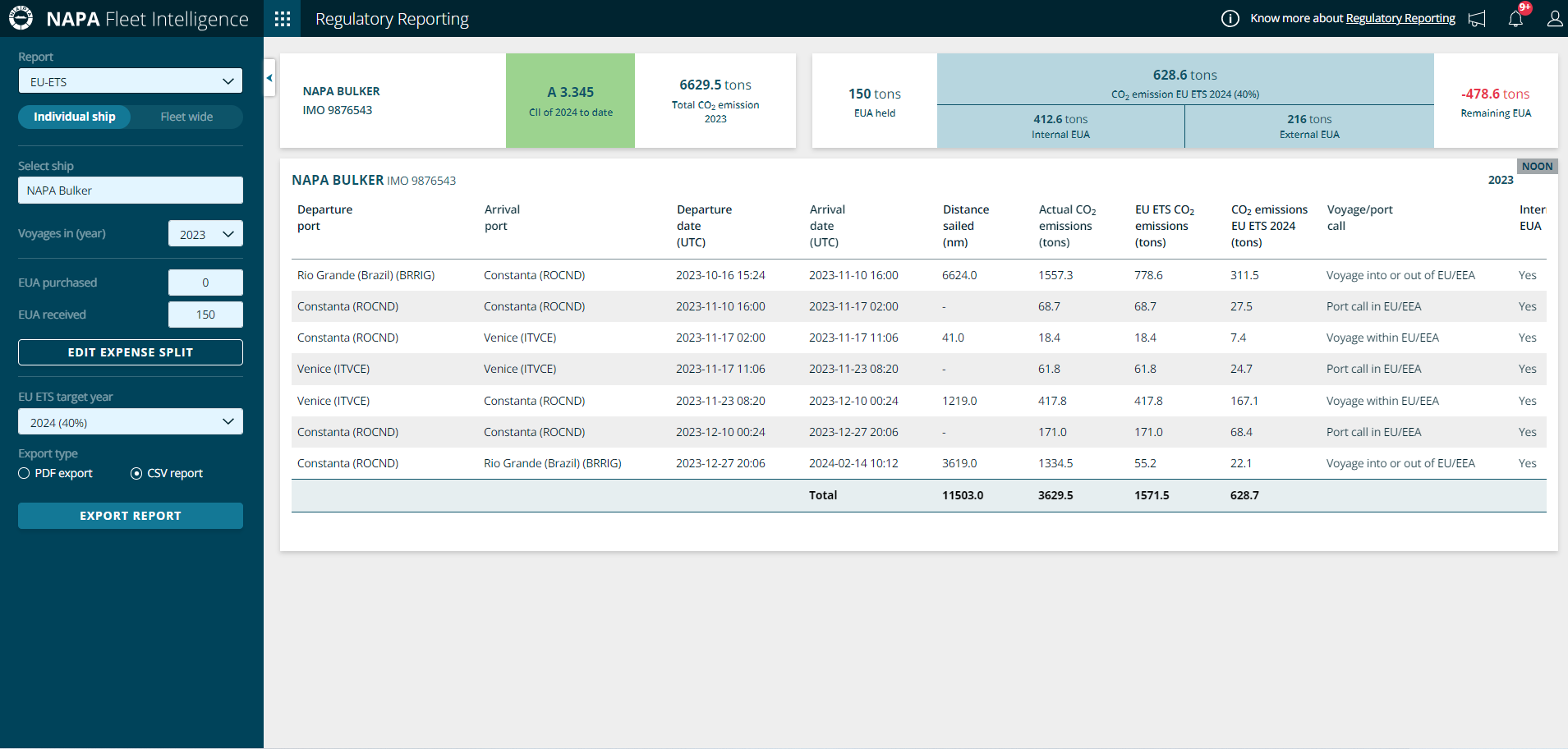
This is where data analysis and simulation tools step in to help businesses plan ahead, build an objective understanding of their operations, and predict emissions (and associated EU ETS payments) for every vessel, accounting for their specific profile and voyages. They can even model what measures, from weather routing to installing wind propulsion, will have the most impact on the specific routes where their fleet is operated.
With the right data, teams across companies, from the bridge to the boardroom, can create strategies to optimize their operations and minimize emissions to lower fuel costs and EUA purchases. More broadly, data modeling can also shed light on how many allowances will be required for each voyage throughout the year, which then allows companies to navigate price and market fluctuations. It’s the best of both human and digital minds in action.
The final cost
Shipping’s environmental sustainability has to, ultimately, be commercially sustainable. The full financial impact of the EU ETS will be determined over the next few years, but initial analysis from Clarksons Research based on 2022 trading patterns and an EUA price of $90 per ton suggests that a VLCC sailing from Ras Tanura to Rotterdam will need an estimated $200,000 in allowances this year. This represents 4% of current freight costs and is expected to rise to 10% in 2026 when EU ETS is in full swing.
It is, therefore, commercially and environmentally prudent to act sooner rather than later to comply with the EU ETS and build strategies to minimize the need for allowances.
Solutions for the here and now
There is no silver bullet solution for shipping’s decarbonization; instead, it is in the industry’s best interest to move sooner rather than later. There are existing and proven technologies to enhance energy efficiency now to ensure that every ton of fuel saved translates into dollar savings for businesses both within and beyond the industry.
Implementing voyage optimization, for example, can help companies not only minimize their emissions but also forecast fuel consumption and lower the cost for each voyage. Whenever future fuels do become available at scale, these digital technologies will have laid the groundwork to optimize their use.
At the same time, weather routing technology allows owners and operators to make the most of wind-assisted ship propulsion systems, which are increasing in popularity, helping achieve better environmental and financial results.
Embracing these low-hanging fruits and making them an integral part of decarbonization strategies is a no-brainer. With their low CAPEX and proven savings of an average 10% fuel consumption on some routes, they offer tangible benefits even on shorter voyages within European ports.
Looking ahead beyond EU ETS, a digital and ‘switched on’ mindset is a long-term solution to enable compliance with environmental regulations. The FuelEU Maritime coming into force in 2025 will be an opportunity for companies to put their strategies to the test and future-proof their operations, creating a win-win for the planet as well as business.
Author: Philippos Giannakos, Senior Sales Manager, NAPA



Related News.

RINA’s Hellenic Technical Committee puts energy-efficient newbuilding design and AI in focus
Project Mermaid, battery integration and practical AI applications highlight opportunities for more efficient ship design and fleet operations…
From mine to market – NORDEN connects Comilog’s manganese ore with global markets
NORDEN’s dedicated transhipment operation in Gabon, run under a long term contract with long-standing customer Comilog, has loaded more than 54…
Oldendorff reflags two capesize vessels to Germany
Oldendorff Carriers is reflagging two of its Capesize bulk carriers to Germany, underlining the company’s long standing ties to the country and its…

AskChief surpasses 100-vessel milestone in under a year and opens its specialised maritime AI to the wider market
Putting each company’s own knowledge to work for maritime Technical and HSQE teams. AskChief, Specialised AI for maritime Technical and HSQE…

Dalian Maritime University’s Yu Jiajia receive 2027 IMO Gender Equality Award
From the bridge to the classroom, Ms Yu has helped build a more inclusive maritime sector in China, serving as a role model for the global maritime…
“K” LINE releases video update on forecasts for FY2026 and progress of the medium-term management plan
Kawasaki Kisen Kaisha, has released a video on its official website explaining its forecasts for FY2026 and progress of its Medium-Term Management…

 …

MOL and MOL CAREER sign 3-way deal with Nagasaki Prefecture to promote recruitment and retention of foreign workers
Mitsui O.S.K. Lines, and MOL CAREER, have entered into a tripartite partnership agreement with Nagasaki Prefecture to promote the revitalization of…
Hapag-Lloyd completes acquisition of 25% stake in APM Terminals Maasvlakte II
Transaction successfully completed following antitrust approval Investment strengthens Hapag-Lloyd’s terminal portfolio and position in Rotterdam…
11th chainPORT annual meeting at Tanger Med Focuses on scaling AI in ports
Representatives from leading ports around the world gathered in Tangier, Morocco, on 29 and 30 October for the 11th chainPORT Annual Meeting, hosted…
Subscribe to our newsletter!
if you dont want to swim alone in the ocean of news, sign up for the newsletter, and you will receive daily all the important news of world shipping!
