
Furthermore, internal analysis of significant claims conducted by West of England P&I Club revealed that approximately 5% of all severe personal injuries occur during mooring or towing operations. Nearly half of these injuries are associated with accidents involving parting lines.
Safety measures are paramount
These alarming statistics highlight the huge importance of comprehensive safety measures during these critical maritime operations. Operators should take every precaution to mitigate the risks; proper maintenance according to manufacturer instructions, regular inspections and adequate familiarization and training as described in the new SOLAS guidelines are crucial.

The SOLAS II-I Reg. 3-8 ‘Towing and mooring equipment’ was amended by the IMO Maritime Safety Committee (MSC.102) in 2020 resulting in the creation of two new guidelines – MSC.1/Circ.1619 and MSC.1/Circ.1620 – and the revision of MSC.1/Circ.1175. The guidelines came into force on 1 January 2024.
Careful product selection is vital
At the same time, mooring lines themselves must be chosen with the utmost care. Passive measures such as the use of proven anti snap back technology should be obligatory to minimize the risk of this phenomenon – which every type of mooring rope displays if they break under tension. The released energy makes the rope snap back uncontrollably, travelling at speeds up to 800km/h and striking everything in its path with extraordinary force.
The genuine Timm Snap Back Arrestor (SBA™)* engineered and produced by Wilhelmsen is designed to reduce the risk of snap back and thus protect both the crew and shore personnel from danger. The technology was introduced in 2019, following seven years of intensive research and development, countless prototypes and thousands of testing rounds, including live tests in a simulated real-world environment (read more about how the SBA™ works here).
Since its launch, many other manufacturers have developed their own solutions that claim to increase safety. Wilhelmsen of course welcomes any products to the market that increase safety, however we firmly believe manufacturers should be challenged to prove their products are, in fact, safe to use.
Beware of impostors
Unfortunately, many of these solutions are unverified imitations that pose a significant risk both to onboard crew and shore personnel. They may look similar to the genuine Wilhelmsen SBA™, but reportedly fail to function as described. Crucially, their use can generate a false sense of safety for everyone involved in the respective mooring operation.
At Wilhelmsen Ships Service we frequently receive feedback from concerned customers regarding these imitations. For example, one manufacturer uses the term ‘WSS Anti-Snap-Back’ under a ‘Line design designation (product name)’ entry on a Mooring Line Certificate, which could potentially be construed as an attempt to associate their product with the genuine SBA™ produced by Wilhelmsen Ships Service.
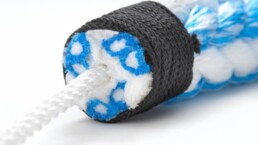
In addition, we are often tasked to test samples of ropes that have failed. The results are alarming in that none have successfully passed our tests. Fig. 1 below shows one such sample incorporating a snap-back prevention device that did not function on the vessel and, in laboratory testing, broke simultaneously with the main rope thus failing to reduce snap-back forces.

To prevent this risk, it is essential to prioritize the use of established and verified solutions such as the genuine SBA™ by Wilhelmsen.
Setting the standard
In November 2022, classification society DNV awarded Wilhelmsen’s SBA™ a statement of qualified technology (Fig. 4), following successful completion of an extensive testing program. This was the first and only time an SBA solution has been recognized by any class society.
The stringent testing protocol comprised different real-world scenarios validate the robust functionality of the technology and identify all possible failure modes. Specific conditions included but were not limited to wet and dry states, varying degrees of contamination, as well as different angles and compression scenarios.
All the tests were conducted in accordance with the DNV-RP-A203 Qualification Procedure for New Technology (industry-recommended practice for qualifying new technology) and were comprehensively reviewed and witnessed by DNV throughout.

SBA™ functionality was subsequently tested in several real-life trials where it showed excellent results compared to ropes without the technology.
Field proven solution
Following the integration of the genuine SBA™ into Wilhelmsen’s mooring portfolio five years ago, it has been thoroughly proven in the field, with over 30,000 SBA™-equipped ropes delivered to vessels around the world. In addition, ship owners, ships’ crews, port terminal personnel and other industry stakeholders have endorsed its effectiveness in preventing potential major accidents.
Our urgent recommendation to vessel operators is that it is crucial to verify that the snap back prevention solution you choose has undergone real-life testing and that the technology has been validated by a third party, typically a class society. Anything less may seriously compromise the safety of vessel crews and shore personnel.
Source: Wilhelmsen



Related News.
RINA’s Hellenic Technical Committee puts energy-efficient newbuilding design and AI in focus
Project Mermaid, battery integration and practical AI applications highlight opportunities for more efficient ship design and fleet operations…
From mine to market – NORDEN connects Comilog’s manganese ore with global markets
NORDEN’s dedicated transhipment operation in Gabon, run under a long term contract with long-standing customer Comilog, has loaded more than 54…
Oldendorff reflags two capesize vessels to Germany
Oldendorff Carriers is reflagging two of its Capesize bulk carriers to Germany, underlining the company’s long standing ties to the country and its…

AskChief surpasses 100-vessel milestone in under a year and opens its specialised maritime AI to the wider market
Putting each company’s own knowledge to work for maritime Technical and HSQE teams. AskChief, Specialised AI for maritime Technical and HSQE…

Dalian Maritime University’s Yu Jiajia receive 2027 IMO Gender Equality Award
From the bridge to the classroom, Ms Yu has helped build a more inclusive maritime sector in China, serving as a role model for the global maritime…
“K” LINE releases video update on forecasts for FY2026 and progress of the medium-term management plan
Kawasaki Kisen Kaisha, has released a video on its official website explaining its forecasts for FY2026 and progress of its Medium-Term Management…
 …
MOL and MOL CAREER sign 3-way deal with Nagasaki Prefecture to promote recruitment and retention of foreign workers
Mitsui O.S.K. Lines, and MOL CAREER, have entered into a tripartite partnership agreement with Nagasaki Prefecture to promote the revitalization of…
Hapag-Lloyd completes acquisition of 25% stake in APM Terminals Maasvlakte II
Transaction successfully completed following antitrust approval Investment strengthens Hapag-Lloyd’s terminal portfolio and position in Rotterdam…
11th chainPORT annual meeting at Tanger Med Focuses on scaling AI in ports
Representatives from leading ports around the world gathered in Tangier, Morocco, on 29 and 30 October for the 11th chainPORT Annual Meeting, hosted…
Subscribe to our newsletter!
if you dont want to swim alone in the ocean of news, sign up for the newsletter, and you will receive daily all the important news of world shipping!
