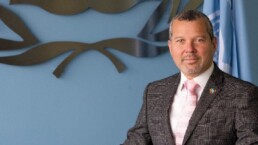

Incoming IMO Secretary-General Arsenio Dominguez speaks to ICS Leadership Insights about his vision for a more outwardly-facing industry and regulator – and how that can help steer shipping through a period of dramatic change.
You are beginning your role of Secretary-General of IMO during what is one of the biggest transitions it has seen in a very long time. What are your core goals and where do you see the challenges ahead?
Decarbonisation is by far the biggest challenge that the International Maritime Organization (IMO) has faced in recent decades. It’s not something that we can do in isolation and is very much in sync with safety, automation, and human element aspects. The decision that the IMO took last July demonstrated the pathway to get to decarbonisation. And that, as well as all these other aspects, will involve players beyond the maritime sector.
Trade may change as well in response to this challenge. But we shouldn’t be afraid to face them and target the opportunities. The reality is that change is not something that maritime has probably always seen as a good thing. But for the future of IMO, we need to demonstrate that change is good and necessary to meet the demands of an evolving world and an evolving shipping sector.
Can you tell us more about how you see IMO’s role evolving in some of its other core areas of responsibility?
The human element and safety continue to be paramount for IMO and probably haven’t received the same level of outside attention as the green agenda in recent years. But the reality is that the IMO was born on safety. The main players are the seafarers, who are such a driving force of this beautiful industry, and we probably haven’t brought them in as much as required into the discussions.
We are going into the STCW Convention revision, which of course is going to take into account both the need for decarbonisation and the way that technologies can support the quality of life for seafarers onboard vessels. It also needs to be recognised that even within the environmental regulations, nothing actually can be put in place that will compromise safety, particularly of seafarers.
Do you think that shipping is sufficiently prepared to cope with recent geopolitical issues and potential ‘black swan’ events? What can be done to improve shipping’s resilience?
I learned during the pandemic how insular we sometimes are in shipping; not everybody was aware of how important shipping is, even some of the United Nations (UN) agencies. If we really want to highlight our importance, as we did during the pandemic, we need to promote ourselves, our industry, and how essential we are, continuously, before major ‘black swan’ events even happen, not during when our voice could be lost in the crowd.
We also need to look at how actions and decisions made outside shipping can be used positively so the industry is not always working in isolation. Part of my vision is that IMO can lead by example with the measures we take internally, such as our internal goals on diversity and inclusion, and then work with member states to demonstrate changes that can actually support this transition. Similarly within the UN, I would like IMO to be one of the agencies that can lead the way, setting an example of how we cooperate with others. We have navigated challenges in the past, including geopolitical situations, and we can continue to do our part to keep trade flowing in a safe and environmentally sound manner, and play our part in contributing towards finding global solutions.
How can shipping close the gap between commercial operating conditions and the requirements of decarbonisation, to marry those two realities together?
It’s important to always listen to commercial concerns and that we always have the objective of a level playing field. But there is a realisation required that we are not all at the same level and do not all have the same capability. So we need early movers that can share experience with others to bring everyone to the stage where we all contribute. Understanding what actions need to be taken for those that are more in need will allow us to move forward, test the areas where we’re still developing, bring back that experience and share it amongst ourselves. In this way, there is productivity even as we continue to develop the regulatory process.
How can IMO support shipping’s decarbonisation journey when some countries have limited resources to implement and enforce IMO regulations? What needs to be done to ensure that we have a just transition?
As we talked about with early movers, it is the same with member states. There are those in a position to act first, to gather information, and it’s about how we translate that. This is constant work that exists within the UN in bridging the gap from north to south and south to south. As someone that comes from a developing country, I know the challenges that are there. The ambitions and the objectives are the same, the realities are slightly different.
One of the key areas that I want to work on is our technical cooperation and capacity building projects, not just to bring on board the maritime sector but also to invite other players. Whenever we go to the different regions and countries, we try to bring onboard the energy sectors, environmental agencies, and other transport sectors, so they better understand what we do.
What is the IMO doing to make sure that seafarers are prepared for these future challenges?
During a recent visit on a ship I had a really good opportunity to speak to a captain, who opened up about the challenges of Covid-19. How seafaring is a career that he really loves, but during the pandemic it became a challenge for him to promote it. He talked about how he felt a lot more could be done and then he stopped talking because he thought he would be blacklisted from IMO. But on the contrary, this is what we need to be faced with, not just what we’ve thought up inside this building but what we get from the people out there that are actually using our regulations.
Shipping is a career like no other. We need to work better on the rights of seafarers. It is important to bring them to the table. We need to look into how we make the life of the seafarer better, but that doesn’t come from us sitting in our offices, it comes from dialogue and using their personal experiences on board the vessels.
How is IMO looking to harness new technology to improve the safety of shipping in general? Do you think a bold target like aiming for zero accidents will ever be feasible?
Stopping accidents is a goal of the IMO. We need to be assured that we are adopting the right technologies for the right reason. We started with navigation and SOLAS, now we’re evolving the STCW Convention, which gives us another opportunity to see what else can reduce human error. It’s also important to enhance the analysis of casualty investigations and transparency in reporting of safety incidents. Over the years we’ve talked about big data, but sometimes the data is difficult to obtain.
When it comes to accidents and analysis, I support the kind of approach others take, for example the airline industry, and give ourselves a target to reduce accidents – and yes, even aim for zero accidents. It’s a welcome approach and we need to focus on the right technology to get us there.
And finally as the figurehead for shipping’s regulatory body, what concerns keep you up at night?
Rather than worries or concerns keeping me up at night, it is actually all the thoughts that I have to make IMO better, to make the maritime community better. Shifting the IMO to a more forward-looking one; a diverse entity that takes on board constructive criticism and looks to engage better with everyone. So what keeps me up at night really is just thinking, what else can we do? As good as we are, we can always be better.
Leadership Insights newsletter story



Related News.
RINA’s Hellenic Technical Committee puts energy-efficient newbuilding design and AI in focus
Project Mermaid, battery integration and practical AI applications highlight opportunities for more efficient ship design and fleet operations…
From mine to market – NORDEN connects Comilog’s manganese ore with global markets
NORDEN’s dedicated transhipment operation in Gabon, run under a long term contract with long-standing customer Comilog, has loaded more than 54…
Oldendorff reflags two capesize vessels to Germany
Oldendorff Carriers is reflagging two of its Capesize bulk carriers to Germany, underlining the company’s long standing ties to the country and its…
AskChief surpasses 100-vessel milestone in under a year and opens its specialised maritime AI to the wider market
Putting each company’s own knowledge to work for maritime Technical and HSQE teams. AskChief, Specialised AI for maritime Technical and HSQE…
Dalian Maritime University’s Yu Jiajia receive 2027 IMO Gender Equality Award
From the bridge to the classroom, Ms Yu has helped build a more inclusive maritime sector in China, serving as a role model for the global maritime…
“K” LINE releases video update on forecasts for FY2026 and progress of the medium-term management plan
Kawasaki Kisen Kaisha, has released a video on its official website explaining its forecasts for FY2026 and progress of its Medium-Term Management…
 …
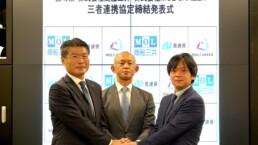
MOL and MOL CAREER sign 3-way deal with Nagasaki Prefecture to promote recruitment and retention of foreign workers
Mitsui O.S.K. Lines, and MOL CAREER, have entered into a tripartite partnership agreement with Nagasaki Prefecture to promote the revitalization of…
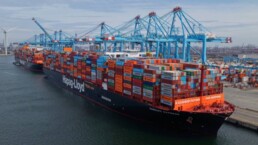
Hapag-Lloyd completes acquisition of 25% stake in APM Terminals Maasvlakte II
Transaction successfully completed following antitrust approval Investment strengthens Hapag-Lloyd’s terminal portfolio and position in Rotterdam…
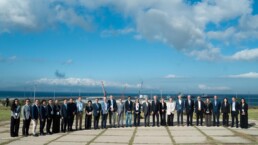
11th chainPORT annual meeting at Tanger Med Focuses on scaling AI in ports
Representatives from leading ports around the world gathered in Tangier, Morocco, on 29 and 30 October for the 11th chainPORT Annual Meeting, hosted…
Subscribe to our newsletter!
if you dont want to swim alone in the ocean of news, sign up for the newsletter, and you will receive daily all the important news of world shipping!
