MacGregor GravityVibeTM a new gravity self-unloading system enhances flexibility and efficiency in bulk handling
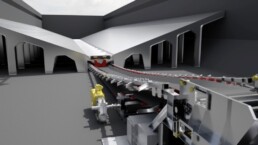

MacGregor, part of Cargotec, has launched a new and augmented gravity self-unloading system that will allow bulk carriers to deliver a wider variety of cargo, in greater volume. The new system, the ‘MacGregor GravityVibeTM’, deploys a patent-pending vibrating unloader to reduce internal friction and ease the discharge of coarse materials such as wood chips from the cargo hold.
While the automated unloading sequence remains a gravity-based operation, the MacGregor GravityVibeTM includes vibrating panels to shift the remnants or break the ‘bridges’ that form when coarse material sticks together to block the outlet. Crucially, the vibrating panels are isolated from the hull structure – using a solution from MacGregor on which a patent is pending – to minimise the transfer of vibrations and noise to other parts of the vessel.
In contrast with a standard gravity self-unloading configuration, where slope angles range from 35 to 60 degrees depending on the material, the MacGregor GravityVibeTM can discharge various cargo types with slope angles of just 15–20 degrees. Since steep slope angles limit hold volume, the system therefore increases not only the variety of cargo types a vessel can handle but also its cargo capacity. The additional capacity also translates into lower carbon dioxide emissions per carried tonne of cargo.
“Bulk carrier cargo holds are typically designed to handle a specific kind of material, meaning the ship owner is somewhat limited in the type of assignments they can take on,” said Mikael Hägglund, Sales Manager, Self-unloading systems and Cranes, MacGregor. “The MacGregor GravityVibeTM overcomes these limitations to afford owners greater flexibility when taking on new contracts, and it also boosts earning potential and environmental performance by optimising cargo capacity.”
Whereas large sized conventional self-unloaders feature two longitudinal and two transfer conveyors, the MacGregor GravityVibe’s low slope angles also mean that it functions with just one longitudinal conveyor. With fewer components installed, the required maintenance and spare-parts will be low when compared with conventional self unloading systems. The streamlined set-up also minimises spillage and the need for cleaning, meaning less work and improved safety for crew. With its increased efficiency and reduced complexity, the MacGregor GravityVibeTM solution provides a highly cost effective alternative to traditional solutions.
“As the culmination of decades of experience in self-unloading systems and years of targeted research, the MacGregor GravityVibeTM is our most advanced self-unloader yet,” said Tomas Wallin, Senior Product Owner, Self-Unloaders, MacGregor. “We developed the system according to established best practice, using textbook understanding of material behaviours in combination with a decisive innovation on how to handle cargo types with different properties. We have also tested it in collaboration with leading research centres and technology area experts.”
MacGregor will be offering customers the opportunity to validate the GravityVibe’s handling of their chosen materials in full-scale mock-up demonstrations at the company’s test facilities.



Related News.

Columbia Group calls for greater focus on retaining women at sea as second She Beyond Conference takes place
Columbia Group has called on the maritime industry to create a future where women can thrive, progress and lead at sea, as it celebrated the second…
Neptune Group Welcomes “NIKOS TRAVLOS”
The new vessel proudly bears the name of Neptune's founder, who laid the foundation for the creation and enduring evolution of the Group. Her…

Wildcat Defense enters into exclusive agreement to acquire Fraser Shipyards
American family firm takes the next step in its strategy to rebuild U.S. shipbuilding and repair capacity, following its offer for Austal USA.…
Kawasaki signs strategic partnership MOU with Romania’s Transgaz for Onshore Hydrogen Gas Transport
Establishing a model for large-scale hydrogen supply and transport via pipelines Kawasaki Heavy Industries, announced at the Romania–Japan…

UK P&I Club and TT Club secure regulatory approval for Thomas Miller acquisition
The UK P&I Club and TT Club announce the successful completion of their joint acquisition of the Thomas Miller Holdings group, marking a major…

Valenciaport presents its Sandbox at PEIC’26 as a tool to bridge the gap between innovation and implementation
The opening session featured a discussion between Valenciaport President Mar Chao and Valenciaport Foundation Director Antonio Torregrosa. The…

Major investments strengthen Gothenburg RoRo Terminal
Expanded terminal areas, new rail connections and modernised quays are among the investments that have strengthened Gothenburg RoRo Terminal in…

ABP appoints key roles in the Humber
Associated British Ports has made two key appointments at its container terminals strengthening its unitised operations at the ports of Immingham…

Xinhua Silk Road 2026 North Bund Forum unveils 20 shipping-related achievements
The 2026 North Bund Forum opened in Shanghai on October 20 with 20 key shipping-related achievements spanning international cooperation, green…
Ports encouraged to prepare now for advanced nuclear in maritime and clean energy
New joint Lloyd’s Register and British Ports Association paper sets out a practical readiness pathway for ports considering nuclear-powered vessels,…
Subscribe to our newsletter!
if you dont want to swim alone in the ocean of news, sign up for the newsletter, and you will receive daily all the important news of world shipping!
