NYK signed contracts for construction of ammonia-fueled Ammonia Gas Carrier

Japanese technology pioneering the future — Aiming for vessel completion by November 2026
Nippon Yusen Kabushiki Kaisha , Japan Engine Corporation, IHI Power Systems and Nihon Shipyard signed a series of contracts to construct the world’s first ammonia-fueled medium gas carrier equipped with Japan-made engines. The completion of the vessel will be a significant step toward the realization of decarbonization in the maritime sector. In October 2021, the four companies were selected by Japan’s New Energy and Industrial Technology Development Organization for its Green Innovation Fund Project,* and together with Nippon Kaiji Kyokai , a partner organization, the five parties (hereafter referred to as “the Consortium”) have been working on “a demonstration project for the commercialization of vessels equipped with a domestically produced ammonia-fueled engine” (the “Project”). Under the slogan “Changing the future of the sea and the future with Japanese technology,” Japan’s maritime industry is now in full swing to lead the world with the AFMGC toward its completion in November 2026.
1. Background and Goals
i. Contributing to the Achievement of Net-Zero Emissions in International Shipping
To achieve net-zero emissions in international shipping, switching from conventional fossil fuels to optimal next-generation fuels is essential. Since ammonia does not emit carbon dioxide (CO₂) during combustion, it is expected to be a next-generation fuel that contributes to preventing global warming. Through the development and construction of the AFMGC, the Consortium will contribute to the practical application of ammonia-fueled ships.
ii. Building an Ammonia Value Chain
Ammonia, which has traditionally been chiefly used for fertilizer and other chemical raw material applications, is expected to be used for co-firing in thermal power plants and as a hydrogen carrier, ** and demand for ammonia is expected to grow rapidly in Japan and overseas. At the same time, demand for ammonia production and marine transportation will also increase, and an ammonia value chain is expected to be established sequentially. Based on the belief that establishing a cleaner, less environmentally burdensome ammonia value chain is indispensable for realizing a decarbonized society, the Consortium will work to complete and popularize the AFMGC and other ammonia-fueled ammonia carriers.
iii. Strengthening Japan’s Maritime Industry
Surrounded by the sea, Japan depends on maritime transportation for more than 99% of its imports and exports of resources and food (by weight). The maritime industry is essential to Japan’s economic security. The maritime industry includes shipping companies that operate ships, shipbuilders that supply transport vessels, and marine equipment manufacturers, all of which are working to maintain and strengthen their international competitiveness. The consortium sees fuel conversion to achieve zero emissions as an opportunity and aims to use the technological capabilities of the Japanese maritime cluster to supply ships with high environmental performance and safety ahead of other countries.
iv. International Rulemaking for Marine Use of Ammonia
International rules for ships using ammonia as fuel are not yet in place, and the International Maritime Organization (IMO) is currently discussing the issue. This Project is one of the first to develop ammonia-fueled ships, and the knowledge gained from the construction and operation of AFMGCs will be essential to the progress of discussions at the IMO. The Consortium aims to work closely with ClassNK and Japan’s Ministry of Land, Infrastructure, Transport and Tourism (MLIT) to contribute actively to international rulemaking.
2. Vessel Overview
| Type | 40,000 m³ type ammonia fuel ammonia carrier |
| Planned delivery date | November 2026 |
| Shipbuilder | Japan Marine United Corporation, Ariake Shipyard |
| Engines | 1. Main engine: ammonia fuel dual-fuel two-stroke engine produced by Japan Engine Corporation
2. Auxiliary engine: ammonia fuel dual-fuel four-stroke engine produced by IHI Power Systems The main engine is an engine that turns a propeller to propel the ship. |
| Major technical development elements | 1. Development of ammonia fuel dual-fuel engine Ammonia fuel dual-fuel engines must co-fire ammonia with fuel oil as pilot fuel. On the other hand, a high ammonia co-firing ratio is required to achieve a high GHG reduction rate. The consortium aims to achieve the following co-firing rates:■ Main engine: an ammonia fuel mixed combustion rate up to 95% ■ Auxiliary engine: an ammonia fuel mixed combustion rate of 80% or more ■ Entire ship: GHG reduction rate of 80% or more 2. Development of ammonia-fueled carrier |
Vessel image
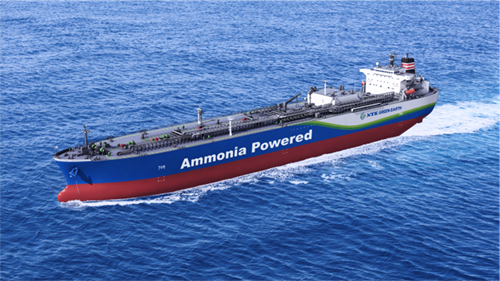
3. Challenges and Progress
| Flame retardancy of ammonia | Because ammonia is a flame retardant, developing advanced technologies for stable combustion in engines is necessary. |
| Treatment of nitrous oxide (N2O), a greenhouse gas | Nitrous oxide (N2O), which has a greenhouse effect of approximately 265 times that of CO2, may be generated during ammonia combustion. Technology is needed to reduce and treat nitrous oxide emissions. |
| Ammonia toxicity | Because ammonia is toxic, the vessel must be designed to prevent leakage from the piping and tanks. Even in the event of leakage, measures must be taken to protect the safety of the ship’s crew. |
ii. Past Progress and Accomplishments
The four companies designed a prototype vessel that overcame these challenges, and the prototype vessel obtained an Approval in Principle (AiP) in September 2022 after a safety verification process that included confirmation of the safety concept and risk assessment by ClassNK. The acquisition of AiP is in anticipation of the approval of an alternative design. After further research and development, the consortium determined that the prototype ship had reached a level sufficient for social implementation, particularly in safety and environmental friendliness, and decided to build the ship.
iii. Safety
To overcome toxicity, the biggest challenge for marine fuels, the consortium conducted a risk assessment review by ClassNK and a risk assessment and safety measures proposal from the user’s point of view led by NYK’s engineers. The consortium reflected safety measures based on these risk assessments in the ship’s specifications to improve the ship’s safety further. Based on the findings from this Project, ClassNK published safety guidelines for ammonia-fueled ships. The consortium proposed the draft safety requirements, a world-leading initiative, for future collaboration with other companies to the IMO through Japan’s Ministry of Land, Infrastructure, Transport and Tourism.
iv. Environmentality
In May 2023, IHI Power Systems achieved the world’s first stable combustion of fuel ammonia at an 80% co-firing rate with fuel oil in a 4-stroke engine that is planned to be used as an auxiliary engine for an AFMGC. This experiment confirmed that emissions of nitrous oxide (N2O) and unburned ammonia from the engine were virtually zero and that there was no ammonia leakage during operation and after shutdown. In the same month, Japan Engine Corporation began mixed firing operations on a large, low-speed, two-stroke engine to optimize engine performance and verify safety. Based on the data obtained from these demonstrations, the consortium has determined that it is generally on track to achieve sufficient environmental performance by the engines. The consortium will continue further research and development with the ultimate target of achieving 80% or more GHG reductions for the entire fleet.
4. Future Schedule
Toward the completion of the vessel in November 2026, the consortium will manufacture the main and auxiliary engines, begin detailed studies for the vessel’s construction, and prepare an operation manual for actual operation. After the ship is completed, the consortium will continue to operate the vessel for demonstration purposes to confirm the vessel’s performance, including environmental friendliness and the practicality of the operation manual, and to provide user feedback to shipbuilders and marine equipment manufacturers for further improvements. We will strive to build a development cycle as a “first mover” in developing ammonia-fueled vessels.



Related News.
Intelligent Skies, Secure Seas: Navigating Connectivity, Cyber Resilience, and AI Liability at the 5th CSN Greece ICT Conference
The 5th CSN Greece ICT Conference, held on 19th November 2026 at the Ploes Floating Venue in Paleo Faliro, Athens, successfully convened maritime…

EU moves to ban tankers insured in Russia, repair services at Russian refineries
EU targets Russian-insured tankers, refineries Von der Leyen announces 22nd sanctions package All 27 member states must approve new…
IMO tackling fraudulent registries together
Strong national systems and international information sharing are crucial to tackling fraudulent registries and fraudulent ship registration…
Open letter on freedom of navigation and the protection of seafarers
Dear High Representative Kallas, Dear Foreign Affairs Ministers, European Shipowners | ECSA, BIMCO, the Cruise Lines International Association…
Davies Turner warns of Rising Asia-UK Container Disruption and European Port Congestion
Davies Turner, one of the UK’s largest independent freight forwarding and logistics companies, says that disruption to container shipments from Asia…
Disruptions still dominate tanker market outlook
"This year, tanker markets have been affected by disruption to transits through the Strait of Hormuz, the Houthi blockade of Saudi Arabian Red Sea…
Panama’s President called on to match COP31 Heroism with action at shipping climate talks
As a series of crucial meetings tasked with cutting greenhouse gas emissions from global shipping takes place this week and next, environmental NGOs…

Trafigura appoints Helio Cumbi as Executive Director, Mozambique
Trafigura has appointed Helio Cumbi as Executive Director, Mozambique, and Business Development Lead for East and Southern Africa Oil. Helio is a…
“K” LINE holds FY2026 Global Dry Bulk Meeting
Kawasaki Kisen Kaisha, announces that it held a global meeting for its dry bulk business at the company’s head office on November 9 and 10. The…
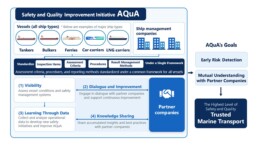
MOL launches ‘AQuA’ safety and quality improvement initiative
Standardizing Group-wide Safety and Quality Assessment Criteria to Enhance Vessel Safety and Quality Mitsui O.S.K. Lines, announced the launch of…
Subscribe to our newsletter!
if you dont want to swim alone in the ocean of news, sign up for the newsletter, and you will receive daily all the important news of world shipping!
