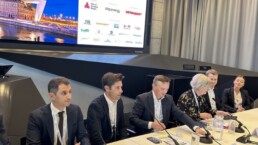

At the Marine Energy Transition Forum in Antwerp this week, Stolt Tankers’ sustainability expert outlined how the business’s carbon-insetting programme is helping to reduce Scope 1 emissions and supporting its customers to lower emissions within their own supply chains.
Giorgio Guadagna (picture above, far left), Stolt Tankers’ Business Partner – Sustainability and Decarbonisation, explained that the programme has the potential to lower fuel lifecycle emissions by more than 75%* and is supporting participants to achieve their respective sustainability goals.
For Stolt Tankers, this includes realising its ambitions to reduce its carbon intensity by 50%(relative to 2008) and operate at least one carbon-neutral ship by 2030, and to be fully carbon neutral by 2050.
“Carbon insetting allows us to share the cost of biofuels with participating partners, which will help lower both our Scope 1 emissions and their Scope 3s,” Giorgio says. “This has almost become standard practice in container shipping, but is still relatively new for tankers.
“Essentially, the programme gives our customers (and interested stakeholders) the opportunity to contribute to the additional cost of more sustainable fuels, even if their cargo is not physically on the ship where this type of fuel is used. Given the cost and limited availability of biofuels, this approach allows us to increase our chances of making biofuels a viable option and using them more widely.”
The programme is specifically looking at FAME-based (fatty acid methyl ester) biodiesel, which is best suited to the engines on Stolt Tankers’ ships. The fuel must also be ‘second generation’ meaning it is produced from waste, and ISCC certified to ensure its sustainability credentials.
To date, Stolt Tankers has used 3,000 tonnes of this biofuel on a small number of ships completing voyages between Europe and the US. And there are plans to use it on more voyages before the end of this year and in early 2024.
Multiple independent third parties are being used to verify the resulting reductions in CO2 and certify shipments as carbon neutral.
“Biofuels do not dramatically change our onboard tank-to-wake emissions – that is, those that come from using fuel once it is in the tank,” Giorgio explains. “But they do allow us to significantly lower emissions over the lifecycle of the fuel – from its production until it is actually used – by more than 75%*.”
And while biofuels are not widely seen as a long-term solution – not least because limited feedstocks are likely to create a bottleneck in their production – they are certainly part of the solution and are providing Stolt Tankers with an invaluable training ground for the future.
“For now, biofuels are a way for us to reduce our impact on the environment and progress towards our decarbonisation targets,” says Giorgio. “And, by setting up our insetting platform and learning how to do this effectively today, we will be well positioned in the future when new green fuels become available and related tracking technologies are introduced.”



Related News.
Beyond Technical Skills: WISTA Cyprus explores the human side of leadership
WISTA Cyprus hosted The Art of Leadership & Emotional Mastery, an interactive workshop held on 15 October at the Alasia Hotel in Limassol,…
The human cost of sending merchant mariners into war zones extends far beyond the immediate danger of missiles and drones. It raises a harder question: who is really protecting the seafarer?
Who protects the seafarer? I have spent much of my professional life at sea. I am a Master Mariner. I have stood on the bridge, made decisions…
Loss of bridge control: Human failure is normal – context is key
When bridge control is lost in a functioning system, it can be easy to blame human error. But accidents rarely happen because of one mistake…

Danish Shipping announces the transport of live animals by sea new rules should improve safety for animals, seafarers and the environment
Revised rules on the transport of live animals by sea are being negotiated in the EU. Danish Shipping wants to ensure good animal welfare,…

Japan’s flawed shipping proposal leaves developing countries adrift
A new analysis by Opportunity Green warns governments of the wide-ranging risks posed by Japan’s proposal at the International Maritime Organization…

Intermodal Report Week 42 2026
Pls find below the Intermodal Report - Week 42 2026 Intermodal Report Week 42 2026

Allied Weekly Market Review Week 42
Pls find below the Allied - Weekly Market Review - Week 42 ALLIED - Weekly Market Report- Week 42
EU Arctic Strategy NGOs welcome EU ambition on on cutting shipping’s Arctic Black Carbon Emissions
Responding to today’s publication of the EU’s Arctic Strategy, which definitively states the EU’s intention to support International Maritime…

The final quarter of 2026 is expected to see softer bauxite flows
Chinese front-loading is expected to have run its course, pointing to softer bauxite flows in 2026 Q4. Global bauxite flows increased by 2.8% y/y…
DP World Foundation and Belewan new container terminal mark groundbreaking of AED 3.7 million school project in Indonesia
Classrooms of Hope initiative expands to Belawan, Medan with a new junior high school designed to provide modern learning facilities and greater…
Subscribe to our newsletter!
if you dont want to swim alone in the ocean of news, sign up for the newsletter, and you will receive daily all the important news of world shipping!
