Israel-Palestine conflict set to create challenges in maritime industry while trade continues with caution

The Israel-Palestine conflict, marked by recent violence between Israel and Hamas, has sent ripples through the shipping and
maritime industry, leading international companies to issue cautionary advisories and adapt their operations in the region.
“In light of recent developments in the Middle East, including the outbreak of war in Israel and its vulnerability to missile attacks and the incursion of opposing militias, the security of transporting goods through the port of Haifa has become uncertain. The transit of containers, especially hazardous materials, and the arrival of commercial vessels greatly emphasize the importance of security on this route. Such insecurity or potential terrorist attacks could lead to a shift in the transportation of goods,” said Hossein Norouz Fashkhami, a senior marketing expert from Middle East.
Shipping industry’s resilience amidst Israel-Palestine conflicts
Maersk, a major player in the industry, reassured stakeholders by announcing that its port operations across Israel’s key terminals are functioning without disruption. MSC echoed this sentiment, asserting that Israel’s major terminals are operational, enabling them to facilitate cargo delivery.
However, the maritime industry is aware of the security situation, and companies such as MSC remain vigilant, pledging to monitor the situation closely and heed government guidance. This underscores the industry’s adaptability and resilience in the face of geopolitical tensions.
The specific impact on individual ports tells a compelling story:
- Port of Ashdod: This port, situated a mere 50 kilometers from the Gaza border, operates in an ’emergency mode’ only, subject to potential missile attacks. Furthermore, restrictions on vessels carrying Hazardous Materials (“HAZMAT”) remain in effect.
- Port of Haifa: In contrast, the port of Haifa, encompassing the Haifa Bay port and Israel shipyard, continues with business as usual, undeterred by the conflict.
- Port of Ashkelon: Located just 15 kilometers from the Gaza border, the Port of Ashkelon is severely impacted, rendering it incapable of normal operations due to missile threats. Vessels can only discharge cargo while moored at sea buoys, highlighting the risk and necessity for adaptive measures.
- Port of Hadera: The port of Hadera, in comparison, carries on without disruption, maintaining its regular functions.
- Port of Eilat: The port of Eilat similarly remains operational, showcasing the industry’s commitment to ensuring the flow of maritime trade.
Beyond the ports, several global companies with a presence in Israel have been forced to adjust their operations. Chevron, the second-largest U.S. oil and gas producer, was directed by Israel’s energy ministry to shut down the Tamar natural gas field off the country’s northern coast. Adani Ports, operator of the Haifa Port, assured stakeholders of operational readiness while closely monitoring the situation and having a business continuity plan in place.
The Israel-Palestine conflict serves as a testament to the shipping and maritime industry’s ability to adapt, demonstrating that despite challenges and disruptions, trade and operations can persist, albeit with the necessary caution and vigilance.
Global trade relationships hang in the balance, with disruptions, diplomacy, and dollars at stake
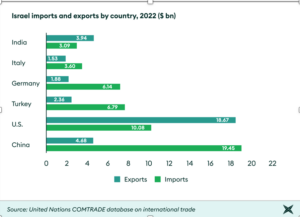
Israel’s trade with China is characterized by a notable trade imbalance, with China being a major importer of Israeli goods. While Israel’s exports to China are substantial at $4.68 billion, the conflict may disrupt trade flows, particularly concerning Israel’s high-tech exports. The disruption could affect Israel’s exports and potentially hinder access to China’s vast market.
The United States is a critical trade partner for Israel, with a strong focus on exports. Israel exports goods worth $18.67 billion to the U.S., including high-tech products and defense-related items. The conflict may strain diplomatic relations between the two countries, potentially impacting Israeli exports to the U.S.
Germany is a key European trade partner for Israel. The conflict might impact Israel’s exports to Germany, valued at $1.88 billion. As Israel navigates regional instability, German imports from Israel could be affected.
India is another crucial trading partner for Israel, with $3.94 billion in Israeli exports. The conflict could have an impact on bilateral trade, potentially leading to disruptions in Israel’s exports to India.
Uncertainties surrounding ambitious trade initiatives
“The Israel-Palestinian conflict serves as a reminder of the uncertainties facing ambitious trade projects like the India-Middle East-Europe Economic Corridor (IMEC), positioned as a Western counterpart to China’s Belt and Road” said Christian Roeloffs, cofounder and CEO, Container xChange.
IMEC, involving railways, ports, and green energy, aligns with the G7’s plans to mobilize $600 billion by 2027 for global infrastructure investments. India’s trade with Saudi Arabia has doubled in two years, reaching $53 billion in 2023, but the corridor’s true potential lies in strengthening Indian-European trade ties.
To fully realize IMEC, a reliable link between Saudi Arabia and Israel is essential. However, the ongoing regional complexities make it riskier for Saudi Crown Prince Mohammed bin Salman to normalize diplomatic relations with Israeli Prime Minister Benjamin Netanyahu.
In the near term, the Suez Canal remains the primary route for goods from India to Europe. This conflict underscores the enduring complexities of reshaping global trade and financial routes, highlighting the unpredictable nature of such endeavors.
Geopolitical conflicts and global health crises, unfortunate as they are, often lead to unintended consequences, boosting profits in specific sectors. Wars tend to inflate returns for defense contractors, while the pandemic brought substantial gains for select pharmaceutical companies. The maritime industry is not immune to these dynamics, with shipowners reaping unexpected benefits from both types of crises.
Christian Roeloffs added – “In the case of the conflict in Israel, any expansion of the hostilities beyond the country’s borders could introduce risks to two vital shipping choke points. The Suez Canal, a critical waterway for various commercial vessels, including container ships, may face disruptions. Similarly, the Strait of Hormuz, a backbone for oil and gas shipping, could be affected. However, the extent of these effects will largely depend on the conflict’s expansion and duration.”
It’s worth noting that Israel itself represents a relatively small market for container shipping, with its primary ports of Ashdod and Haifa accounting for just 0.4% of global throughput. Consequently, the threat of disruptions to container trade flow through the Mediterranean region remains limited.
Additional Information
India-Israel exports, costs, and risk management amid conflict
Key Indian exports to Israel include diesel, cut and unpolished diamonds, electronics, and telecom components like integrated circuits and photovoltaic cells. Conversely, India’s imports from Israel consist mainly of rough diamonds, fertilizers, and herbicides. This evolving trade relationship extends beyond traditional sectors, encompassing electronic machinery, high-tech products, communication systems, and medical equipment.
Higher costs for Indian exporters: The Israel-Hamas conflict has raised concerns about increased costs for Indian exporters, such as higher insurance premiums and elevated shipping expenses. These expenses stem from the heightened risk associated with shipping goods to regions experiencing geopolitical unrest.
Limited impact on trade volumes but financial strain on exporters: While the conflict may result in higher expenses for Indian exporters, the impact on trade volumes is expected to be limited unless the war escalates significantly. The primary concern is the financial burden on exporters, which may reduce their profit margins.
Risk Premiums from ECGC to Safeguard Indian Businesses: To protect Indian businesses from potential losses due to geopolitical uncertainties, India’s Export Credit Guarantee Corporation (ECGC) may introduce higher risk premiums for firms exporting to Israel. This is a standard risk management practice in regions facing increased instability.
While the Israel-Hamas conflict has the potential to increase shipping costs and insurance premiums for Indian exporters, it is essential to emphasize that the impact on trade volumes remains relatively limited at this stage. The bilateral trade relationship between India and Israel has diversified in recent years, encompassing various sectors beyond diamonds and petroleum products.



Related News.

Beyond Technical Skills: WISTA Cyprus explores the human side of leadership
WISTA Cyprus hosted The Art of Leadership & Emotional Mastery, an interactive workshop held on 15 October at the Alasia Hotel in Limassol,…
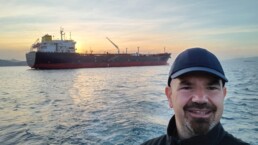
The human cost of sending merchant mariners into war zones extends far beyond the immediate danger of missiles and drones. It raises a harder question: who is really protecting the seafarer?
Who protects the seafarer? I have spent much of my professional life at sea. I am a Master Mariner. I have stood on the bridge, made decisions…

Loss of bridge control: Human failure is normal – context is key
When bridge control is lost in a functioning system, it can be easy to blame human error. But accidents rarely happen because of one mistake…

Danish Shipping announces the transport of live animals by sea new rules should improve safety for animals, seafarers and the environment
Revised rules on the transport of live animals by sea are being negotiated in the EU. Danish Shipping wants to ensure good animal welfare,…

Japan’s flawed shipping proposal leaves developing countries adrift
A new analysis by Opportunity Green warns governments of the wide-ranging risks posed by Japan’s proposal at the International Maritime Organization…

Intermodal Report Week 42 2026
Pls find below the Intermodal Report - Week 42 2026 Intermodal Report Week 42 2026

Allied Weekly Market Review Week 42
Pls find below the Allied - Weekly Market Review - Week 42 ALLIED - Weekly Market Report- Week 42
EU Arctic Strategy NGOs welcome EU ambition on on cutting shipping’s Arctic Black Carbon Emissions
Responding to today’s publication of the EU’s Arctic Strategy, which definitively states the EU’s intention to support International Maritime…

The final quarter of 2026 is expected to see softer bauxite flows
Chinese front-loading is expected to have run its course, pointing to softer bauxite flows in 2026 Q4. Global bauxite flows increased by 2.8% y/y…

DP World Foundation and Belewan new container terminal mark groundbreaking of AED 3.7 million school project in Indonesia
Classrooms of Hope initiative expands to Belawan, Medan with a new junior high school designed to provide modern learning facilities and greater…
Subscribe to our newsletter!
if you dont want to swim alone in the ocean of news, sign up for the newsletter, and you will receive daily all the important news of world shipping!
