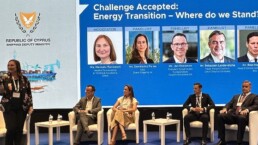

Highlights from day two of the Conference addressing the energy transition, industry transformation and shipbuilding
The second day of the “Maritime Cyprus 2023” Conference took place at the Parklane Resort & Spa in Limassol on Tuesday. Themed Shipping in Action: An Agenda for Change, more than 900 shipping professionals from around the world, originating from more than 35 countries, attended the Conference, organized biennially in Cyprus. Panel discussions and a keynote presentation saw industry experts unpacking issues concerning the energy transition, the transformation of the industry as it continues its path towards decarbonization and the role that shipbuilding plays in the shifting context of the shipping industry.

The first panel discussion, titled “Challenge Accepted: Energy Transition – Where do we Stand?”, was moderated by Ms Manuela Tomassini, Head of Sustainability and Technical Assistance, EMSA, and featured Ms Semiramis Paliou, CEO, Diana Shipping Inc, Mr Jan Dieleman, President, Cargill Ocean Transportation/Cargill International SA, Mr Sebastien Landerretche, Head, Freight Platform, Louis Dreyfus Company, and Mr Roel Hoenders, Head of Climate Action and Clean Air, International Maritime Organization (IMO).

“We must be open minded when discussing the energy transition,” said Ms Manuela Tomassini, opening the discussion. “Energy efficiency is a priority, as are alternative fuels. Most important, though, is filling the knowledge gap, and focusing on supporting investment in the industry to drive us towards our energy transition goals. Adaptability, flexibility, taking full advantage of opportunities, positivity, cooperation, and collaboration will all be crucial to success,” she said, before posing questions to the panel. Mr Roel Hoenders, speaking from the perspective of the IMO, said the organization echoed challenges mentioned yesterday, during the first day of the Conference. He highlighted that focus needs to be put on fuel availability and pricing, as well as the important element of creating energy transition opportunities across the maritime industry. He also acknowledged how the concept of net zero needs to be further defined, and that this will be on the IMO’s agenda moving forward. Ms Semiramis Paliou emphasized the role of seafarers in the energy transition, stressing the importance of increasing the attractiveness of the industry to ensure the resilience and diversity of the next generation of the workforce. She also noted how shipowners need to be incentivized through the energy transition process – “We’re taking risks to move the industry forward. While moving in the right direction, currently available technology is not necessarily optimal.” Commenting on progress made so far, Mr Jan Dieleman said that outcomes of MEPC 80 were positive, but that it was now time to convert discussion into action. “It’s time to raise the bar and move away from our reliance on first movers in the industry. Zero carbon fuels offer huge opportunities in the wider supply chain – let’s take advantage of that,” he said. Mr Sebastien Landerretche noted how shipowners’ relationship with the supply chain must be converted from transactional in nature, to strategic. “We need to develop our understanding of technology and increase collaboration with best-in-class owners to boost progress across the board. Bringing energy players into the value chain will also be crucial,” he concluded.

Following the panel discussion, Ms. Anne Katrine Bjerregaard, Head of Strategy, Sustainability and ESG, Mærsk Mckinney Møller Center for Zero Carbon Shipping took stage with a keynote presentation titled, “The time to act is now – radically transforming an industry by 2050.” Ms. Bjerregaard outlined the worrying progression of climate change, and how we’ve been “living well beyond the nine planetary boundaries” for a while now. “The decisions made at MEPC 80 indicate that we are moving in the right direction. As we press ahead, we must do everything possible to install the maximum amount of energy efficiency technologies throughout the global fleet, if we are to meet minimum climate goals. This requires, too, the installation of carbon capture systems on at least 30% of the fleet,” she remarked. Echoing the thoughts of previous panels, her presentation reiterated the importance of increasing the attractiveness of the industry to talent through robust ESG policies. “Doing good does good for commercial success, and attracting the right people,” she said. On alternative fuels, she commented on the range of fuels in development, emphasizing how it was imperative that shipping creates a significant demand signal for fuels being considered, as other industries begin vying for the same fuels. She explained that regulators, investors, and customers are and will continue to demand change. “The scope of sustainability is widening in shipping, and we are running out of time: transformative action is required. is your company going to be part of this, how you are you going to contribute to the scaling of sustainable fuels?”

The second panel discussion, “The Role of Shipbuilding in an Evolving Shipping Industry”, was moderated by Mr Nick Brown, IACS Chairman, CEO, Lloyd’s Register, and included Mr Konstantinos Stampedakis, Co-Founder & MD, ERMA FIRST, Mr Polys V. Hajioannou, CEO & Chairman, Safe Bulkers, Inc, Mr Chris-Alexander Korfiatis, Vice President, Marine Operations, Royal Caribbean, Mr Mark O’Neil, President, InterManager, Mr Kenneth Tveter, Head of Green Transition, Clarksons, and Mr Stephanos E. Angelakos, CEO, Angelakos (Hellas) S.A. The discussion focused on how shipbuilding is transforming to align with new expectations from customers, which are resulting from existing and incoming regulations. This, complicated by issues relating to undefined climate goals, lack of alternative fuel availability, and the need for additional investment in new technologies.

Mark O’Neil pointed to the global social, governmental, and political factors currently influencing the decarbonization of all industries, and urged a more realistic and pragmatic approach to the decarbonization challenges faced by shipping. “Shipyards facing a level of uncertainty when it comes to the rationale behind building the carbon neutral vessels of the future,” he said, suggesting that focus and funding is shifted more towards company shareholders and voters – who he believes will be the true drivers of global change. Highlighting the increased visibility of the cruise sector compared to other areas of shipping, Mr Chris-Alexander Korfiatis said decisions around newbuilds were dependent on the needs of customers. “With each order, we build ships that are 20-25% more efficient than those delivered previously, using whatever technology is available at the time.” He explained that the strategy places strong emphasis retrofitting, ensuring vessels can be adapted to align with fuels and technologies of the future, which today are still under consideration. Mr Konstantinos Stampedakis thanked the Cyprus Shipping Deputy Ministry for organizing the Conference – “Anyone can organize an event, but creating an atmosphere that fosters open and productive discussion is something that the industry has been missing.” He went on to champion carbon capture and retrofitting as a necessity, suggesting that “updating the existing fleet might be a better green solution in the short term. To support shipping, we must encourage the retrofitting of existing technologies – and continue its development.” Mr Polys Hadjioannou offered encouragement, sharing his optimism around Fuel EU Maritime, which he believes will drive momentum in the transformation of shipbuilding. Commenting as a member of the cruise sector, Mr Chris-Alexander Korfiatis emphasized the importance of maintaining seafarer and cruise passenger safety as shipbuilding develops to align with incoming technologies, regulations & climate goals. Adding to conversation around seafarers, Mark O’Neil warned that the crewing market will be further segmented as the industry trains different groups to handle and operate various vessel types using different alternative fuels. “We’ll need to pay higher salaries to keep these trained personnel on the same vessel types, to decrease ongoing recruitment costs” he said.

Taking place during the afternoon on the second day of the Conference, the Young Executives Session, offered an interactive, capacity-building and problem-solving session for shipping executives under the age of 40. This session was organized in collaboration with Young Ship Cyprus and WISTA Cyprus for young shipping professionals.

Within the framework of creating the necessary environment for young people to be included in, and inspired by, maritime affairs, seek jobs within the industry and provide them with future career development, the session is a forum for young shipping professionals to debate career-related shipping issues and discuss their vision of the industry, opportunities and challenges that stimulate and affect them.



Related News.
Global study finds Cyprus ranks SEVENTH and set for $1.1 billion AI GDP boost
Cyprus beats India and New Zealand to come SEVENTH in major AI study – with potential €1.1 billion GDP boost and youth jobs opportunity Some 86% of…

Global shipping’s trillion dollar climate bill according to Zero Carbon Analytics
A new study by Zero Carbon Analytics finds that emissions from international shipping cost the global economy around USD 963 billion between 1990…

Keeping Children Safe Online at Sea Seafy® earns friendly WiFi Certification across 26 vessels
Seafy becomes Friendly WiFi’s first partner in the maritime sector, helping protect kids from harmful content online. Friendly WiFi is delighted…
ShipManager joins Star Information Systems to accelerate the maritime industry’s transition to cloud
CFARER, a DNV Company selects Star Information Systems as the longterm home for ShipManager and its cloud future Star Information Systems (Star)…
Seafarer experience must shape maritime technology, initial STEER Project report finds
New research finds technology can shift rather than remove risk as The Nautical Institute, with support from Lloyd’s Register Foundation, calls for…
New LR service targets cargo disruption when trade routes fail
New LR Advisory service helps ports, governments and logistics operators respond to disruption, protect critical cargo flows and strengthen trade…

DORIC WEEKLY INSIGHT 06 NOVEMBER 2026
Please find below the DORIC Market Insight for the week ending 06th November 2026. Weekly Report 06.11.2026
BIMCO Shipping Number of the Week
Coal shipments to India drop 7%, but limited recovery may lie ahead "Between January and October, coal shipments to India dropped 7% y/y due to the…
Hapag-Lloyd marks 20 years in South Africa and targets further growth
South Africa has become a cornerstone of Hapag-Lloyd's business in Africa Hapag-Lloyd surpasses 1 million TEU in Africa for the first time in its…
Subscribe to our newsletter!
if you dont want to swim alone in the ocean of news, sign up for the newsletter, and you will receive daily all the important news of world shipping!
