ADNOC deploy repurposed EV batteries to decarbonise operations and reduce costs
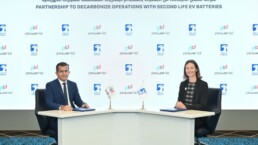

Innovation expected to cut carbon dioxide emissions by up to 25% and halve energy expenditure in remote drilling operations as part of ADNOC’s net zero by 2045 ambition
In partnership with Power I.D., pilot will curtail diesel power generation in remote locations through use of reused EV batteries
ADNOC establishes UAE’s first Battery Center of Excellence to spearhead research into promising new cell technologies and future battery energy system
ADNOC is to trial the use of repurposed electric vehicle batteries to decarbonize its remote production operations and reduce costs. The pilot, run in partnership with German startup Power I.D., will see electric vehicle batteries deployed that would have otherwise been disposed of and assembled into a large-scale Battery Energy Storage System.
The system, which will be built in the United Arab Emirates, can hold up to two megawatts (MW) of power within a single 20-foot storage container. Each container will be mobile, allowing for deployment to remote sites.
The Battery Energy Storage System will reduce reliance on diesel generators to power remote drilling rigs. It is estimated the system will cut the carbon emissions of remote drilling rigs by up to 25% and reduce their energy expenditure by 50%.
To support the long-term development and deployment of Battery Energy Storage Systems, ADNOC has established the UAE’s first Battery Center of Excellence. Located at the ADNOC Research and Innovation Center (ADRIC), it will spearhead research into promising new cell technologies and future battery energy systems.
Sophie Hildebrand, ADNOC Chief Technology Officer, said: “Leveraging innovative technology and partnerships is a key pillar in ADNOC’s strategy to achieve net zero emissions by 2045. The Battery Energy Storage System is a cutting-edge innovation that will enhance efficiency and allow us to continue decarbonizing our operations.”
The Battery Energy Storage System utilizes advanced electric vehicle technology. It comprises 24 second life electric vehicle batteries joined together using silicon carbide convertors. Each system contains a combination of high performance and high energy cells to provide rig operators with dynamic and versatile power output and uses disruptive liquid cooling technology, instead of conventional methods, to enhance efficency and lifespan. An autonomous control system ensures optimal energy management.
Naser Abu Daqqa, Founder and Managing Director, Power I.D., said: “This Battery Energy Storage System is unique for its high energy density. Together with ADNOC we have developed a system that packs in two megawatts per hour within a 20-foot container. The compact nature of the system will allow for convenient deployment to remote locations, helping ADNOC to cut emissions from its off-grid production activities.”
ADNOC is accelerating the decarbonization of its operations as it reduces the carbon intensity of its operations by 25% by 2030 and moves towards its Net Zero by 2045 ambition. Its decarbonization plan is backed by an initial allocation of $15 billion (AED55 billion) towards low-carbon solutions, new energies and climate technologies.



Related News.

Poland’s additional national requirements distort competition says Danish Shipping
Poland has introduced a national survey requirement for smaller foreign-flagged vessels operating in Polish waters. This creates significant…

Battery Vessels could help electrify most of Global Shipping Emissions
Battery-electric ships are economical only if the pack is cycled frequently, so they have been confined to short-sea, ferry and harbour vessels…

Mintra and Ledgid explore collaboration to connect Maritime digital identity, learning and workforce development
Mintra® and LEDGID are exploring opportunities to bring together complementary capabilities in digital learning, maritime training, professional…

World Shipping Council calls for global agreement on shipping emissions as industry investment surpasses $200 billion USD
The World Shipping Council (WSC) is calling on governments to agree on binding global greenhouse gas regulations for international shipping without…

What happened to the ITF whistleblower’s complaint?
In January 2026, a whistleblower complained that International Transport Workers’ Federation (ITF) General Secretary Stephen Cotton had manipulated…

Growing regulatory scrutiny puts seafarer wellbeing firmly on maritime safety agenda, VIKAND warns
Seafarer wellbeing is coming under greater regulatory scrutiny as international rules and guidance increasingly recognise crew health and welfare as…

Good Times Bad Times the Premium Stays with the Strait
In October, we wrote that if the transfer network off Oman kept pace, Gulf crude would carry China's refill and keep drawing tonnage east,…

Allied Weekly Market Review Week 47
Pls find below the Allied - Weekly Market Review - Week 47 ALLIED - Weekly Market Report- Week 47


Climate TRACE releases September 2026 Emissions Data
Climate TRACE reported that global greenhouse gas (GHG) emissions for the month of September 2026 totaled 4.7 billion tonnes CO₂e. This remains…
Subscribe to our newsletter!
if you dont want to swim alone in the ocean of news, sign up for the newsletter, and you will receive daily all the important news of world shipping!
