Russia in the Black Sea. The Law of armed conflict at sea needs due consideration Alongside UNCLOS
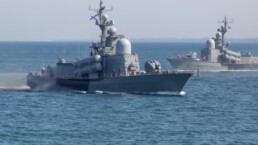

The Law of Armed Conflict applicable at sea must be considered alongside the UN Convention on the Law of the Sea 1982 and military intent of the Kremlin for influence of Russian maritime operations. It is not just the normative considerations of UNCLOS which will determine the legality, or not, of Russian military actions in the Black Sea.
Neutrality and Breach of Laws of War
The recent announcement by the Kremlin that Russia is pulling out of the arrangement by which grain has been shipped out of Ukrainian ports for global consumption, was accompanied by an explicit threat to all merchant shipping in the Black Sea region.
It seems that Russia will be tracking and may be targeting merchant vessels regardless of their flag and, in one interpretation, with little apparent focus on their activity and purpose.
So, it would appear there is to be no concern for the neutrality of many of those vessels or for the civilian crews, of multiple nationalities, that are manning them.
We should not be surprised. To suggest that Russia appears to be ignoring the rule of law amounts to a profound understatement in relation to this war.
Regarding both the law on the use of force between states (the jus ad bellum) and that governing the application of force by armed forces during armed conflict (the jus in bello), Russia has an appalling record.
The law appears not to matter as far as either Mr Putin, or his military commanders are concerned, either on land or at sea.
We should, however, be careful not to accuse the Kremlin of breaches in the law simply because we do not like what Russian forces are doing, or about to do. We must be conscious of what the law allows and what it does not.
There has, understandably, been much comment on breaches of LOAC during the current conflict on land, but relatively little in relation to the war at sea, which is not a regular feature on the daily news feeds.
What may not be obvious to all is that there are important differences between the laws governing war on land and on the sea.
The Law of Armed Conflict at Sea
The Law of Armed Conflict (LOAC) Applicable at Sea (the ‘laws of war and neutrality at sea’ in traditional language) includes significant rules relating to ‘economic warfare’ or the interdiction of shipping and the disruption of trade.
Leaving aside arguments about the categorisation of the conflict, whether it is an international or a non-international conflict, we need to focus on what the Russian threats amount to.
In naval warfare the interdiction of shipping can be lawful, and that includes the interdiction of both enemy and neutral flagged civilian-owned and operated vessels.
All shipping should comply with the law and relevant rules, including those relating to ‘contraband’ i.e., goods that can benefit the enemy’s fighting capability.
So, even a neutral flagged vessel can be subject to interdiction if it is carrying contraband destined for the enemy.
Immunity from Attack?
If a vessel, be it enemy or neutral, fails to comply with legitimate calls to stop and be searched, it can render itself vulnerable to targeting and may even be sunk in certain circumstances.
Although there are rules for the protection of their civilian crews contained in the 1949 Geneva Conventions, civilian crewmembers are at higher risk of being injured in an attack on a vessel if, for example, the merchant vessel is in a convoy under military command.
Since the LOAC applicable at sea has not been developed or amended since the early-mid 20th century, one might claim that the civilian nature of both vessels and crews should now be regarded differently. In that sense, one might today argue that crews of all merchant vessels either breaching a legally imposed blockade or carrying contraband in the Black Sea are ‘directly participating in hostilities’ (DPH) and are therefore potentially subject to attack.
Blockade and Interdiction
But what of the current Russian threat to merchant shipping?
In relation to Russian activities in the Black Sea, economic warfare rules permit the two methods of warfare: blockade and interdiction of vessels suspected of carrying contraband or of conducting other non-neutral service.
Operations aimed at preventing passage into and out of Ukrainian ports could be regulated under the Law of Blockade.
A naval blockade must be formally announced and promulgated, and it has to be applied in a non-discriminatory manner. That is to say that no vessel should be allowed through the blockade, regardless of flag or cargo.
Russia has not to our knowledge formally declared a blockade, nor did it do so at the outbreak of the war or at any point since neither 2014 nor 2022, nor any point since.
In relation to interdiction operations, the position would be that an attack against an enemy flagged merchant vessel could be viewed as a legitimate target.
In relation to all vessels, the vessel is only targetable if it refuses to stop for boarding and search, if challenged.
For that reason and leaving aside any consideration of de facto versus de jure arguments, the Russian attempt to prevent access to the Ukrainian coast and its ports is contrary to LOAC.
Russia could, however, immediately establish a legal blockade simply by announcing one and promulgating the details. That could be legitimate, despite the provisions of UNCLOS which do not apply equally in peace and war.
As for contraband interdiction operations on the high seas, these could be regarded as legitimate without any formal declaration of intent by Russia.
So What?
Russia and Ukraine are engaged in an international armed conflict and all the relevant rules and laws of war apply.
If Russia chooses to apply economic pressure through the interdiction of shipping (either Ukrainian or neutral flag) on the High Seas (outside 12 Nm Territorial Waters for the case of the Black Sea), or formally impose a blockade, it may do so.
What Russia cannot do, and what it appears to be suggesting it will do, is simply regard all merchant shipping in the Black Sea as legitimate targets for attack without first establishing their engagement in the transport of contraband and/or non-neutral service.
Russian maritime forces must therefore stop, visit and search vessels before either seizing them as prize or destroying them if the decision is to do so (after removing their crews to a place of safety) if they are found to be carrying contraband, for example.
Russian forces must operate within the LOAC and must always respect human rights protections for all crew, without exception.
The Reality?
It appears that Russia does not currently have the naval capability to conduct such blockade or interdiction operations in a lawful manner, though they could resort to unlawful targeting activity which may cause injury or death of seafarers, and/or damage and destruction of merchant vessels and cargo.
Source: HRAS



Related News.

Beyond Technical Skills: WISTA Cyprus explores the human side of leadership
WISTA Cyprus hosted The Art of Leadership & Emotional Mastery, an interactive workshop held on 15 October at the Alasia Hotel in Limassol,…
The human cost of sending merchant mariners into war zones extends far beyond the immediate danger of missiles and drones. It raises a harder question: who is really protecting the seafarer?
Who protects the seafarer? I have spent much of my professional life at sea. I am a Master Mariner. I have stood on the bridge, made decisions…
Loss of bridge control: Human failure is normal – context is key
When bridge control is lost in a functioning system, it can be easy to blame human error. But accidents rarely happen because of one mistake…

Danish Shipping announces the transport of live animals by sea new rules should improve safety for animals, seafarers and the environment
Revised rules on the transport of live animals by sea are being negotiated in the EU. Danish Shipping wants to ensure good animal welfare,…

Japan’s flawed shipping proposal leaves developing countries adrift
A new analysis by Opportunity Green warns governments of the wide-ranging risks posed by Japan’s proposal at the International Maritime Organization…

Intermodal Report Week 42 2026
Pls find below the Intermodal Report - Week 42 2026 Intermodal Report Week 42 2026

Allied Weekly Market Review Week 42
Pls find below the Allied - Weekly Market Review - Week 42 ALLIED - Weekly Market Report- Week 42

EU Arctic Strategy NGOs welcome EU ambition on on cutting shipping’s Arctic Black Carbon Emissions
Responding to today’s publication of the EU’s Arctic Strategy, which definitively states the EU’s intention to support International Maritime…

The final quarter of 2026 is expected to see softer bauxite flows
Chinese front-loading is expected to have run its course, pointing to softer bauxite flows in 2026 Q4. Global bauxite flows increased by 2.8% y/y…

DP World Foundation and Belewan new container terminal mark groundbreaking of AED 3.7 million school project in Indonesia
Classrooms of Hope initiative expands to Belawan, Medan with a new junior high school designed to provide modern learning facilities and greater…
Subscribe to our newsletter!
if you dont want to swim alone in the ocean of news, sign up for the newsletter, and you will receive daily all the important news of world shipping!
