Groundbreaking first Ammonia Engine test completed
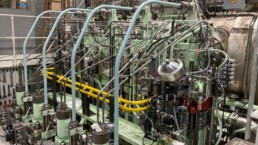

MAN Energy Solutions has announced the successful first running of a test engine on ammonia at its Research Centre Copenhagen . The company reports that the successful combustion was performed on a MAN B&W two-stroke 4T50ME-X type and produced positive results with particularly promising data regarding pilot-oil amount and combustion stability.
Gunnar Stiesch, Chief Technical Officer, MAN Energy Solutions, said: “This marks a major milestone on our road to developing a full-scale two-stroke ammonia marine engine. It’s been a historic week for our team at the RCC where a lot of groundwork and research has now paid off and we have gained a deep understanding of ammonia’s unique characteristics as a marine fuel, as well as its effects on fuel supply and safety systems. This successful combustion represents yet another, important step towards decarbonising the marine market and bringing big things to zero.”
MAN Energy Solutions reports that safety has been of paramount importance at all stages leading to the new milestone. Precautions taken due to the fuel’s inherent characteristics include the construction of a custom-built ‘cold hall’, which can contain ammonia vapour in the unlikely event of a leak with the activation of a water screen. Robust safety features from the company’s existing dual-fuel portfolio, such as double-walled piping and system ventilation, have also been built into the ammonia engine’s design.
Brian Østergaard Sørensen, Vice President and Head of Research & Development, Two-Stroke at MAN Energy Solutions, said: “This is groundbreaking for both our company and the maritime industry as a whole. That said, we know we still have a lot of hard work ahead and, over the following months, will execute a testing programme that will study aspects such as heat-release, ignition, safety, pilot-oil energy fraction, NOx and N2O emissions. We then plan on rebuilding the test engine from one cylinder capable of running on ammonia to a full-scale test engine running on ammonia around the end of this year or early in 2024.”
MAN Energy Solutions states that it broadly expects to hold its delivery timeline for the first ammonia engine, with subsequent operation onboard a commercial vessel from around 2026.
Bjarne Foldager, Head of Two-Stroke Business, MAN Energy Solutions, said: “Interest in this breakthrough has been overwhelming. However, while we provide the decarbonising technology, the maritime industry must show the will to implement it. Now it’s up to the International Maritime Organization to establish clear regulations that ensure that maritime actors are not penalised for choosing carbon-neutral fuels. At MAN Energy Solutions, our expectations for ammonia are positive owing to its predicted lower production cost compared to other, relevant e-fuels; we foresee around 27% of fuel used onboard large merchant-marine vessels to be ammonia by 2050.”
Thomas S. Hansen, Head of Promotion and Customer Support, MAN Energy Solutions, said: “The first MAN B&W ammonia engine will be a 60-bore engine, which will be applicable to a very wide range of vessel types. The interest in this engine is very high and we have received many queries across basically all large merchant-marine vessels. MAN Energy Solutions expects a quick uptake of ammonia-fuelled engines towards the end of the current decade.”
Project steps
The ammonia engine R&D project started in 2019 with a pre-study and investigation of ammonia combustibility. The following year, a second test-engine arrived in Copenhagen, enabling a parallel-test engine setup with different fuels at RCC; HAZID workshops on the engine concepts were performed simultaneously.
In 2021, the ammonia fuel-supply system and auxiliary systems were specified with the highest possible focus on safety, while 2022 saw the installation of the same systems at RCC with instrumentation for test engine No. 1 for 1-cylinder ammonia testing initiated.
In 2023, ammonia bunkering and service-tank facilities were built with all auxiliary systems enabling a full containment of ammonia in the unlikely event of a leak. Similarly, all auxiliary systems were initially tested with water, followed by ammonia.



Related News.

Poland’s additional national requirements distort competition says Danish Shipping
Poland has introduced a national survey requirement for smaller foreign-flagged vessels operating in Polish waters. This creates significant…

Battery Vessels could help electrify most of Global Shipping Emissions
Battery-electric ships are economical only if the pack is cycled frequently, so they have been confined to short-sea, ferry and harbour vessels…

Mintra and Ledgid explore collaboration to connect Maritime digital identity, learning and workforce development
Mintra® and LEDGID are exploring opportunities to bring together complementary capabilities in digital learning, maritime training, professional…

World Shipping Council calls for global agreement on shipping emissions as industry investment surpasses $200 billion USD
The World Shipping Council (WSC) is calling on governments to agree on binding global greenhouse gas regulations for international shipping without…

What happened to the ITF whistleblower’s complaint?
In January 2026, a whistleblower complained that International Transport Workers’ Federation (ITF) General Secretary Stephen Cotton had manipulated…

Growing regulatory scrutiny puts seafarer wellbeing firmly on maritime safety agenda, VIKAND warns
Seafarer wellbeing is coming under greater regulatory scrutiny as international rules and guidance increasingly recognise crew health and welfare as…

Good Times Bad Times the Premium Stays with the Strait
In October, we wrote that if the transfer network off Oman kept pace, Gulf crude would carry China's refill and keep drawing tonnage east,…

Allied Weekly Market Review Week 47
Pls find below the Allied - Weekly Market Review - Week 47 ALLIED - Weekly Market Report- Week 47


Climate TRACE releases September 2026 Emissions Data
Climate TRACE reported that global greenhouse gas (GHG) emissions for the month of September 2026 totaled 4.7 billion tonnes CO₂e. This remains…
Subscribe to our newsletter!
if you dont want to swim alone in the ocean of news, sign up for the newsletter, and you will receive daily all the important news of world shipping!
