Floating Photovoltaics emerge as a promising solution for Southeast Asia’s Clean Energy Future
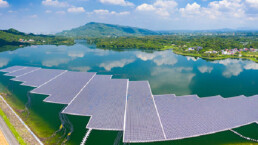

NREL Researchers Are Laying the Groundwork for Southeast Asia’s Floating Photovoltaics Development
Countries around the world are seeking innovative solutions to reduce carbon emissions while meeting energy security and economic development needs. From rooftop photovoltaics (PVs) to offshore wind, creative energy generation sources have solved challenges associated with typical renewable energy sources such as land use restrictions and geographical constraints.
For countries with abundant solar resource potential and limited land availability, floating PV, or FPV, has emerged as a potential clean energy solution. In a first-of-its-kind assessment, National Renewable Energy Laboratory (NREL) researchers, funded by the laboratory’s partnership with the United States Agency for International Development’s (USAID) Regional Development Mission for Asia, completed an analysis of FPV potential for the Association of Southeast Asian Nations (ASEAN).
The report, Enabling Floating Solar Photovoltaic (FPV) Deployment: FPV Technical Potential Assessment for Southeast Asia, estimates the technical potential for the 10 ASEAN countries and is coupled with an FPV data set that is publicly accessible through the USAID-NREL Partnership’s Renewable Energy (RE) Data Explorer tool.

FPV generation and capacity technical potential for reservoirs in Southeast Asia. Graphic by Prateek Joshi, NREL

FPV generation and capacity technical potential for natural water bodies in Southeast Asia. Graphic by Prateek Joshi, NREL
Untraditional Solutions for Traditional Demands: The Case for Floating Photovoltaics in Southeast Asia
While traditional renewable energy sources (solar arrays, wind farms, etc.) are effective types of energy generation, they often come with land-use challenges and concerns.
By contrast, FPV arrays are situated on water bodies such as lakes, reservoirs, or water treatment ponds, where they can be installed alone or in combination with hydropower dams. This method of installation eliminates land use concerns and makes use of spaces that may otherwise go unused for energy generation. This is particularly of interest in cases where hydropower infrastructure is planned or already in place, and increased frequency or severity of drought may raise concerns around electricity reliability.
Increasing Energy Security
Such is true for Southeast Asia, a region with significant existing hydropower infrastructure yet some concerns around energy security during periods of drought and water scarcity. Solar and hydropower are complementary energy resources, and FPV has the potential to firm up energy generation during periods of drought and low reservoir levels.
“While we can’t generalize about Southeast Asia as a whole, one thing that is basically universally true of the region is that it has an established network of hydropower generation sites. FPV can support these sources as water levels fluctuate to ensure grid stability,” said Evan Rosenlieb, a geospatial data scientist at NREL who performed the resource and technical potential analysis for this project.
“Additionally, much of the region is covered by rainforest ecosystems,” Rosenlieb said. “Siting PV on water can be a way to increase renewable energy generation without deforestation.”
The Food-Water-Energy Nexus
Furthermore, Southeast Asia is exploring other water-based solutions such as aquaculture—a method of farming where aquatic creatures such as fish, crustaceans, and others are raised on controlled water environments. Aquaculture sites present unique opportunities for FPV deployment and benefits.
“Along with its other co-benefits, FPV can play an important role in bolstering food security in Southeast Asia through incorporation with the region’s fast-growing aquaculture industry,” said Prateek Joshi, NREL energy engineer and lead author of the report.
“This emerging combination of aquaculture and photovoltaics, commonly referred to as AquaPV, can allow countries to colocate energy and food production on existing natural or artificially created water bodies while minimizing the overall environmental impact of both sectors,” Joshi said.
Meeting Renewable Energy Goals
Countries across Southeast Asia have ambitious renewable energy generation goals that FPV can help make a reality. Together, ASEAN has set a target of 35% renewable energy installed power capacity by 2025, which has spurred these countries’ interests in aggressive and creative solutions, like FPV development.
“FPV is an option that can allow many of these countries to take advantage of high-quality solar resources to combat challenges such as land availability or rugged geographies that can make siting traditional renewable energy sources difficult,” said Sika Gadzanku, the NREL energy technology and policy researcher who led the development of this analysis. “They also offer resilience opportunities in regions that use a lot of hydropower but are facing droughts and significant changes in rainfall patterns.”
Determining Technical Potential and Developing Data for All
“Southeast Asia leads FPV deployment, and Thailand is emerging as a major player in this space. Our FPV work has really been demand-driven—several country partners and developers expressed their interest in FPV and in turn, we embarked on our first Southeast Asia-specific FPV analysis four years ago,” Gadzanku said.
Gadzanku is an emerging expert in FPV research and development. In the past four years, she has thoroughly examined FPV development in Southeast Asia, including a 2021 report detailing barriers to FPV deployment and a 2022 analysis of the operational benefits of FPV-hydropower hybrid systems.
Building off previous FPV studies, the NREL team used existing data on waterbodies, infrastructure, and energy resources to determine which waterbodies showed the highest potential for FPV development. They found that all the ASEAN countries have significant potential for FPV energy generation.
As these countries look ahead to begin developing FPV projects, data will be critical for their decision-making. To support developers, policymakers, and other regional stakeholders, the USAID and NREL teams made this technical potential data available through the RE Data Explorer tool.
“Among the four essential data required for successful FPV development, site location stands out as one of the most critical factors to consider due to geographic variations in Southeast Asian countries,” said Chatchai Mawong, assistant governor of power plant engineering and construction at the Electricity Generating Authority of Thailand.”
Accurate and detailed data of the site location is crucial, as it affects the feasibility of project development in each location, as well as technology selection, project costs and eco-friendliness.”
This data set is the first FPV data to be added to RE Data Explorer, expanding access to the types of analyses Southeast Asian stakeholders can do to assess renewable energy generation.
“This data will lead to more discussions and can inform decisions on the potential role of FPV in the region. It wouldn’t have been possible without all the existing work of previous FPV studies and previous RE Data Explorer tool development,” Gadzanku said.
“The data is publicly accessible and can be used by all kinds of stakeholders—energy planners and modelers, developers, and researchers—to support more detailed FPV research activities and modeling and analysis efforts.”



Related News.
India joins ISF Verify, bringing trusted digital certification within reach of 30 per cent of the global seafarer workforce
Agreement with the world’s second-largest seafarer supply country marks a major milestone for global digital certification. The Directorate General…

OpenGate Capital to acquire Maersk Training, the Global Safety Training and Gas-Safety Services Business of Maersk
OpenGate Capital, a global private equity firm, announced today that it has signed a definitive agreement to acquire Maersk Training and its…

Can AI Save the Planet? Planet Classroom examines AI’s Climate Impact, Energy Demands and Clean Energy Solutions
C. M. (Cathy) Rubin and The Nest Campus CEO Peter Gilmer explore AI's growing environmental footprint, billions in climate investment, and the…

Smart Port Market Size to be valued at USD 23.10 Billion by 2034; Increasing Volume of International Maritime Trade to Boost Market Development: Fortune Business Insights™
The global smart port market size was valued at USD 3.4 billion in 2025 and is expected to be worth USD 4.2 billion in 2026. The market is projected…

Closer cooperation with India can strengthen Danish shipping
Minister of Business and Competitiveness Martin Lidegaard is leading a Danish business delegation to India. Green shipping is among the…
IRClass Academy and PIP Makassar strengthen Executive Maritime Capability through IMPDP 2026
Indian Register of Shipping , through its professional training and development arm IRClass Academy, has further strengthened its engagement in…
MOL, Sharp, IOM Implement Solar Panel Donation Project
Move Will Enhance Living Conditions in Power-short Areas of Kenya Mitsui O.S.K. Lines, announced the donation of solar power panels to communities in…

Intermodal Report Week 44 2026
Pls find below the Intermodal Report - Week 44 2026 Intermodal Report Week 44 2026

Allied Weekly Market Review Week 44
Pls find below the Allied - Weekly Market Review - Week 44 ALLIED - Weekly Market Report- Week 44

Nor-Shipping partners with Marketing in Maritime to deliver Marketing & Communications day and awards in 2027
Nor-Shipping is partnering with Marketing in Maritime to deliver a dedicated Marketing & Communications Day and awards initiative at the 2027…
Subscribe to our newsletter!
if you dont want to swim alone in the ocean of news, sign up for the newsletter, and you will receive daily all the important news of world shipping!
