
As the International Maritime Organization (IMO) gathers today for a meeting of its Marine Environment Protection Committee (MEPC 80, July 3-7), the Clean Arctic Alliance called on IMO member states to adopt ambitious interim targets that will lead to a 50% reduction in shipping’s climate impact by 2030, commit to delivering mandatory black carbon emissions reductions from shipping – which impact the Arctic, and to support designation of new Emission Control Areas (ECAs) to reduce air pollution in the Arctic.
“During MEPC 80, governments can change the world by slashing shipping’s greenhouse gas emissions by 50% by 2030 – and 100% by 2040”, said Clean Arctic Alliance Lead Advisor Dr Sian Prior. “As a recent study shows, this can be achieved without impacting trade”.
“Amidst the current climate and biodiversity crisis, halving greenhouse gas emissions would set a crucial precedent by global shipping that would inspire other sectors to follow”, she added. “However, as the planet is already considered to have heated by around 1.1 degrees Celsius, we must take advantage of ‘low-hanging fruit’: that means slashing black carbon emissions from shipping that are contributing to Arctic warming”
“The shipping sector has the power to rapidly reduce its emissions of black carbon – what’s needed now is the political will”, continued Prior. “Reducing black carbon emissions from shipping in and near the Arctic is straightforward, does not require development of new fuels or new technology, and can be achieved immediately.”
“Individual marine engines would see up to a 80% reduction in black carbon emissions depending on the engine by moving from heavy fuels to diesel fuels (the type and condition of the engine, and load of the ship are also factors). Moving all the ships operating in the Arctic and currently using heavy fuels will result in around a 44% reduction in black carbon emissions. Installing a diesel particulate filter – an existing technology used in land-based transport but which can only be used with cleaner fuels, would reduce black carbon emissions by over 90%.”
“News that the Arctic – a major regulator of the global climate – considered by climate scientists to now be warming as much as four times faster than the planet as a whole, and the possibility of days with no summer sea ice – known as blue ocean events – as soon as the 2030s raises serious concerns”, said Prior.
“We have known for around three decades that reducing black carbon emissions is necessary, due to its climate and health impacts. On land, considerable effort has been made to ban dirtier fuels in power stations, and to install diesel particulate filters on land-based transport, but despite over a decade of prevarication the same efforts have not yet been made at sea.”
“The International Maritime Organization truly has a chance to pluck low-hanging fruit, by cutting black carbon emissions, and while no major decisions on reduction of black carbon emissions are expected week, it does provide the opportunity for the IMO to bring forward concrete proposals for cutting these emissions for consideration in early 2024.”
Black Carbon and the Arctic
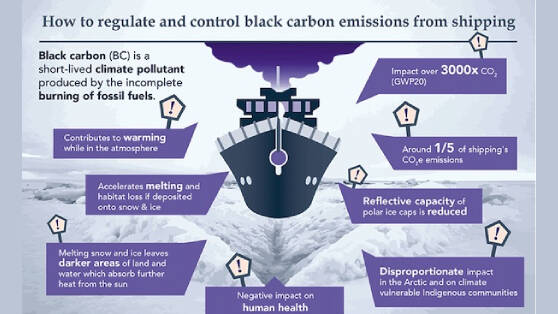
Black carbon is a short-lived climate pollutant, produced by the incomplete burning of fossil fuels, with an impact more than three thousand times that of CO2 over a 20 year period. It makes up around one-fifth of international shipping’s climate impact.
Not only does it contribute to warming while in the atmosphere, black carbon accelerates melting if deposited onto snow and ice – hence it has a disproportionate impact when released in and near to the Arctic. The melting snow and ice exposes darker areas of land and water and these dark patches then absorb further heat from the sun and the reflective capacity of the planet’s polar ice caps is severely reduced. More heat in the polar systems – results in increased melting. This is the loss of the albedo effect.

Infographic: Emission Control Areas – Reducing Air Pollution From Shipping
Declines in sea ice extent and volume are leading to a burgeoning social and environmental crisis in the Arctic, while cascading changes are impacting global climate and ocean circulation. Scientists have high confidence that processes are nearing points beyond which rapid and irreversible changes on the scale of multiple human generations are possible. Scientists say it is now too late to save summer Arctic sea ice, and research has shown that “preparations need to be made for the increased extreme weather across the northern hemisphere that is likely to occur as a result.”
Black carbon also has a negative impact on human health, and recent research has found black carbon particles in the body tissues of foetuses, following inhalation by pregnant mothers.
The need to reduce emissions of black carbon because of both the climate and health impacts has been long recognised. On land, considerable effort has been made to ban dirtier fuels in power stations, to install diesel particulate filters on land-based transport, and to improve the burning of dry wood – all to reduce emissions of black carbon and improve air quality. However, at sea the same efforts have not yet been made.
Source: Clean Arctic Alliance



Related News.
Cyprus Maritime Innovation takes Centre Stage at SMM Hamburg 2026
Underscoring its expanding role as a premier international hub for cutting-edge maritime technology and sustainable shipping, the Republic of Cyprus…

Trump seeks to refill US oil reserve with Venezuela deal but faces long delay
U.S. President Donald Trump said on the 30th (local time) that he would refill the U.S. Strategic Petroleum Reserve, which has been depleted with…
US Navy Official visits South Korean Shipyards in private
With U.S. President Donald Trump pushing a plan to allow overseas construction of U.S. warships, attention is focusing on whether the building of…
SES and De Boer Marine expand collaboration with FlexMaritime deployment across Global Markets
SES, a leading space solutions company, and De Boer Marine, a leading provider of top-quality marine equipment and maritime connectivity services,…

New ESG guidance to help maritime industry turn sustainability into commercial advantage
New framework helps shipowners and ports align ESG strategy with access to capital, charterer expectations and long-term asset value. Maritime…

Britannia P&I Club analysis finds four in five crew deaths linked to illness rather than accidents
New report highlights cardiovascular disease as leading cause of fatalities and raises concerns over mental health risks among younger seafarers.…
The Swedish Club launches new Loss Prevention podcast, Knot Another Lesson
The Swedish Club has launched Knot Another Lesson, a new podcast exploring the practical lessons, emerging risks and operational challenges shaping…

Lloyd’s Register appoints Jens Grunenberg as Senior Representative for Germany
Lloyd’s Register has appointed Jens Grunenberg as its Senior Representative for Germany, effective 1 September. Based in Hamburg, Grunenberg will…
Indian Register of Shipping sets sights on Hamburg for European Expansion
Indian Register of Shipping, a leading international classification society and full member of the International Association of Classification…
MOL completes Merger of 6 Ship Management Companies
Unifying Management of Over 200 Vessels and Strengthening Safety Mitsui O.S.K. Lines, announced that it has completed the integration of the MOL…
Subscribe to our newsletter!
if you dont want to swim alone in the ocean of news, sign up for the newsletter, and you will receive daily all the important news of world shipping!
