Multiple crane operations demand heightened flexibility for AAL
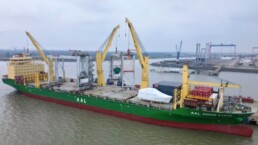

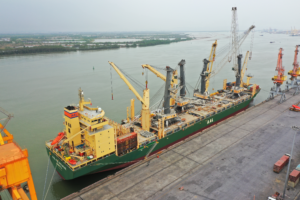
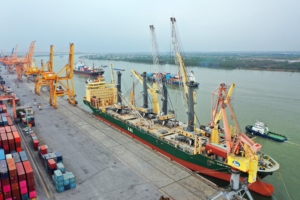
This Spring has seen AAL Shipping undertake the long-haul transport of some impressive heavy lift cranes and related components for port and terminal development projects worldwide. These have included an operation to move four 439-tonne Liebherr shore cranes from Shuaiba in Kuwait to Haiphong in Vietnam for a new dry dock facility. A second operation comprised two shipments of six new-build Kalmar Automated Stacking Cranes from Taicang and Shanghai to Melbourne, Australia, for a container terminal expansion programme.
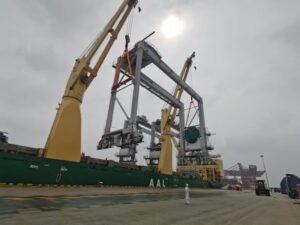
Four Second-Hand Heavy Lift Liebherr Cranes Demand Last Minute Recalibration
Project heavy lift cargo operations are complex at the best of times and made more challenging when the cargo involved is older and its integrity and even specification are in question.

Yahaya Sanusi, Deputy Head of Transport Engineering at AAL, explained, “This operation involved the transport onboard the 31,000dwt heavy lift mega-size ‘AAL Melbourne’ of four second-hand Liebherr crane units. The lead time of this project was extremely short, as the client had been left stranded by another carrier, realising the operational parameters were beyond their scope. Three of the units were the LMH 500 series and the other an LMH 550. These are some of the biggest cranes in the series, each weighing more than 400 tonnes, 35 metres tall and featuring a jib length of close to 55 metres.
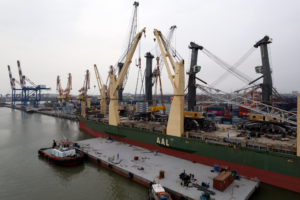
“The loading of cranes of different size and of an older age required detailed preparation, made more complicated by the fact that the delivered units were in far poorer condition than expected and documentation provided was inaccurate. This not only required on-site stowage plan adjustment by our attending CSI, but also the re-calibration of each jib’s centre of gravity to ensure lifting stability could be guaranteed. Furthermore, we had to drive the first three units around deck to optimise space before the fourth unit could be loaded, which involved building bridges to connect four-metre gaps between hatch covers with heavy load platforms and corresponding ramps. Due to the poor condition of the units, we dealt with burst crane tyres, crane engine malfunction and resulting delays – handled by our crew and attending team with grit and determination.”
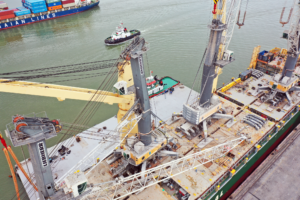
He concluded, “The cranes were extremely tall and affected bridge visibility, requiring special permission from the Flag State administration and further safety precautions, including the engagement of an additional safety officer on the bridge. At the port of Haiphong, the four units had to be discharged to a barge that was not self-trimming, which meant we could only discharge one crane at a time and to specific areas of the vessel. With so many ships passing closely by and generating wake, discharging to barge in Haiphong requires perfect timing. Despite all challenges, we delivered the cargo safely and within laycan.”
Six Giant Kalmar Automated Stacking Cranes (ASC) Pose Visibility & Size Challenges
AAL also recently shipped three ASCs, each 35 metres wide and 215 tonnes, from Taicang in China to Melbourne, onboard the 31,000dwt heavy lift mega-size ‘AAL Hong Kong’. A second sailing is planned with sister vessel ‘AAL Shanghai’ in early July to transport three further cranes of the same type into the Victoria State Capital from Shanghai. All six cranes are being shipped for cargo handling solutions provider Cargotec for use in Melbourne’s Victoria International Container Terminal (VICT), as part of an ongoing expansion programme for which AAL already shipped 20 ASC units in 2016.
The massive 3,000 sqm clear weather deck space of the A-Class proved ideal for these 35-metre-long, 13-metre-wide, and 27-metre-high units, enabling the safe stowage of two of the cranes side-by-side. Having already successfully shipped 20 of these units on five sailings from China to Australia in the past for Cargotec, AAL provided the experience and technical know-how that the customer demanded.

Nicola Pacifico, Head of Transport Engineering at AAL, commented, “Visibility challenges posed by these tall units required early dialogue with local authorities and other stakeholders to establish and then secure necessary safety requirements for operational approval. Multiple diagrams, extensive documentation, detailed safety analyses and a raft of preventive measures were prepared and delivered through a strong collaborative effort involving AAL’s Engineering and Operations teams, and our Technical and Crew Manager, Columbia Shipmanagement (CSM).
“Measures undertaken included the deployment of CCTV cameras to compensate for blind spots, establishing forward radar, and employing additional watchkeeping, tugs and pilot assistance during departure and arrival at port. Bespoke adaptations to accommodate the significant size of the cranes included the use of bolsters to extend deck width on the starboard side, removing the support of ship crane number three to enable a suitable swing angle during loading and discharge, and the additional stowing of the crane’s jib in an upper position during sea voyage.”



Related News.

Poland’s additional national requirements distort competition says Danish Shipping
Poland has introduced a national survey requirement for smaller foreign-flagged vessels operating in Polish waters. This creates significant…

Battery Vessels could help electrify most of Global Shipping Emissions
Battery-electric ships are economical only if the pack is cycled frequently, so they have been confined to short-sea, ferry and harbour vessels…

Mintra and Ledgid explore collaboration to connect Maritime digital identity, learning and workforce development
Mintra® and LEDGID are exploring opportunities to bring together complementary capabilities in digital learning, maritime training, professional…

World Shipping Council calls for global agreement on shipping emissions as industry investment surpasses $200 billion USD
The World Shipping Council (WSC) is calling on governments to agree on binding global greenhouse gas regulations for international shipping without…

What happened to the ITF whistleblower’s complaint?
In January 2026, a whistleblower complained that International Transport Workers’ Federation (ITF) General Secretary Stephen Cotton had manipulated…

Growing regulatory scrutiny puts seafarer wellbeing firmly on maritime safety agenda, VIKAND warns
Seafarer wellbeing is coming under greater regulatory scrutiny as international rules and guidance increasingly recognise crew health and welfare as…

Good Times Bad Times the Premium Stays with the Strait
In October, we wrote that if the transfer network off Oman kept pace, Gulf crude would carry China's refill and keep drawing tonnage east,…

Allied Weekly Market Review Week 47
Pls find below the Allied - Weekly Market Review - Week 47 ALLIED - Weekly Market Report- Week 47


Climate TRACE releases September 2026 Emissions Data
Climate TRACE reported that global greenhouse gas (GHG) emissions for the month of September 2026 totaled 4.7 billion tonnes CO₂e. This remains…
Subscribe to our newsletter!
if you dont want to swim alone in the ocean of news, sign up for the newsletter, and you will receive daily all the important news of world shipping!
