U-Ming pioneers towards a Sustainable Future
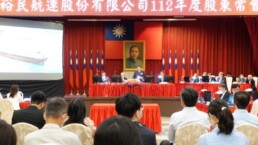

U-Ming Marine Transport Corporation held its 2023 Annual Shareholders’ Meeting at the Taipei Hero House in Taipei City. It was hosted by Chairman Mr Douglas Hsu and conducted in a hybrid format for the first time.
The meeting was successfully concluded with the approval of the financial statements and profit distribution for 2022. The consolidated revenue for 2022 was NT$14.17 billion, with a net profit after tax of NT$4.406 billion and earnings per share (EPS) of NT$5.21. The motion was passed for a cash payment dividend of NT$3 per share, maintaining the company’s record of high surplus payouts and dividend yields.
U-Ming has continued to demonstrate its sound financial structure with a total of NT$16.323 billion equivalent to NT$19.31 per share in undistributed earnings and statutory reserves available for future distribution. U-Ming will continue its efforts to reward shareholders with a strong performance.
B. Overview of The Shipping Market
In 2022, global economic growth was predominantly impacted by various factors, namely the Russia-Ukraine conflict, geopolitical tensions, inflationary pressures, and the COVID-19 pandemic. These elements collectively contributed to heightened uncertainty surrounding the demand for bulk shipping. Throughout the year, the Baltic Dry Index (BDI) exhibited an average of 1,934 points, reflecting a significant 34% decrease in comparison to 2021. As the year drew to a close, China shifted its focus towards achieving “stable growth” through the implementation of a loose and proactive macroeconomic policy. This strategic direction was formulated subsequent to the convening of the 20th National Congress of the Chinese Communist Party, which prioritized economic stability and security. Supported by the aforementioned “stable growth” policy, the overall economic stance remained optimistic. This sentiment was further reinforced by the augmentation of policy development and financial instrument support, thereby fostering favorable conditions for the growth of bulk shipping demand.
The competition between China and the United States, along with the global inflation crisis, exerted a significant influence on the state of affairs. In light of these circumstances, the International Monetary Fund (IMF) released a forecast in April, projecting a global GDP growth rate of 2.8% for 2023. This figure reflects a deceleration compared to the 3.4% growth rate observed in 2022. The slowdown in global economic growth had a notable impact on the bulk shipping market, particularly due to China’s imposition of restrictions on steel production and the subsequent reduction in new construction activities within the real estate sector. As a result, the demand for iron ore imports experienced a decline. Furthermore, as the Covid-19 pandemic gradually eased and congestion in ports subsided, the average daily charter rates for all categories of bulk carriers witnessed a decline during the first five months of 2023 compared to the same period in the previous year. However, it is anticipated that as inflation eases and the upcoming peak season for bulk raw material exports approaches, there will be a gradual resurgence in demand for shipping capacity. This development presents an opportunity for the shipping market to regain momentum during the latter half of 2023.
Presently, the order book ratio for new bulk carriers stands at a mere 6.9%, thus emerging as a favorable aspect for the future outlook of the bulk shipping industry. The forthcoming enforcement of crucial shipping carbon emission regulations, namely the Energy Efficiency Existing Ship Index (EEXI) and the Carbon Intensity Indicator (CII), will intensify the imperative for global shipping companies to replace aging vessels. Consequently, the availability of bulk shipping capacity will be constrained, thereby bolstering the prevailing positivity and anticipations surrounding the future prospects of the bulk shipping market.
C. Expansion of Energy-Saving, Efficient and Younger Fleet
U-Ming has persistently pursued its fleet renewal program, resulting in an impressive proportion of 94% of its own vessels being classified as eco-friendly ships. This figure significantly surpasses the market average of 32%. Furthermore, U-Ming boasts an average fleet age of 5.5 years, which is considerably lower than the average age of 11.6 years observed within the bulk shipping market. These distinguishing factors of environmental sustainability and a younger fleet, combined with a team of professional crew and efficient operational management, serve as prominent competitive advantages for U-Ming, establishing a robust foundation for its operational growth.
At present, U-Ming has six vessels currently under construction, and their gradual delivery is anticipated to be completed by 2024. These forthcoming additions to the fleet will not only contribute to U-Ming’s overall performance but also equip the company to effectively navigate the dynamic and ever-changing conditions of the global economic market, paving the way for further achievements and success.
D. Commitment to ESG Sustainable Operations
U-Ming’s steadfast dedication to sustainable management has garnered recognition both domestically and internationally. In 2022, U-Ming was awarded the Gold Award in the Taiwan Corporate Sustainability Awards for the transportation industry by the Taiwan Sustainable Energy Research Foundation. It is also a constituent stock of the FTSE4Good Emerging Index and the Taiwan Sustainability Index FTSE4Good TIP Taiwan ESG Index.
In response to the “1.5°C Climate Action Declaration” presented by the Taiwan Business Council for Sustainable Development, U-Ming took proactive measures to embark on a low-carbon transformation journey. Furthermore, U-Ming signed the Climate Advocacy Document of the R20 Regions of Climate Action, underscoring its commitment to allocating resources toward combating climate change and supporting climate actions in the Asian region. By joining the Getting to Zero Coalition, U-Ming pledged to formulate and develop zero-emission ships propelled by carbon-neutral fuels, aiming to achieve zero-carbon emissions within the marine sector.
U-Ming diligently implements corporate responsibility and governance principles, practices public welfare, emphasizes on occupational safety and human rights, advocates for “just transition” and promotes social inclusion. It values employee well-being and has attained the Badge of Accredited Healthy Workplace by the Health Promotion Administration. In addition, the company has been awarded the HR “Asia Best Companies to Work for in Asia” for 2 consecutive years.
U-Ming has also joined the Maritime Anti-Corruption Network (MACN) platform, collaborating with international Governments and civil society organizations to combat corruption in the shipping industry. Guided by the principle of “Taking from society, giving back to society”, U-Ming considers corporate social responsibility as one of its core values, actively promoting various ESG public welfare activities in areas such as charity, environment protection, community development, education and gender quality.
E. Future Sustainable Development Goals and Strategies
U-Ming’s future fleet development trajectory is firmly directed towards low-carbon or zero-carbon fleets, aligning with its commitment to sustainable shipping practices and the contemporary emphasis on environmental protection. To this end, U-Ming has devised a comprehensive plan that encompasses retrofitting or equipping existing vessels with green energy technologies, such as wind turbine systems or the utilization of biofuels as alternative power sources. Additionally, U-Ming intends to explore the procurement of zero-emission green energy vessels, including those propelled by methanol, hydrogen, or ammonia. Furthermore, the establishment of joint ventures focused on the development of LNG vessels is being considered as part of U-Ming’s strategic efforts to attain carbon neutrality across its fleet by 2050.
By prioritizing zero-carbon emission solutions, U-Ming is resolutely dedicated to reducing the carbon footprint of its vessels, thereby actively contributing to environmental preservation. Concurrently, U-Ming upholds disciplined financial management practices to ensure the company’s enduring financial stability. These strategic initiatives collectively fortify U-Ming’s competitive advantage in the international market, reinforcing its position as a leading player in the shipping industry.



Related News.

Poland’s additional national requirements distort competition says Danish Shipping
Poland has introduced a national survey requirement for smaller foreign-flagged vessels operating in Polish waters. This creates significant…

Battery Vessels could help electrify most of Global Shipping Emissions
Battery-electric ships are economical only if the pack is cycled frequently, so they have been confined to short-sea, ferry and harbour vessels…

Mintra and Ledgid explore collaboration to connect Maritime digital identity, learning and workforce development
Mintra® and LEDGID are exploring opportunities to bring together complementary capabilities in digital learning, maritime training, professional…

World Shipping Council calls for global agreement on shipping emissions as industry investment surpasses $200 billion USD
The World Shipping Council (WSC) is calling on governments to agree on binding global greenhouse gas regulations for international shipping without…

What happened to the ITF whistleblower’s complaint?
In January 2026, a whistleblower complained that International Transport Workers’ Federation (ITF) General Secretary Stephen Cotton had manipulated…

Growing regulatory scrutiny puts seafarer wellbeing firmly on maritime safety agenda, VIKAND warns
Seafarer wellbeing is coming under greater regulatory scrutiny as international rules and guidance increasingly recognise crew health and welfare as…

Good Times Bad Times the Premium Stays with the Strait
In October, we wrote that if the transfer network off Oman kept pace, Gulf crude would carry China's refill and keep drawing tonnage east,…

Allied Weekly Market Review Week 47
Pls find below the Allied - Weekly Market Review - Week 47 ALLIED - Weekly Market Report- Week 47


Climate TRACE releases September 2026 Emissions Data
Climate TRACE reported that global greenhouse gas (GHG) emissions for the month of September 2026 totaled 4.7 billion tonnes CO₂e. This remains…
Subscribe to our newsletter!
if you dont want to swim alone in the ocean of news, sign up for the newsletter, and you will receive daily all the important news of world shipping!
