Survey shows households are willing to shift to greener lifestyles but that cost and convenience are key


While households are willing to adjust their behaviour for the benefit of the environment, governments need to do a lot more to encourage more sustainable choices. Making environmentally friendly options more affordable and convenient, and creating concrete incentives for behavioural change is key, according to a new OECD analysis.
How Green is Household Behaviour? Sustainable choices in a time of interlocking crises analyses responses in the OECD’s third Survey on Environmental Policies and Individual Behaviour Change (EPIC). It says that – given significant pressures on the climate and environment from household consumption – people should be given easier access to sustainable options and real enticements to make choices that can reduce environmental footprints, ranging from households’ ability to choose renewably generated electricity or to easily charge electric vehicle batteries.
Availability and feasibility must be complemented by affordability and convenience – for example improved public transport through more frequent services, better network coverage and lower fares. Rewards for greener behaviour can also drive sustainable habits; for example, shoppers bringing reusable containers could receive discounts on sustainable food items. Equally, it is important to ensure that the more environmentally sustainable alternatives are not confined to small segments of the population, such as higher-income households, homeowners and those living in detached housing, but also for lower-income households, tenants and those living in apartment buildings.
Of the more than 17,000 households surveyed across nine countries in the EPIC Survey, over half of respondents expect climate change and environmental issues to reduce quality of life for both current and future generations. Two thirds (65%) indicate that they are willing to make personal compromises to their lifestyles for the benefit of the environment. However, for many respondents these compromises should not entail a financial cost; 63% of respondents agreed that environmental policies should not impose extra money. Approximately 40% of respondents agreed with both these statements, pointing to a likely challenge for governments in implementing demand-side measures.
“This Survey shows that availability, affordability and convenience are the key drivers for people to make environmentally sound decisions, and there’s still a lot of room for improvement,” OECD Environment Director Jo Tyndall said. “Governments should seek to remove barriers to sustainable choices and to improve the incentives for making these choices. Households need greater access to all manner of more sustainable options – from enhanced public transport and accessible car charging stations to renewable energy and collection services for different types of waste.”
The Survey, which follows the OECD’s earlier EPIC Surveys in 2008 and 2011, was conducted in mid-2022 across households in Belgium, Canada, Israel, France, the Netherlands, Sweden, Switzerland, the United Kingdom and the United States. Overall, 42% of respondents report that personal safety is a very important issue and 41% report economic concerns as very important. In comparison, 35% think climate change or other environmental issues are very important. Concern about climate change and the environment tends to be higher among women, older respondents and those with higher education.
Other key findings from the Survey include:
- Energy: People are more likely to take energy-saving actions that require little effort, such as turning off lights on leaving a room (92% of respondents) rather than harder-to-adopt behaviours, such as minimising heating or air-conditioning (68%). Uptake of renewables and energy efficiency is more limited even when options are available. Among households for whom installation is possible, less than a third have installed heat pumps (30%), solar panels (29%), and battery storage (27%).
- Transport: Most households still rely on fossil fuel-driven cars, with 75% reporting that at least one household member uses one regularly. Among regular car users, 54% said they would drive less if public transport were better, e.g. if it were cheaper, more frequent, or more widespread. A lack of charging infrastructure appears to remain a barrier to the uptake of electric vehicles, with 33% of respondents reporting that there are no charging stations within 3km of where they live.
- Waste: Many households use reusable shopping bags (83%) but fewer buy second-hand items (37%) or rent goods where this could be a viable option (20%). Households with access to drop-off and kerbside recycling collection produce on average 26% and 42% less mixed waste than households without such services, underscoring the importance of access to convenient options. Households who are charged for mixed waste compost 55% of their food waste versus 35% for those that are not charged. 16% of households dispose of unwanted electric and electronic goods along with their mixed waste.
- Food: Affordability, taste, freshness and nutritional value are more important to respondents than environmental considerations when making food purchases. Dairy products are the most frequently consumed animal products, with 69% of households reporting that they consume them several times. Overall 24% of households report eating red meat several times week, and less than half of respondents would be willing to substitute meat with a lab-grown alternative.
- COVID-19: While the pandemic has resulted in long-lasting shifts in certain behaviours like working from home, other environmentally related behaviour has seen less of a lasting impact. 57% of respondents expect to fly as much post-COVID as they did before and just 28% expect to fly less. On food habits, 29% expect to eat out less frequently post-COVID and 17% expect to do so more often. Similarly, 25% expect to order takeout for delivery less often while 15% expect to do so more often. Households overwhelmingly reported that their volumes of mixed and recyclable waste had not changed since the pandemic.
This latest EPIC Survey took place as environmental issues have risen up policy agendas. Technological innovations mean renewable energy is now cheaper than fossil fuel electricity in many countries, electric vehicles are more available and affordable, and app-based solutions can reduce food waste and enable peer-to-peer sharing of goods and services.
Expressed support for environmental policies varies by the type of policy instrument considered and it is also linked to peoples’ environmental attitudes. For example, support is widespread for information-based and structural measures, but consistently lower for taxes or fees. People with higher environmental concern express greater support for all of the environmental policies surveyed than those with lower concern.



Related News.

Intelligent Skies, Secure Seas: Navigating Connectivity, Cyber Resilience, and AI Liability at the 5th CSN Greece ICT Conference
The 5th CSN Greece ICT Conference, held on 19th November 2026 at the Ploes Floating Venue in Paleo Faliro, Athens, successfully convened maritime…

EU moves to ban tankers insured in Russia, repair services at Russian refineries
EU targets Russian-insured tankers, refineries Von der Leyen announces 22nd sanctions package All 27 member states must approve new…
IMO tackling fraudulent registries together
Strong national systems and international information sharing are crucial to tackling fraudulent registries and fraudulent ship registration…
Open letter on freedom of navigation and the protection of seafarers
Dear High Representative Kallas, Dear Foreign Affairs Ministers, European Shipowners | ECSA, BIMCO, the Cruise Lines International Association…

Davies Turner warns of Rising Asia-UK Container Disruption and European Port Congestion
Davies Turner, one of the UK’s largest independent freight forwarding and logistics companies, says that disruption to container shipments from Asia…

Disruptions still dominate tanker market outlook
"This year, tanker markets have been affected by disruption to transits through the Strait of Hormuz, the Houthi blockade of Saudi Arabian Red Sea…

Panama’s President called on to match COP31 Heroism with action at shipping climate talks
As a series of crucial meetings tasked with cutting greenhouse gas emissions from global shipping takes place this week and next, environmental NGOs…

Trafigura appoints Helio Cumbi as Executive Director, Mozambique
Trafigura has appointed Helio Cumbi as Executive Director, Mozambique, and Business Development Lead for East and Southern Africa Oil. Helio is a…

“K” LINE holds FY2026 Global Dry Bulk Meeting
Kawasaki Kisen Kaisha, announces that it held a global meeting for its dry bulk business at the company’s head office on November 9 and 10. The…
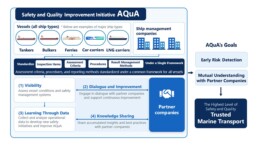
MOL launches ‘AQuA’ safety and quality improvement initiative
Standardizing Group-wide Safety and Quality Assessment Criteria to Enhance Vessel Safety and Quality Mitsui O.S.K. Lines, announced the launch of…
Subscribe to our newsletter!
if you dont want to swim alone in the ocean of news, sign up for the newsletter, and you will receive daily all the important news of world shipping!
