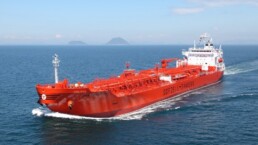

Odfjell Ship Management has partnered with Alfa Laval in their decarbonization effort by selecting the Alfa Laval OceanGlide fluidic air lubrication system to be installed on one of their tankers. Alfa Laval OceanGlide is the name of Alfa Laval’s newly acquired air lubrication system, which is based on patented fluidic technology. This technology is the latest addition to Alfa Laval’s sustainable portfolio, aimed at supporting shipowners in addressing fuel and emission challenges
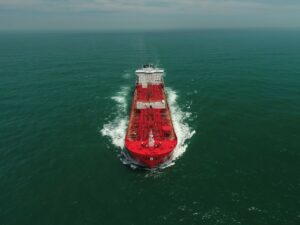
Alfa Laval has signed an agreement with Odfjell, a leading chemical tanker company, to install OceanGlide on one of their tankers, later this year. Odfjell is known for embracing new technologies for improving the energy efficiency and sustainability of its global deep-sea fleet. By installing OceanGlide, Odfjell aims at enhancing further its tanker operations by gaining the advantage of this new innovative technology.
OceanGlide integrates fluidic technology into air lubrication to optimize energy saving. This patented and class-approved system utilizes fluidic oscillators to generate an even layer of micro air bubbles across a vessel’s entire flat bottom, reducing friction and drag. By reducing the vessel’s resistance, the OceanGlide system offers a proven method for reducing fuel consumption and CO2 emissions.

Image Caption: Anders Lindmark, Business Unit President, Heat & Gas Systems Alfa Laval Marine
“We are delighted that Odfjell has selected OceanGlide to enhance their vessel’s energy efficiency,” says Anders Lindmark, Business Unit President, Heat & Gas Systems, Alfa Laval. “We strive to develop and bring innovative and environment-friendly technologies, such as OceanGlide, to our customers which support them in meeting their decarbonization targets and enable them to sail efficiently.”
“Odfjell has installed more than 130 energy-saving devices on its vessels since 2014. In Q1 2023 we reported a historical low carbon intensity – more than 50% below the IMO baseline for our fleet. Our decarbonization efforts do not stop with this achievement – now the time has come to start deploying more enhanced technologies. We believe fluidic air lubrication technology is a natural next step for us, and we look forward to deploying the OceanGlide system to further reduce our carbon intensity”, says Erik Hjortland, Vice President Technology at Odfjell.

Leveraging the power of air lubrication based on fluidic technology
One of the key advantages of Alfa Laval OceanGlide is the ability to regulate power consumption through oscillation bands. OceanGlide uses fluidic technology to create streamlined sections on the vessel’s flat bottom, each with its own fluidic band that generates bubbles. The independent steering of each band allows a more controlled and streamlined flow of air bubbles for ensuring optimal efficiency, maximum coverage, and reduced compressor power.
“The unique configuration of bands into sections for a regulated flow of air bubbles is a distinguishing feature of the OceanGlide system. This set-up allows for precise control and optimization of power consumption, and we look forward to documenting its energy-saving effect on our chemical tankers,” says Erik.
The OceanGlide fluidic air lubrication system’s high efficiency in producing bubbles not only ensures an effective air layer with fewer compressors but also provides the added advantage of conveniently positioning them anywhere on board. The system requires no structural modifications or vessel recertification, which makes it ideal for retrofitting as well as for new builds. The fluidic bands, designed with a low profile and no moving parts, can be configured underneath the ship at any shipyard with ease.
Enabling adherence to environmental regulations
Air lubrication technology is recognized by the International Maritime Organization (IMO) as an “Innovative Energy Efficiency Technology” to lower carbon emissions. The technology supports compliance with Energy Efficiency Existing Ship Index (EEXI), Energy Efficiency Design Index (EEDI) and the reduction of carbon intensity to meet IMO’s carbon Intensity Indicator (CII) requirements. Besides this, the innovative fluidic air lubrication technology minimizes CO2 emissions thereby helping in limiting CO2 tax



Related News.
The final quarter of 2026 is expected to see softer bauxite flows
Chinese front-loading is expected to have run its course, pointing to softer bauxite flows in 2026 Q4. Global bauxite flows increased by 2.8% y/y…
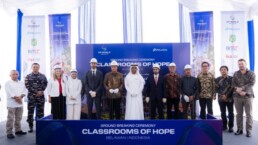
DP World Foundation and Belewan new container terminal mark groundbreaking of AED 3.7 million school project in Indonesia
Classrooms of Hope initiative expands to Belawan, Medan with a new junior high school designed to provide modern learning facilities and greater…

Chapman Freeborn named Air Charter Broker of the Year at Payload Asia Awards 2026
Chapman Freeborn has been named Air Charter Broker of the Year at the 13th Payload Asia Awards, held on 19 October at the Four Seasons Hotel…
BW LPG announces sale of BW Loyalty
BW LPG announced that its 52%-owned subsidiary, BW LPG India, has entered into an agreement to sell the 2008-built BW Loyalty for continued……

Family businesses Amer Shipping and Van de Graaf & Meeusen establish Belgian chartering office TriBarge
New office in Antwerp focuses on Belgian and French shippers and offers a broad range of inland shipping solutions based on its own assets. The first…
HMM invest KRW 2 trillion in Newbuild Fleet
HMM has announced that it placed a newbuilding order for eight 13,000 TEU containerships with HD Hyundai. The eight newbuildings will be built to LNG…
World’s first commercial ship-to-ship green ammonia bunkering completed in China
The FKAB-designed L21 ammonia carrier Shenghang Yongle has successfully supplied 1,000 tonnes of green ammonia to the ammonia-powered bulk carrier…
LD Armateurs World’s largest RoRo vessel fitted with Norsepower Rotor Sails
Norsepower, the global leader in wind-assisted propulsion for commercial shipping, announced the completion of an historic installation. The Spirit…
RAD expands European presence with new French partner KENT Group
RAD, the British marine technology company, has appointed KENT Marine Equipment, part of KENT Group, as a partner to supply and integrate RAD…
Wärtsilä engines selected for two additional inland waterway tugs in Brazil
Technology group Wärtsilä will supply the engines for two new inland waterway pusher tugs being built by Brazilian shipyard Estaleiro Rio Maguari.…
Subscribe to our newsletter!
if you dont want to swim alone in the ocean of news, sign up for the newsletter, and you will receive daily all the important news of world shipping!
