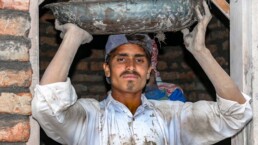

International cooperation aimed at bolstering jobs and social protection can help tackle growing disparities between high and low-income countries
Mutually reinforcing crises, including rising debt levels, are disproportionately affecting developing countries, worsening the global employment divide between high-income and low-income countries and widening existing inequalities exacerbated by the COVID-19 pandemic, says a new ILO report.
While global unemployment in 2023 is expected to fall below pre-pandemic levels – to 191 million, corresponding to a global unemployment rate of 5.3 per cent – estimates show that low-income countries remain far behind in the recovery process, according to the ILO Monitor on the World of Work – 11th edition .
ILO projects that low-income countries in Africa and the Arab region are unlikely to recover to pre-pandemic levels of unemployment this year. For North Africa, the unemployment rate in 2023 is projected to be 11.2 per cent (10.9 per cent in 2019); for Sub-Saharan Africa, 6.3 per cent (5.7 in 2019); and for the Arab States 9.3 per cent (8.7 in 2019). Other regions have managed to reduce their rates substantially below pre-crisis levels, with 6.7 per cent in Latin America and the Caribbean (8.0 per cent in 2019), 6.3 per cent in Northern, Southern and Western Europe (7.0 per cent in 2019), and 7.8 per cent in central and Western Asia (9.2 per cent in 2019).
Growing employment divide
Beyond unemployment rates, a new indicator developed by the ILO, the jobs gap, offers a more comprehensive measure of the unmet demand for employment, especially in developing countries. It captures all persons who would like to work but do not have a job.
Variations in the jobs gap point further to a global employment divide. Low-income countries face the largest jobs gap rate at an alarming 21.5 per cent, while the rate in middle-income countries stands slightly above 11 per cent. High-income countries register the lowest rates, at 8.2 per cent. Furthermore, low-income countries comprise the only country income group that has seen a long-term rise in the jobs gap rate, from 19.1 per cent in 2005 to 21.5 per cent in 2023, says the report.
Rising debt levels constrain policy responses to multiple crises
For developing countries, rising debt levels add additional challenges, considerably narrowing the scope for policy interventions. Financial and fiscal constraints hamper responses to complex threats, which include conflict, natural disasters, and economic crises that tend to reinforce themselves (a polycrisis), worsening the jobs gap. According to the report, low-income developing countries that are in debt distress are facing a significantly higher jobs gap, reaching 25.7 per cent in 2023, compared with 11 per cent in developing countries at low risk of debt distress.
Expand social protection to achieve social justice
The report also highlights significant social protection policy gaps in developing countries and provides new evidence that increasing investment would bring large economic, social, and employment benefits and narrow the global jobs divide.
It examines basic old-age pensions, especially in lower-middle-income and low-income countries where just 38.6 per cent and 23.2 per cent of older persons receive a pension respectively, compared to 77.5 per cent globally. The Monitor finds that introducing universal basic old-age pensions in developing countries would increase their GDP per capita by 14.8 per cent within 10 years and reduce extreme poverty (share of people who live on less than 2.15 USD a day) by 6 percentage points – a drastic reduction from the current rate of 15.5 per cent.
Financing social protection is challenging, but not unattainable, says the report. For developing countries, the annual cost of providing old-age pensions at the level of national poverty lines would be the equivalent to 1.6 per cent of their GDP.
Coordinated financial support needed
The analysis provides a strong case for global financial support for job creation and social protection during a time of multiple crises and shocks, to ensure that recovery and reconstruction will leave no one behind and support long-term structural transformation. The report stresses the critical importance of creating fiscal space for social investments in low-income countries. This needs to be considered with urgency as part of the current global discussion on the reform of the international financial architecture.
“Investing in people through jobs and social protection will help narrow the gap between rich and poor nations and people.”
Gilbert F. Houngbo, ILO Director-General
“The findings of this report are a stark reminder of growing global inequalities. Investing in people through jobs and social protection will help narrow the gap between rich and poor nations and people. This is why the ILO is launching a Global Coalition for Social Justice. The Coalition will bring together a wide range of multilateral bodies and stakeholders. It will help to position social justice as the keystone of a global recovery, and make it a priority for national, regional, and global policies and actions,” said ILO Director-General, Gilbert F. Houngbo.
Source: ILO



Related News.
The final quarter of 2026 is expected to see softer bauxite flows
Chinese front-loading is expected to have run its course, pointing to softer bauxite flows in 2026 Q4. Global bauxite flows increased by 2.8% y/y…

DP World Foundation and Belewan new container terminal mark groundbreaking of AED 3.7 million school project in Indonesia
Classrooms of Hope initiative expands to Belawan, Medan with a new junior high school designed to provide modern learning facilities and greater…

Chapman Freeborn named Air Charter Broker of the Year at Payload Asia Awards 2026
Chapman Freeborn has been named Air Charter Broker of the Year at the 13th Payload Asia Awards, held on 19 October at the Four Seasons Hotel…
BW LPG announces sale of BW Loyalty
BW LPG announced that its 52%-owned subsidiary, BW LPG India, has entered into an agreement to sell the 2008-built BW Loyalty for continued……

Family businesses Amer Shipping and Van de Graaf & Meeusen establish Belgian chartering office TriBarge
New office in Antwerp focuses on Belgian and French shippers and offers a broad range of inland shipping solutions based on its own assets. The first…

HMM invest KRW 2 trillion in Newbuild Fleet
HMM has announced that it placed a newbuilding order for eight 13,000 TEU containerships with HD Hyundai. The eight newbuildings will be built to LNG…
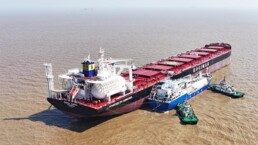
World’s first commercial ship-to-ship green ammonia bunkering completed in China
The FKAB-designed L21 ammonia carrier Shenghang Yongle has successfully supplied 1,000 tonnes of green ammonia to the ammonia-powered bulk carrier…
LD Armateurs World’s largest RoRo vessel fitted with Norsepower Rotor Sails
Norsepower, the global leader in wind-assisted propulsion for commercial shipping, announced the completion of an historic installation. The Spirit…

RAD expands European presence with new French partner KENT Group
RAD, the British marine technology company, has appointed KENT Marine Equipment, part of KENT Group, as a partner to supply and integrate RAD…

Wärtsilä engines selected for two additional inland waterway tugs in Brazil
Technology group Wärtsilä will supply the engines for two new inland waterway pusher tugs being built by Brazilian shipyard Estaleiro Rio Maguari.…
Subscribe to our newsletter!
if you dont want to swim alone in the ocean of news, sign up for the newsletter, and you will receive daily all the important news of world shipping!
