Dutch Ministry of Infrastructure and 5 major sea ports move to expand shore power

The Ministry of Infrastructure is allocating €140 million over the next few years to help realise shore power plants in sea ports. A further €40 million will be added from the climate fund. By allowing moored vessels to ‘plug in’, polluting diesel generators on the ships do not have to run while noise pollution is also reduced.
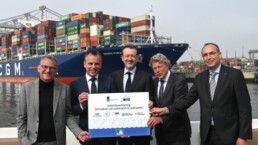
Minister Mark Harbers (Infrastructure and Water Management) signed a letter of intent with the Branch Organisation for Seaports (BOZ) on Monday, setting out public-private agreements on the roll-out of shore-based power.
With the forthcoming Alternative Fuels Infrastructure Regulation (AFIR), European ports will be required to supply so-called AFIR vessels with shore power from 2030. These include container ships, cruise ships, passenger ships, and combined passenger and cargo ships from 5,000 GT (gross tonnage, indicating the size of a vessel). These are all large vessels, which also consume a lot of energy at the quay.
‘To meet the climate targets, it is essential that all sectors do their part, including the maritime sector,’ minister Mark Harbers said. ‘At the same time, this requires huge investments. I am glad that with this subsidy scheme, we can lend a helping hand to the sector and will further encourage the installation of shore power. This will not only result in environmental gains, but also to fewer noisy generators on vessels moored at the quay. It will hopefully also free up space for development in the ports as well as new climate projects.’
The funds for shore power are mainly intended for terminals where AFIR vessels moor, but other shore power projects for maritime shipping will also become eligible for subsidies.
‘BOZ commends the government’s commitment when it comes to shore power,’ said BOZ chairman Boudewijn Siemons. ‘Shore power offers many benefits to society, including the reduction of emissions from CO2, NOx, particulate matter and noise. However, this does not translate into a conclusive business case for terminals and shipping companies. With the proposed subsidy scheme, Infrastructure and Water Management and BOZ have established attractive framework conditions to install shore power now, ahead of the mandatory European introduction of shore power by 2030.’
BOZ previously calculated that some 270 megawatts of shore power capacity will need to be installed in ports for AFIR vessels in the coming years to meet the upcoming obligation, requiring an investment of more than €300 million. The sector organisation assumes this will lead to an annual reduction of over 220 kilotonnes of CO2 (equivalent to about 75,000 households being disconnected from the gas grid), and a reduction of 2.5 kilotonnes of NOx. When shore power is also offered to vessels that will not be covered by the obligation, the potential and environmental benefits become much higher still.
Realising shore power facilities will not only bring environmental benefits and reduce noise pollution, but it may also create nitrogen space for climate projects in the port.
The 5 major sea ports of national importance are working with the Ministry of Infrastructure and Water Management and the terminals on the shore power task in the respective ports. These are the ports of Rotterdam, Amsterdam, Groningen, Moerdijk and North Sea Port (Vlissingen, Terneuzen and Ghent).



Related News.

Poland’s additional national requirements distort competition says Danish Shipping
Poland has introduced a national survey requirement for smaller foreign-flagged vessels operating in Polish waters. This creates significant…

Battery Vessels could help electrify most of Global Shipping Emissions
Battery-electric ships are economical only if the pack is cycled frequently, so they have been confined to short-sea, ferry and harbour vessels…

Mintra and Ledgid explore collaboration to connect Maritime digital identity, learning and workforce development
Mintra® and LEDGID are exploring opportunities to bring together complementary capabilities in digital learning, maritime training, professional…

World Shipping Council calls for global agreement on shipping emissions as industry investment surpasses $200 billion USD
The World Shipping Council (WSC) is calling on governments to agree on binding global greenhouse gas regulations for international shipping without…

What happened to the ITF whistleblower’s complaint?
In January 2026, a whistleblower complained that International Transport Workers’ Federation (ITF) General Secretary Stephen Cotton had manipulated…

Growing regulatory scrutiny puts seafarer wellbeing firmly on maritime safety agenda, VIKAND warns
Seafarer wellbeing is coming under greater regulatory scrutiny as international rules and guidance increasingly recognise crew health and welfare as…

Good Times Bad Times the Premium Stays with the Strait
In October, we wrote that if the transfer network off Oman kept pace, Gulf crude would carry China's refill and keep drawing tonnage east,…

Allied Weekly Market Review Week 47
Pls find below the Allied - Weekly Market Review - Week 47 ALLIED - Weekly Market Report- Week 47


Climate TRACE releases September 2026 Emissions Data
Climate TRACE reported that global greenhouse gas (GHG) emissions for the month of September 2026 totaled 4.7 billion tonnes CO₂e. This remains…
Subscribe to our newsletter!
if you dont want to swim alone in the ocean of news, sign up for the newsletter, and you will receive daily all the important news of world shipping!
