Van Oord takes next step in implementing more sustainable fuels
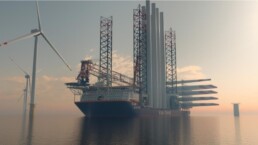

Recently Van Oord christened two new dual fuel trailing suction hopper dredgers, which are built to run on the more sustainable LNG. Now Van Oord takes another big step towards implementing the fuels of the future. Five methanol engines are ready to power Van Oord’s offshore installation vessel Boreas. The Wärtsilä 32 Methanol engines have successfully passed their Factory Acceptance Tests and have been handed over to the Yantai CIMC Raffles Shipyard in China. They are now on their way to the shipyard where the mega vessel is currently being built. The Boreas will be able to transport and install the next generation of 20 MW offshore wind turbines and is expected to be commercially available in 2025.
Van Oord is committed to reducing carbon emissions and to becoming carbon-neutral by 2050, in line with the Paris Agreement. Approximately 95% of Van Oord’s carbon footprint is linked to its fleet. Most progress can therefore be made by investing in decarbonisation of its vessels, as well as in green vessels and alternative fuels. The Boreas is an example of the energy transition within Van Oord. The vessel is the first of its kind to run on the future fuel methanol. Running on methanol reduced the ship’s carbon footprint by more than 78%.

Pioneers
The delivery of the methanol engines is a major milestone for the three parties YCRO, Wärtsilä and Van Oord and a result of successful collaboration. It is the first order for newbuild methanol-fuelled engines for Wärtsilä. Van Oord is pleased to be the pioneer of Wärtsilä’s latest methanol-fuelled engine technology. It demonstrates the companies’ shared commitment to supporting the maritime industry’s goals to reduce its environmental impact.
‘Van Oord is committed to lowering its impact on climate change by reducing our emissions and becoming net-zero. Our equipment roadmap focuses on low-carbon fuels and energy efficiency. We see methanol as one of the alternatives to meet the industry’s goals to reduce its environmental impact. The delivery of these methanol engines is a major achievement and a result of successful collaboration.’
Methanol
Methanol is a clear, colourless liquid that is soluble in water and is biodegradable. It comprises four parts hydrogen, one part oxygen, and one part carbon, and is the simplest member of a group of organic chemicals called alcohols. As a marine fuel, methanol has many advantages. Methanol is relatively inexpensive to produce, widely available and easy to store. Green methanol is an even better choice because of how it’s made. The best option would be E-methanol: produced from hydrogen from renewable-sourced electricity and recaptured carbon, making it carbon neutral. Green methanol is among the potential and most promising future fuel candidates. It is expected that the global supply infrastructure of green methanol will develop substantially.
‘We congratulate Van Oord on their vision and commitment to a decarbonised future. At Wärtsilä we are actively supporting this commitment with heavy investments in engine technologies capable of operating with alternative clean-burning fuels. The Wärtsilä 32 engines for this vessel, fuelled with methanol, showcases that shipping is entering an era of greater sustainability.’
Heavy-duty jack-up vessel Boreas
Offshore wind is a key contributor to achieving climate change targets around the world. The Boreas, being able to install the next generation of 20 MW offshore wind turbines, is preparing Van Oord for the increase in scale in the offshore wind industry. The 175-metre long vessel is purpose-built for the transport and installation of foundations and turbines at offshore wind farms. With a top-class crane it can lift more than 3,000 tonnes. The Boreas has an advanced jacking system, allowing the vessel to work in waters up to 70 metres deep. The vessel will be equipped with a cutting-edge active emissions control technology (Selective Catalytic Reduction) to reduce the NOx emission to an absolute minimum. A 5,000 kWh battery pack can take peak loads and regenerate energy to reduce the fuel consumption (and corresponding emissions) even further.



Related News.

Poland’s additional national requirements distort competition says Danish Shipping
Poland has introduced a national survey requirement for smaller foreign-flagged vessels operating in Polish waters. This creates significant…

Battery Vessels could help electrify most of Global Shipping Emissions
Battery-electric ships are economical only if the pack is cycled frequently, so they have been confined to short-sea, ferry and harbour vessels…

Mintra and Ledgid explore collaboration to connect Maritime digital identity, learning and workforce development
Mintra® and LEDGID are exploring opportunities to bring together complementary capabilities in digital learning, maritime training, professional…

World Shipping Council calls for global agreement on shipping emissions as industry investment surpasses $200 billion USD
The World Shipping Council (WSC) is calling on governments to agree on binding global greenhouse gas regulations for international shipping without…

What happened to the ITF whistleblower’s complaint?
In January 2026, a whistleblower complained that International Transport Workers’ Federation (ITF) General Secretary Stephen Cotton had manipulated…

Growing regulatory scrutiny puts seafarer wellbeing firmly on maritime safety agenda, VIKAND warns
Seafarer wellbeing is coming under greater regulatory scrutiny as international rules and guidance increasingly recognise crew health and welfare as…

Good Times Bad Times the Premium Stays with the Strait
In October, we wrote that if the transfer network off Oman kept pace, Gulf crude would carry China's refill and keep drawing tonnage east,…

Allied Weekly Market Review Week 47
Pls find below the Allied - Weekly Market Review - Week 47 ALLIED - Weekly Market Report- Week 47


Climate TRACE releases September 2026 Emissions Data
Climate TRACE reported that global greenhouse gas (GHG) emissions for the month of September 2026 totaled 4.7 billion tonnes CO₂e. This remains…
Subscribe to our newsletter!
if you dont want to swim alone in the ocean of news, sign up for the newsletter, and you will receive daily all the important news of world shipping!
