Supply of critical raw materials risks jeopardising the green transition


A significant scaling up of both production and international trade of critical raw materials is needed to meet projected demand for the green transition and achieve global net zero CO2 emissions targets.
A new policy paper on Raw Materials for the Green Transition: Production, International Trade and Export Restrictions, shows the price of many materials – including aluminum and copper – have reached record highs, driven by the repercussions of the COVID-19 pandemic, trade tensions and the continuing consequences of Russia’s invasion of Ukraine.
While the production and trade of most critical raw materials has expanded rapidly over the last ten years, growth is not keeping pace with projected demand for the metals and minerals needed to transform the global economy from one dominated by fossil fuels to one led by renewable energy technologies.
Lithium, rare earth elements, chromium, arsenic, cobalt, titanium, selenium and magnesium recorded the largest production volume expansions – ranging between 33% for magnesium and 208% for lithium – in the last decade, but this falls far short of the four- to six-fold increases in demand projected for the green transition. At the same time, global production of some critical raw materials, such as lead, natural graphite, zinc, precious metal ores and concentrates, as well as tin, actually declined over the last decade.
“The challenge of achieving net zero CO2 emissions will require a significant scaling up of production and international trade in critical raw materials,” OECD Secretary-General Mathias Cormann said. “Policy makers must closely scrutinise how the concentration of production and trade coupled with the increasing use of export restrictions are affecting international markets for critical raw materials. We must ensure that materials shortfalls do not prevent us from meeting our climate change commitments.”
Production of critical raw materials is becoming more concentrated amongst countries, with China, Russia, Australia, South Africa and Zimbabwe among the top producers and reserve holders.
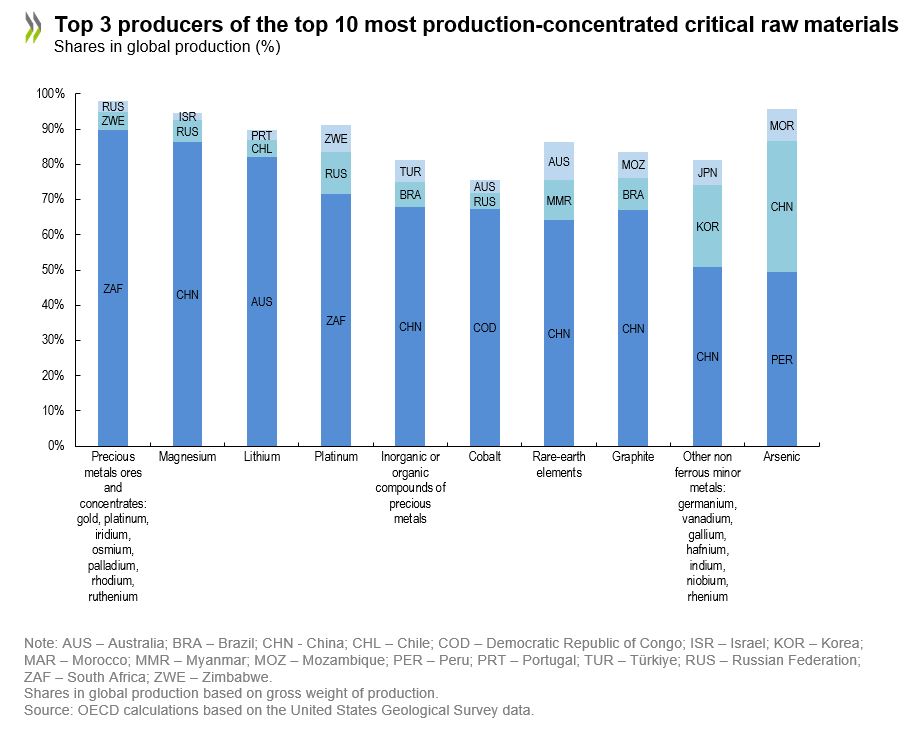 |
While both imports and exports of critical raw materials have also become increasingly concentrated amongst countries, trade of these materials remains relatively well diversified. This suggests that the possibility of significant disruption to the global green transition by disturbances to import or export flows of critical raw materials is limited. However, concentrations of exports and imports are significant in some specific cases, notably in upstream segments of supply chains for some critical raw materials, including lithium, borates, cobalt, colloidal precious metals, manganese and magnesium.
Export restrictions on critical raw materials have seen a five-fold increase since the OECD began collecting data in 2009, with 10% of global exports in critical raw materials now facing at least one export restriction measure. Export restrictions on ores and minerals — in essence the raw materials located upstream in critical raw material supply chains — grew faster than restrictions in the other segments of the critical raw materials supply chain, correlating with the increasing levels of production, import and export, as well as the concentration in a small number of countries.
China, India, Argentina, Russia, Viet Nam and Kazakhstan issued the most new export restrictions over the 2009 to 2020 period for critical raw materials, and also account for the highest shares of import dependencies of OECD countries. The OECD finds that the trend toward increasing export restrictions may be playing a role in key international markets, with potentially sizable effects on both availability and prices of these materials.



Related News.

5th CSN Greece ICT Conference, Athens 19th November 2026 “Intelligent Skies, Secure Seas: The AI Impact on ICT” – Save the date
About the Conference The 5th CSN Greece Shipping ICT Conference, titled “Intelligent Skies, Secure Seas: The AI Impact on ICT”, will take place on…
Maritime piracy incidents remain at historic lows despite Somali piracy concerns
The ICC International Maritime Bureau (IMB) has reported the lowest level (51) of piracy and armed robbery incidents since 1992 in the first nine…

Piraeus Port Authority main sponsor of Ferry Shipping Summit 2026
With the participation of more than 200 delegates from several European countries, the Ferry Shipping Summit 2026 took place on 8–9 October 2026 in…

EuroDry announces order for the construction of a third modern 82,000 DWT Kamsarmax Bulk Carrier
EuroDry , an owner and operator of drybulk vessels and provider of seaborne transportation for drybulk cargoes, announced that it has signed a…
India urges Russia, Ukraine to protect Black Sea shipping
India has urged both Russia and Ukraine to ensure safe passage for commercial shipping through the Black Sea as attacks on merchant vessels put…

PD Ports strengthens its commitment to the River Tees with multi-million pound Marine investment
PD Ports has officially opened a new multi-million-pound Marine facility on the banks of the River Tees, reinforcing its long-term commitment to the…
Maritime leaders head to Shanghai for the Annual Summit 2026
Shared seas, shifting horizons Maritime trade stands at a turning point. The rules-based order on which shipping has long depended is under…

Indian Register of Shipping grants type approval to Medha Energy’s 92 kWh LTO Lithium-Ion battery system
Indian Register of Shippinghas successfully completed the Type Approval process for the 92 kWh Lithium-Ion Battery System developed by M/s Medha…

KLine opens a Singapore New Hub for Consolidated Ship Management and Maritime Talenτ
Three Companies, One Roof — Singapore's New Hub for Consolidated Ship Management and Maritime Talenτ A ceremony for around 280 guests sets the stage…
ASA explores measures to Safeguard Free and Safe Navigation at Critical International Maritime Chokepoints
The Asian Shipowners’ Association which accounts for 56% of the world’s fleet capacity and consists of China, Cook Islands, Hong Kong, Japan, Korea…
Subscribe to our newsletter!
if you dont want to swim alone in the ocean of news, sign up for the newsletter, and you will receive daily all the important news of world shipping!
