
The EU Emissions Trading Scheme and FuelEU Maritime can offer significant competitive advantage to owners and charterers that understand the incentives.
At first glance, it is easy to believe that the ETS, covering 100% of in-scope 2026 emissions by 2027, will have the bigger impact of the two mechanisms. FuelEU Maritime, by contrast, covers only a small percentage of emissions even as late as 2035. But analysis by Lloyd’s Register reveals that by that stage, the financial impact of FuelEU Maritime could already have overtaken the EU ETS. By 2050, the cost in FuelEU penalties could be six to eight times greater than the cost of buying EUAs.
“I think ETS is easier to understand,” says Luke Shu, Technical Manager – Maritime Commercial Markets at Lloyd’s Register. “If you emit one tonne of CO2, then you buy one allowance and you pay for that. Whereas FuelEU Maritime is entirely technical. The easiest way to see the impact is to model the compliance costs next to each other.”

Modelling compliance costs
The results are clear. For a large handy bulk carrier emitting 9,725 tonnes of CO2equivalents (CO2e) on voyages to and from the EU, and 1,399 CO2e tonnes on intra-EU voyages or at berth in EU ports, the cost of EUAs in 2026 would be €0.58 million, while the FuelEU Maritime penalty would be €0.20 million if the ship keeps using the same fossil fuel. But by 2035, the FuelEU Maritime penalty would be €0.71 million, while the EUA price would stay similar assuming the carbon market is stable. Looking to 2050, the FuelEU Maritime penalty reaches €3.60 million, six times the EUA spend needed to cover emissions.
Although EU ETS foresees providing the right to shipping companies to pass on the financial cost under certain conditions to commercial operators or charterers, a significant amount of work remains to be done.
Most of the current commercial contracts are not yet ready to cover the multitude of scenarios of ‘who pays what’, so for both charterers and shipping companies starting with a sound understanding of regulatory impact and an understanding who owns operational exposure is fundamental prior to any updates to their commercial and risk management framework.
While EUA costs can be reduced by operating vessels more efficiently, exposure to FuelEU Maritime penalties can only be reduced significantly by changing fuel technologies. Further, Shu notes that FuelEU Maritime effectively rewards early adopters by decreasing the surplus for over-achieving compliance over time, while multiplying the penalty for failing to meet the target. Understanding the relative significance of each measure, and the optimal means and timing of compliance, is an important first step in successfully navigating carbon pricing.
There are other opportunities too for those that grasp the full implications of the EU measures. One example is the potential to offset an entire fleet or pool’s penalties with just a few over-performing vessels. This opportunity arises from the EU’s decision to allow vessels with emissions verified by the same verifier to be pooled together. This can be done regardless of shipping companies, meaning it applies to the company’s fleets or to pools of vessels owned/chartered by several companies.
The ability to pool emissions penalties and surpluses has important consequences. For example, a pool of ten boxships could avoid around €277 million in FuelEU Maritime penalties in five years (2030-2034) if they are joined by a single vessel fuelled with e-methanol. That saving far outweighs the likely cost of building the methanol-fuelled containership.
The pooling option in FuelEU Maritime means that companies investing in a zero-emission capable ship would be in a very strong bargaining position when offering to pool with other non-compliant vessels. However, depending on the type of charter party agreement the vessels were under, and especially where charterers are responsible for buying the fuel, care will be needed. The regulation does not define whether it is the owner or charterer who owns the surplus associated with a vessel, meaning that parties entering into such arrangements will need to be sure that they understand the implications to maximise their advantage.

Knowledge is power
“Whoever has more knowledge in such a negotiation will win the battle,” says Shu. “If you are an owner without that knowledge, you may just think that a long-term charter is good. But if you sign the contract without looking into all the clauses, you may find that all the FuelEU Maritime compliance surpluses go to the charterer.”
The pooling elements of the FuelEU Maritime regulation have yet to be finalised, and some of these potential opportunities and challenges are likely to change once the draft is settled. But they highlight some of the new commercial considerations that are likely to come into play as carbon pricing becomes a reality for both ship owners and charterers.
For operators and charterers looking to develop their response to carbon pricing and other market-based measures, Lloyd’s Register’s Advisory Team can offer expert support, leveraging its industry know-how and regulatory insight to identify cost-effective compliance solutions and commercial opportunities.



Related News.
Intelligent Skies, Secure Seas: Navigating Connectivity, Cyber Resilience, and AI Liability at the 5th CSN Greece ICT Conference
The 5th CSN Greece ICT Conference, held on 19th November 2026 at the Ploes Floating Venue in Paleo Faliro, Athens, successfully convened maritime…

EU moves to ban tankers insured in Russia, repair services at Russian refineries
EU targets Russian-insured tankers, refineries Von der Leyen announces 22nd sanctions package All 27 member states must approve new…
IMO tackling fraudulent registries together
Strong national systems and international information sharing are crucial to tackling fraudulent registries and fraudulent ship registration…
Open letter on freedom of navigation and the protection of seafarers
Dear High Representative Kallas, Dear Foreign Affairs Ministers, European Shipowners | ECSA, BIMCO, the Cruise Lines International Association…
Davies Turner warns of Rising Asia-UK Container Disruption and European Port Congestion
Davies Turner, one of the UK’s largest independent freight forwarding and logistics companies, says that disruption to container shipments from Asia…
Disruptions still dominate tanker market outlook
"This year, tanker markets have been affected by disruption to transits through the Strait of Hormuz, the Houthi blockade of Saudi Arabian Red Sea…
Panama’s President called on to match COP31 Heroism with action at shipping climate talks
As a series of crucial meetings tasked with cutting greenhouse gas emissions from global shipping takes place this week and next, environmental NGOs…

Trafigura appoints Helio Cumbi as Executive Director, Mozambique
Trafigura has appointed Helio Cumbi as Executive Director, Mozambique, and Business Development Lead for East and Southern Africa Oil. Helio is a…

“K” LINE holds FY2026 Global Dry Bulk Meeting
Kawasaki Kisen Kaisha, announces that it held a global meeting for its dry bulk business at the company’s head office on November 9 and 10. The…
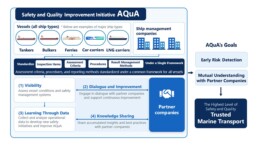
MOL launches ‘AQuA’ safety and quality improvement initiative
Standardizing Group-wide Safety and Quality Assessment Criteria to Enhance Vessel Safety and Quality Mitsui O.S.K. Lines, announced the launch of…
Subscribe to our newsletter!
if you dont want to swim alone in the ocean of news, sign up for the newsletter, and you will receive daily all the important news of world shipping!
