EU ‘Fit for 55’ FuelEU Regulation by LR

What is FuelEU?
The European Union wish to incentivise the use of renewable and low-carbon fuels on ships to reduce greenhouse gas emissions . This draft Regulation forms a substantive part of the EU’s ‘Fit for 55’ package. The final draft text of the Regulation is not yet available, but this Class News gives foresight of what the requirements are expected to be.
The Regulation is expected to apply from 1 January 2025 to ships over 5000 GT which use EEA ports. To incentivise the use of renewable and low carbon fuels, FuelEU will impose limits on the greenhouse gas intensity of fuels used onboard, and require certain ship types to have zero-emissions at berth from 2030, with stringent financial penalties for non-compliance.
What are the key requirements of FuelEU?

Reduction of GHG intensity: The yearly average GHG intensity of energy used onboard a ship will need to be determined in accordance with the Regulation. The value is not to exceed the 2020 fleet average GHG intensity of energy used onboard ships. Every 5 years from 2025 to 2050 this reference value will be reduced as follows:
- By 2% from 2025
- By 6% from 2030
- By 14.5% from 2035
- By 31% from 2040
- By 62% from 2045
- By 80% from 2050
-
- There will be a financial penalty for each quantum of energy used above the reference value.
- Any compliance surplus, compared to the annual reference value, may be banked until the followingreporting period.
- Any compliance deficit, compared to the annual reference value, may be borrowed as an advance compliance surplus from the subsequent reporting period. However, it will be subtracted from that subsequent reporting period at a rate of 1.1 x the borrowed surplus . Once a FuelEU certificate of compliance is issued surplus banking or use of an advanced surplus cannot be changed.
- To incentivise the decarbonisation of the maritime industry, the annual compliance balance of two or more ships may be pooled if verified by the same verifier. Allocation of the pooled allowance is at the discretion of the company/companies.
- Penalties are to be paid for each ship with a compliance deficit. Similarly, penalties are to be paid for each non-compliant port call. (The funds raised from the penalties will be allocated to support common projects aimed at decarbonising the maritime sector.)Zero Emission Berthing: From 1 January 2030 container and passenger ships entering major EEA ports will need to connect to onshore power supplies to meet new zero-emission at berth requirements. This will also apply to other EEA ports from 2035 if they have an onshore power supply. There are several exceptions to the requirements, which include staying at port for less than two hours, using zero-emission technology onboard whilst at berth or making a port call due to unforeseen circumstances or emergencies.
Fuel certification: The calculation of GHG intensity will require factors for each fuel type used. Greenhouse gas emission factors of the following fuels (compliant with the greenhouse gas emission savings criteria) will be determined according to the methodologies set out in Directive (EU) 2018/2001:
- biofuels and biogas not produced from food or feed crops
- renewable fuels of non-biological originIf they do not comply, they will be considered as having the least favourable fossil fuel equivalent emission factors.
Data provided on the above fuels must be verified by a scheme that is recognised by the Commission in accordance with Article 30(5) and (6) of Directive (EU) 2018/2001. Companies may use values other than the default values for the tank-to-wake emission factors provided that the actual values are certified by means of laboratory testing or direct emissions measurements.
Which voyages will fall into scope of FuelEU?
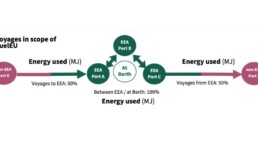
Ships entering EEA ports from a non-EEA ports / EU outermost regions or vice-versa will have 50% of the energy used in that voyage subject to the Regulation, whilst intra-EEA voyages will have all the energy used in those voyages subject to the Regulation. All energy used at berth in the EEA will be subject to the Regulation
Who is responsible for ensuring compliance with the FuelEU requirements?
The shipping company is responsible for ensuring compliance with the requirements of the FuelEU regulation. As per regulation EU 2015/757 (MRV), the ‘company’ means the shipowner or any other organisation or person, such as the manager or the bareboat charterer, which has assumed the responsibility for the operation of the ship from the shipowner.
What is the timeline for compliance with the FuelEU requirements?
By 31 August 2024 – Monitoring plans
Shipping companies will need to submit a monitoring plan to verifiers for assessment for each of their ships indicating their chosen method to monitor and report the amount, type and emission factor of energy used onboard.
From 1 January 2025 – Recording information
Based on the monitoring plan, each company will need to record the following information on an annual (1 January to 31 December) basis, for each of its ships arriving at, berthed at, or departing from an EEA port:
- port of departure and port of arrival including the date and hour of departure and arrival and time spent at berth;
- for container and passenger ships, the connection to and use of on-shore power or the existence of any of the exceptions;
- the amount of each type of fuel consumed at berth and at sea;
- the well-to-wake emission factors for each type of fuel consumed at berth and at sea, broken down bywell-to-tank, tank-to-wake and fugitive emissions, covering all relevant greenhouse gases; and
- the amount of each type of substitute source of energy consumed at berth and at sea.By 30 March 2026 – Information submission
From 2026, and in each subsequent year, by 30 March the company is to provide the verifier the information listed above (in recording information) for each of its ships.
By 30 March 2026 – Pooling
From 2026, and in each subsequent year, by 30 March companies are to notify verifiers of their intention to include a ship in a pool for the preceding reporting period. If the pool includes ships controlled by two or more companies, they should jointly notify the verifier.
Once a FuelEU certificate of compliance is issued pooling cannot be changed.
By 30 April 2026 – Reporting
From 2026, and in each subsequent year, by 30 April the verifier will have reported the following information back to the company:
- the yearly average GHG intensity of the energy used on-board by the ship
- the ship’s compliance balance
- the number of non-compliant port calls in the previous reporting
- period including the time spent at berth for each non-compliant port call; and
- the amount of the penalties.The shipping company will then record that information in a compliance database (to be established by the European Commission).
By 30 April 2026 – Compliance surplus / deficit
From 2026, and in each subsequent year, by 30 April, the company must record the use of any advance compliance surplus, following approval by its verifier, in the compliance database.
Once a FuelEU certificate of compliance is issued surplus banking or use of an advanced surplus cannot be changed.
By 30 April 2026 – Pooling
From 2026, and in each subsequent year, by 30 April, the verifier has to record the use of a pool in the compliance database, after which the composition of the pool cannot change.
On 1 May 2026 – Penalties
From 2026, and in each subsequent year, on 1 May, if the ship has a compliance deficit the company will need to pay a penalty.
By 30 June 2026 – FuelEU certificate of compliance
From 2026, and in each subsequent year, by 30 June the verifier will issue a FuelEU certificate of compliance for the ship valid until 30 June in the subsequent year. Ships entering an EEA port will have to carry a valid certificate of compliance.
A certificate cannot be issued if the ship has a compliance deficit or non-compliant port calls for which the penalty has not been paid.
Failure to present a FuelEU certificate of compliance for two or more consecutive reporting periods could result in a ship being banned from the EU.
Is LR an accredited verifier?
As the Regulation hasn’t been finalised its not yet possible to be an accredited verifier. Once finalised, Lloyd’s Register will be making an application to become an accredited verifier.



Related News.

Connected Fleets under Siege: Navigating Geopolitical Cyber Threats and Modern Maritime IT
An exclusive CSN interview between Adonis Violaris and Dr Matthew Maheras As commercial shipping becomes ever more digitally integrated, the industry…
InterManager warns enclosed space deaths demand urgent industry action
InterManager has called for urgent industry action on enclosed space safety after its latest research highlighted persistent failures in procedures,…

ATPI Greece marks 50 years at the heart of global crew changes
Five decades supporting the Greek and global shipping community 35% of ATPI’s marine business now managed from Greece More than 130 professionals…
Euroseas announces a new time charter contract for its 2001-built 2,556 teu Feeder Containership, M/V EM Corfu, and the sale of its sister vessel, M/V Evridiki G
Euroseas an owner and operator of container carrier vessels and provider of seaborne transportation for containerized cargoes, announced a new…
Possible further delay to road transport’s inclusion in EU ETS causes serious concern
Interferry, the global trade association representing the ferry shipping industry, is raising serious concerns over the current state of EU Emissions…

ABP appoints new head of commercial for Humber
Associated British Ports, the UK’s largest port operator, has appointed Sandrine Lagrost as its new Head of Commercial for the Humber, joining the…
Commodity Radar | Spotlight: Bauxite – Week 43.2026
The final quarter of 2026 is expected to see softer bauxite flows Chinese front-loading is expected to have run its course, pointing to softer…
Japan IMO attempt to weaken the IMO Net-Zero Framework
Japan has put forward a proposal to the International Maritime Organization to remove the Net-Zero Fund and put shipping companies in control of…

xclusiv S&P Report 19th October 2026
Pls find below the [xclusiv] S&P Report 19th October 2026 [xclusiv] 2026_10_19

Glencore achieves land access for the Coroccohuayco project at Antapaccay
Antapaccay, a Peruvian entity controlled by Glencore, has completed the access agreements required for the last blocks of land to unlock the…
Subscribe to our newsletter!
if you dont want to swim alone in the ocean of news, sign up for the newsletter, and you will receive daily all the important news of world shipping!
