
On behalf of the Technical University Delft (TU Delft) and the Sea Axe Fund, wind-assisted ship propulsion specialist Blue Wasp Marine has assessed the potential of a straightforward adjustment to a Flettner rotor. Using its in-house developed Pelican software, the company studied the effects of adding a flap to the rotor and achieved improved performance and significant reductions in both emissions and fuel consumption.
The bottom line
In the circumstances covered by Blue Wasp’s tests, inclusion of the flap was shown to increase performance by a significant 35%. The fuel savings were increased from 6.8% to 9.2% when using one rotor (which is an increase of about 35%), or from 10% to 13.3% when using two rotors (which is an increase of about 33%).
Giovanni Bordogna, founding partner and aerodynamics specialist at Blue Wasp Marine, said, “These tests demonstrate the significant potential of wind-assisted propulsion to support the maritime industry meet the challenges it is currently facing. Our results demonstrate how a small adjustment to a Flettner rotor can have a big impact, making shipping operations considerably cleaner and more cost-effective.”
What a drag
The potential of a Flettner rotor to reduce a vessel’s fuel consumption is already well established. However, the rotor is also known to have a relatively large drag, which reduces its aerodynamic efficiency, particularly when sailing upwind.
Fixing the flow
TU Delft and the Sea Axe Fund hit upon the idea of incorporating a flap to the rotor to fix the flow separation point, thereby altering the lift and drag forces created. To test this, they approached Blue Wasp Marine.
To collect the required data on Flettner rotor aerodynamics, Blue Wasp conducted tests at the wind tunnel at the Politecnico di Milano in Italy. This information was then combined with the in-built force models of Blue Wasp’s Pelican software.
Controlling for reliability
Next, Blue Wasp established a series of controls to ensure the accuracy of the experiment. Pelican was to assess the two vessels, one with a Flettner rotor alone and one with rotor and flap, sailing at the same speed, in the same conditions, on the same route.
The company selected to perform the study with a Damen Combi Freighter 5000. This 86 x 15.3 metre vessel serves as a good representative of its type and indicates the effects of the Flettner rotor and flap on a nearshore cargo vessel.
Factors included in the tests were the thrust of the Flettner rotor, wind, resistance in both waves and calm water and resistance resulting from leeway, heeling and rudder operation.
The performance of the two vessels was considered over the same North Sea route, between Rotterdam, the Netherlands and Trondheim, Norway.
Closer to the wind
The tests demonstrated that the addition of the flap delivered a significant increase in aerodynamic thrust, increasing the vessel’s operating profile. The vessel equipped with the Flettner rotor and flap has a tacking angle in the region of 15 degrees smaller than the one with only the rotor. This allows the vessel to sail significantly closer to the wind, vastly improving efficiency of performance upwind.
Exceeding the brief
Though not a part of the study, the results also established that, in most positions, the flap’s decreases of lift and drag resulted in reduced downwash and less accelerated flow in the rotor wake. This results in a relatively smaller aerodynamic sideforce, requiring smaller heeling, leeway, and rudder angles to reach sailing equilibrium. This means that the vessel with the rotor and flap can operate at higher wind speeds.
Albert Rijkens of TU Delft explained the education establishment’s thinking behind asking Blue Wasp to perform the research, saying, “Wind-assisted ship prolusion has found renewed interests from the shipping industry to meet the global climate goals and it will play a vital role to lower emissions, especially for large ocean-going vessels. This research demonstrates how small modifications to well-known rotor systems can already make a big difference in the propulsion efficiency of wind-assisted ships. Delft University of Technology will continue to intensify its research in this area by making wind-assisted ship propulsion one of its spearheads of maritime research for the coming years.”
De-risking decarbonisation
Giovanni Bordogna: “This case study highlights the effectiveness of Pelican. By conducting studies such as this, we can investigate the potential of various approaches to wind-assisted propulsion prior to implementation, de-risking wind investment for ship owners and operators and helping to decarbonise the industry.”



Related News.
Intelligent Skies, Secure Seas: Navigating Connectivity, Cyber Resilience, and AI Liability at the 5th CSN Greece ICT Conference
The 5th CSN Greece ICT Conference, held on 19th November 2026 at the Ploes Floating Venue in Paleo Faliro, Athens, successfully convened maritime…

EU moves to ban tankers insured in Russia, repair services at Russian refineries
EU targets Russian-insured tankers, refineries Von der Leyen announces 22nd sanctions package All 27 member states must approve new…
IMO tackling fraudulent registries together
Strong national systems and international information sharing are crucial to tackling fraudulent registries and fraudulent ship registration…
Open letter on freedom of navigation and the protection of seafarers
Dear High Representative Kallas, Dear Foreign Affairs Ministers, European Shipowners | ECSA, BIMCO, the Cruise Lines International Association…

Davies Turner warns of Rising Asia-UK Container Disruption and European Port Congestion
Davies Turner, one of the UK’s largest independent freight forwarding and logistics companies, says that disruption to container shipments from Asia…

Disruptions still dominate tanker market outlook
"This year, tanker markets have been affected by disruption to transits through the Strait of Hormuz, the Houthi blockade of Saudi Arabian Red Sea…

Panama’s President called on to match COP31 Heroism with action at shipping climate talks
As a series of crucial meetings tasked with cutting greenhouse gas emissions from global shipping takes place this week and next, environmental NGOs…

Trafigura appoints Helio Cumbi as Executive Director, Mozambique
Trafigura has appointed Helio Cumbi as Executive Director, Mozambique, and Business Development Lead for East and Southern Africa Oil. Helio is a…

“K” LINE holds FY2026 Global Dry Bulk Meeting
Kawasaki Kisen Kaisha, announces that it held a global meeting for its dry bulk business at the company’s head office on November 9 and 10. The…
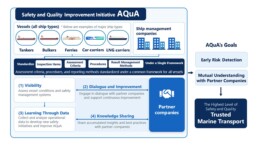
MOL launches ‘AQuA’ safety and quality improvement initiative
Standardizing Group-wide Safety and Quality Assessment Criteria to Enhance Vessel Safety and Quality Mitsui O.S.K. Lines, announced the launch of…
Subscribe to our newsletter!
if you dont want to swim alone in the ocean of news, sign up for the newsletter, and you will receive daily all the important news of world shipping!
