

Despite LNG carriers accounting for a mere 1.45% of the total cargo fleet, the overall value of LNG sale and purchase transactions accounted for nearly 12% of all cargo transactions that took place in 2022, up from 3% in 2021. This statistic reflects the surging freight rates and values experienced by the LNG sector in 2022, in the wake of major disruptions to Europe’s gas supply.
As a result of this strong market, older, inefficient steam turbine units have swung from prime demolition candidates to attractive investments, gaining a new lease on life as opportunistic buyers scoop them up for bargain prices.
Supply and Demand Factors in 2022
Demand
Prior to the Russia Ukraine conflict, LNG carriers were already in high demand. With LNG cited as a clean burning, more energy efficient alternative to oil, demand for the fuel has been on the rise for the last decade. In 2022, demand would be amplified by a global energy crisis.
In February 2022, the escalation of the conflict in Ukraine precipitated a series of events that led to a massive disruption of the European pipeline gas supply. Over the following months the Nord Stream, Yamal Europe, Turk Stream, and Blue Stream pipelines ceased entirely or dramatically reduced the volumes of LNG being transported into Europe.
Consequently, demand for seaborne LNG spiked as European nations looked to acquire gas from further afield. A combination of vessel undersupply and surging demand led to a huge increase in LNG carrier spot rates, with the BLNG1g reaching a historic peak of 466,524 USD/Day in December 2022, a YOY growth of 27% from the previous peak in 2021.
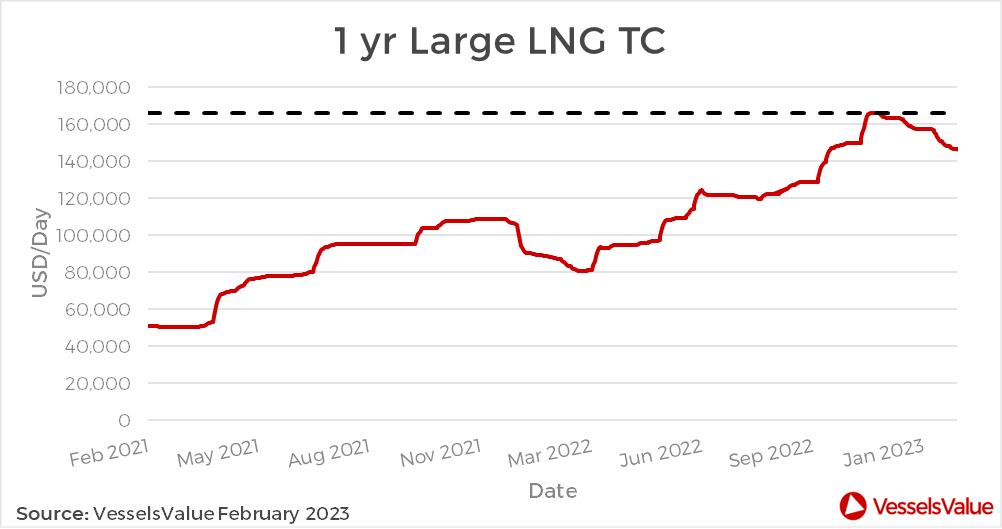
The strong demand is also reflected in 1 year Time Charter rates, which are shown in Figure 1. The VV 1 year Large LNG TC rate reached a 10 year peak of 163,209 USD/Day in November 2022.
Supply
As of 31st January 2022, there were 767 live LNG carriers and 232 on order, leaving the order book at nearly 30% of the live fleet.
Many of these units are due to enter the fleet with long term charters attached, scheduled to serve a specific project for years to come, For example, Capital Gas’ Large LNG Assos (174,000 CBM, 2024, Hyundai HI) will hit the water on a 10 year charter to Tokyo gas. The same applies to the live fleet, with many vessels operating on charters as long as 20 years.
The large portion of LNG vessels attached to long term charters led to a tight spot market, which pushed rates up further, as well as reducing liquidity in the S&P market.
LNG Fleet Breakdown
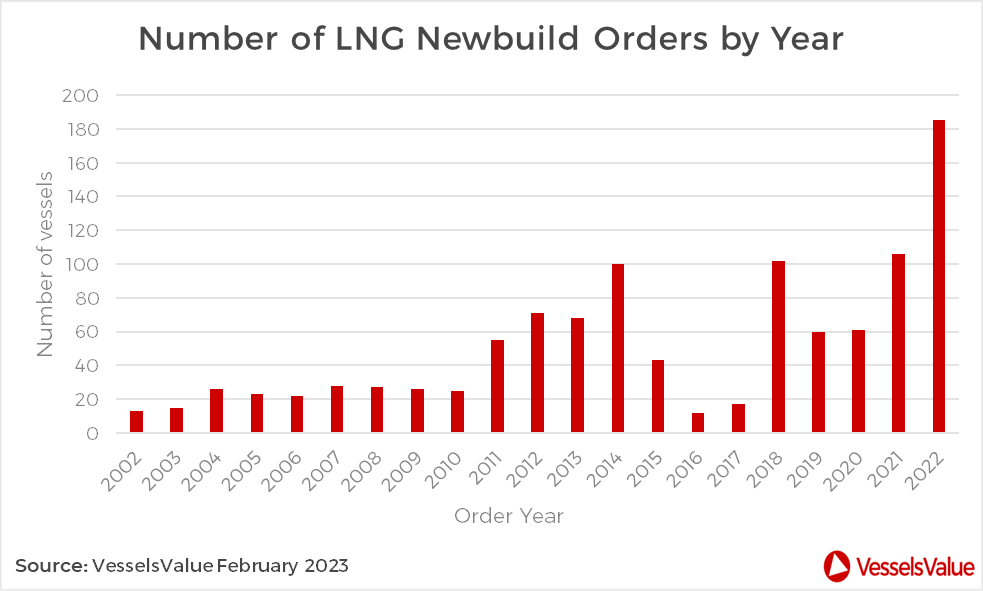
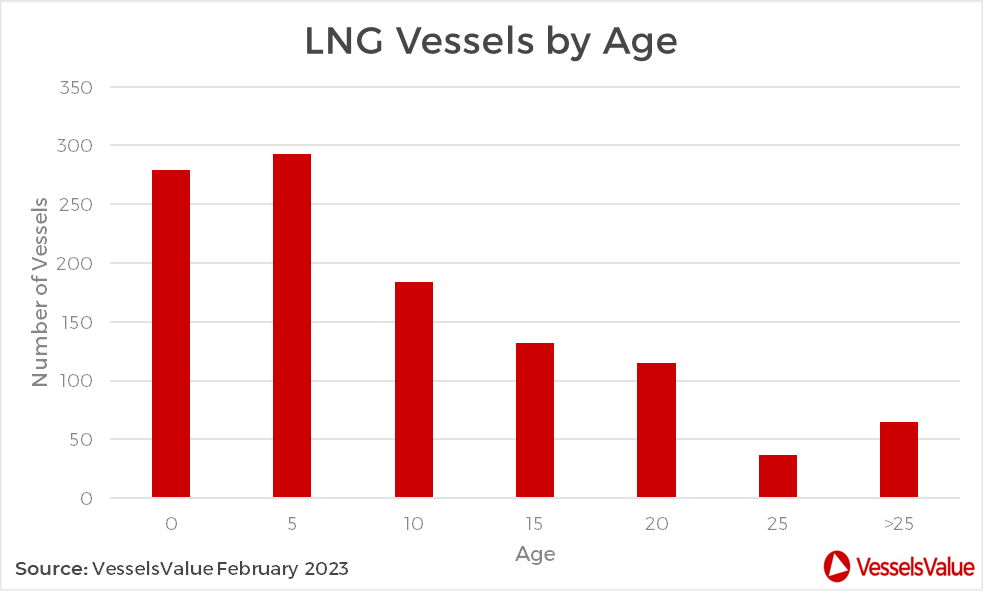
LNG’s popularity as a fuel has increased substantially over the last decade, and as a result, the LNG carrier sector has seen substantial growth. The number of newbuild orders placed every year has been increasing steadily since 2019, with the data showing a clear upward trend over the last 20 years. The current LNG fleet is therefore extremely modern, with the majority of vessels less than five years old.
Similarly, the fleet is becoming increasingly standardised, with almost all vessels ordered in 2022 due to be built with dual fuel engines, the most popular engine types being DFDE (38%), MEGA (13%) and XDF (12%). Over three quarters of the vessels (75.7%) are due to be built with a capacity of 174,000 CBM.
The introduction of IMO efficiency measures, namely the EEXI and CII in 2023, have placed further pressure on design specifications, and dual fuel looks increasingly like the optimum choice for 174,000 CBM LNG carriers.
Many vessels, built before 2010, are fitted with outdated and less efficient Steam Turbine engines, and without slow steaming or the addition of ESDs, these older units may struggle to comply with EEXI and CII in the future.
Sale and Purchase
Steam Turbine Units
In a less buoyant market, it is likely that older, smaller units would struggle to compete with the large number of modern Dual Fuel tonnage in the fleet and would become candidates for scrapping.
This includes vessels such as the Trader III (Ex Puteri Intan Satu, 137,100 CBM, Aug 2002, Mistubishi HI). This older and smaller vessel, fitted with a Mitsubishi Steam Turbine engine, and out of class, reached a VV Value of USD 29.9 mil on 1st May 2022, only USD 2.5 mil greater than its estimated scrap value of USD 26.5 mil.
In 2022, market factors would combine to make this mature vessel a surprisingly attractive investment. As rates reached historic highs, the earnings potential increased dramatically, and with a large portion of the LNG fleet tied up in long term charters, liquidity in the S&P market was greatly reduced.
In January of this year, the Trader III was acquired by Capital Gas for USD 50 mil, as LNG supply disruptions continue to reverberate within the S&P market. This was not, however, the first steam turbine unit to gain a new lease on life. In October 2022, Capital acquired the Trader II (138,000 CBM, Nov 2002, Samsung), a 21 year old steam turbine vessel, for USD 33 mil. This followed the sale of the Abadi (137,000 CBM, Jun 2002, Mitsubishi HI) another 21 year old Steam Turbine vessel, to Xinhang Shipping.
In 2022, a total of 10 steam turbine LNG carriers found willing buyers in market transactions, up from just four last year.
This is representative of the red hot S&P market in the wake of the Russia Ukraine conflict and a wider growing global demand for LNG as a fuel.
Regasification Facilities
To accommodate the increase in seaborne LNG imports, many European nations are seeking to expand LNG import capacity, spiking demand for Floating Regasification and Storage Units (FSRUs).
Out of the 45 Live FSRUs, only c.70% (31 vessels) were ordered specifically for regas and storage. The remaining 30% (14 vessels) were converted from LNG carriers, usually older ships with limited remaining lifespan. Certain shipyards, for example, Keppel Singapore, offer conversions from LNG carrier to FSRU, costing between USD 80 – 100 mil.
With the recent demand for regasification facilities, conversion to FSRU has presented itself as another attractive option for older LNG carriers. Such an opportunity was seized by Golar LNG, with the sale of the Golar Arctic (138,500 CBM, Dec 2003, Daewoo) to Snam for conversion to an FSRU. The vessel was purchased for USD 286 mil in May 2022.
Conclusion and 2023 Outlook
With European storage inventories filled much quicker than anticipated, it is unlikely that we will see a repeat of the soaring rates seen during the scramble for LNG volumes in 2022.
However, although 61 LNG vessels are scheduled to be delivered in 2023, most are already committed to long term Time Charters and will therefore be unavailable for spot fixtures. This will serve to keep rates high and ensure that old LNG vessels will continue to find profitable employment in the short to medium term.
Source: VesselsValue



Related News.

5th CSN Greece ICT Conference, Athens 19th November 2026 “Intelligent Skies, Secure Seas: The AI Impact on ICT” – Save the date
About the Conference The 5th CSN Greece Shipping ICT Conference, titled “Intelligent Skies, Secure Seas: The AI Impact on ICT”, will take place on…
Maritime piracy incidents remain at historic lows despite Somali piracy concerns
The ICC International Maritime Bureau (IMB) has reported the lowest level (51) of piracy and armed robbery incidents since 1992 in the first nine…
Piraeus Port Authority main sponsor of Ferry Shipping Summit 2026
With the participation of more than 200 delegates from several European countries, the Ferry Shipping Summit 2026 took place on 8–9 October 2026 in…

EuroDry announces order for the construction of a third modern 82,000 DWT Kamsarmax Bulk Carrier
EuroDry , an owner and operator of drybulk vessels and provider of seaborne transportation for drybulk cargoes, announced that it has signed a…

India urges Russia, Ukraine to protect Black Sea shipping
India has urged both Russia and Ukraine to ensure safe passage for commercial shipping through the Black Sea as attacks on merchant vessels put…

PD Ports strengthens its commitment to the River Tees with multi-million pound Marine investment
PD Ports has officially opened a new multi-million-pound Marine facility on the banks of the River Tees, reinforcing its long-term commitment to the…

Maritime leaders head to Shanghai for the Annual Summit 2026
Shared seas, shifting horizons Maritime trade stands at a turning point. The rules-based order on which shipping has long depended is under…

Indian Register of Shipping grants type approval to Medha Energy’s 92 kWh LTO Lithium-Ion battery system
Indian Register of Shippinghas successfully completed the Type Approval process for the 92 kWh Lithium-Ion Battery System developed by M/s Medha…
KLine opens a Singapore New Hub for Consolidated Ship Management and Maritime Talenτ
Three Companies, One Roof — Singapore's New Hub for Consolidated Ship Management and Maritime Talenτ A ceremony for around 280 guests sets the stage…
ASA explores measures to Safeguard Free and Safe Navigation at Critical International Maritime Chokepoints
The Asian Shipowners’ Association which accounts for 56% of the world’s fleet capacity and consists of China, Cook Islands, Hong Kong, Japan, Korea…
Subscribe to our newsletter!
if you dont want to swim alone in the ocean of news, sign up for the newsletter, and you will receive daily all the important news of world shipping!
