Early detection is key to preventing shipboard electrical vehicles fires advises Survitec
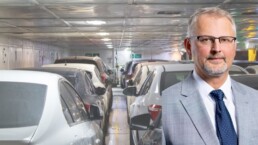

Following several high-profile ship fires involving electric vehicles, leading Survival Technology solutions provider Survitec is advising operators of vessels transporting hybrid and EVs – such as ferries, ropaxes, roros, PCCs and PCTCs – on how best to prevent and control fire onboard ship involving lithium-ion batteries.
As part of ongoing initiatives within the industry to improve safety, there is a drive to develop early fire detection systems to better monitor and protect car decks and lithium-ion batteries installed in vehicles onboard. Any slight deviation in their properties can provide an early indication that conditions are right for a fire and afford time to take preventative measures to protect or quarantine hybrid and EVs.
Pre-ignition signs of a battery fire include heat and smoke from parts of the vehicle where the battery is usually placed, popping sounds from battery cells, and toxic gas emissions.
While early detection solutions are readily available, Rafal Kolodziejski, Survitec’s Head of Product Support & Development – Fire Systems, revealed that these systems are not yet adapted to allow for pre-fire conditions specific to lithium-ion batteries. That is, not only smoke and heat but also gas emissions, including, potentially, sound frequencies related to gas release.
“Monitoring car decks for early-stage fire conditions – typically any fluctuation in temperature or atmospheric condition – is critical to preventing fire propagation. The type and location of sensors are vitally important.”
Kolodziejski said that Survitec is investing “heavily in the development of new solutions capable of pre-ignition monitoring” and is working with a major ship operator to design a comprehensive fire detection and extinguishing system for the EV cargo deck of a new build PCC (Pure Car Carrier).
Currently in development, the company’s integrated graphical monitoring system can provide real-time status of all the fire-protected zones onboard. The monitoring system will link all the detection systems and sensors onboard to allow for the remote or local activation of a compartment’s fire suppression system.
“An EV battery fire is different to any other type of fire in that the battery generates explosive and toxic gases, increasing the size and propagation of the fire,” explained Kolodziejski.
“The heat is, therefore, more intense, and an extinguished fire can potentially reignite at any time until the battery is completely burnt down. This presents a real challenge regarding gas-based fixed fire systems, such as CO2. Traditionally, a system pack has sufficient gas for just one discharge in the event of a fire. Currently, classification societies propose that double the gas volume is provided, but this may not be enough to control fire or prevent reignition,” he continued.
Water-based solutions provide the best cooling effect, which is crucial in the case of this type of fire. However, the volume of water required to control an EV deck fire could impact ship stability, so a suitable drainage system must also be considered.
Research shows that a water mist system has the highest efficiency for this type of fire. However, because battery modules are installed under the floor in most EVs, the most significant heat will be generated at deck level. There are various R&D initiatives investigating the best water spraying method for this. One of these solutions is a pop-up nozzle that sprays water mist upwards and fixed, and mobile solutions are now at the testing stage.
Fire onboard ships where EVs may be involved is now a genuine industry concern, and, referring to guidelines the European Maritime Safety Agency (EMSA) published in May last year, Kolodziejski highlights some of the recommendations currently being proposed to limit fire propagation and allow for effective monitoring of the environment around EV cargoes and also easy access in the event of a fire.
For example, EV car-carrying ship owners are urged to consider increasing the space between each vehicle or reducing the number of units transported. Some ship operators are already requesting that batteries in used or second-hand EVs are disconnected prior to shipment, especially if EVs or their batteries show signs of damage.
“Prevention is certainly better than the cure at the moment,” said Kolodziejski. “Early monitoring and detection are becoming increasingly important safety factors for ship operators and crew. With an EV cargo, the earlier the crew can detect pre-fire conditions, the better.”



Related News.

5th CSN Greece ICT Conference, Athens 19th November 2026 “Intelligent Skies, Secure Seas: The AI Impact on ICT” – Save the date
About the Conference The 5th CSN Greece Shipping ICT Conference, titled “Intelligent Skies, Secure Seas: The AI Impact on ICT”, will take place on…
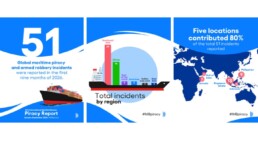
Maritime piracy incidents remain at historic lows despite Somali piracy concerns
The ICC International Maritime Bureau (IMB) has reported the lowest level (51) of piracy and armed robbery incidents since 1992 in the first nine…
Piraeus Port Authority main sponsor of Ferry Shipping Summit 2026
With the participation of more than 200 delegates from several European countries, the Ferry Shipping Summit 2026 took place on 8–9 October 2026 in…

EuroDry announces order for the construction of a third modern 82,000 DWT Kamsarmax Bulk Carrier
EuroDry , an owner and operator of drybulk vessels and provider of seaborne transportation for drybulk cargoes, announced that it has signed a…

India urges Russia, Ukraine to protect Black Sea shipping
India has urged both Russia and Ukraine to ensure safe passage for commercial shipping through the Black Sea as attacks on merchant vessels put…
PD Ports strengthens its commitment to the River Tees with multi-million pound Marine investment
PD Ports has officially opened a new multi-million-pound Marine facility on the banks of the River Tees, reinforcing its long-term commitment to the…

Maritime leaders head to Shanghai for the Annual Summit 2026
Shared seas, shifting horizons Maritime trade stands at a turning point. The rules-based order on which shipping has long depended is under…
Indian Register of Shipping grants type approval to Medha Energy’s 92 kWh LTO Lithium-Ion battery system
Indian Register of Shippinghas successfully completed the Type Approval process for the 92 kWh Lithium-Ion Battery System developed by M/s Medha…

KLine opens a Singapore New Hub for Consolidated Ship Management and Maritime Talenτ
Three Companies, One Roof — Singapore's New Hub for Consolidated Ship Management and Maritime Talenτ A ceremony for around 280 guests sets the stage…
ASA explores measures to Safeguard Free and Safe Navigation at Critical International Maritime Chokepoints
The Asian Shipowners’ Association which accounts for 56% of the world’s fleet capacity and consists of China, Cook Islands, Hong Kong, Japan, Korea…
Subscribe to our newsletter!
if you dont want to swim alone in the ocean of news, sign up for the newsletter, and you will receive daily all the important news of world shipping!
