Energy services sector set to grow to 1 trillion in 2025

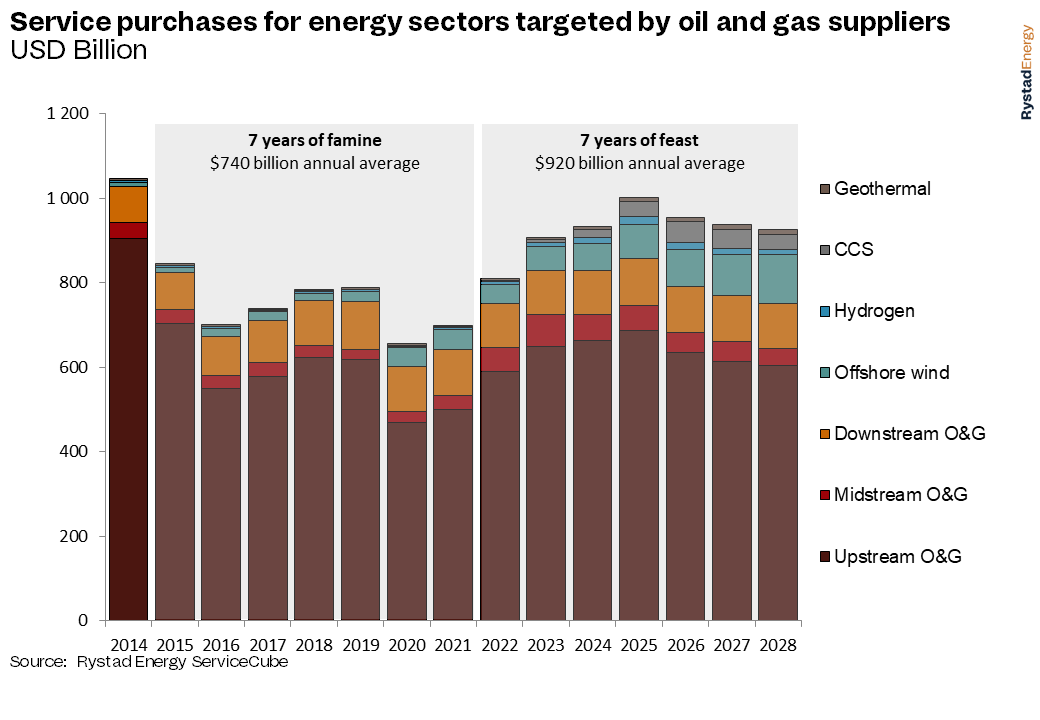
Rystad Energy expects the global market for oil and gas contractors to rise to a peak of $1 trillion in 2025 and remain at high levels for several years thereafter. Helped by strong growth in the midstream part of the industry to liquefy, transport, and re-gasify natural gas, overall oil and gas spending will stay above $920 billion annually on average for the 2022-2028 period.
Despite the risk that another downturn cycle in oil and gas may occur after 2025, oilfield service suppliers should be able to balance out the downturn by branching out into other parts of the wider energy market – and in so doing, expanding the overall target market for contractors. The key for suppliers is to continue chasing obvious opportunities within geothermal energy, hydrogen, offshore wind, and carbon capture, utilization and storage.
Together with oilfield services, this expansion into other energy areas could provide a $1 trillion market for suppliers by 2025, which could be sustained for several years after that. Breaking down the various service segments among the oil and gas suppliers reveals that all segments will grow in nominal terms, led by suppliers targeting equipment and materials and those providing operations and maintenance services.
While we expect the next seven years to provide a strong market for energy services, companies still have to improve their economics to make it a feast. Luckily, overall utilization is improving rapidly as suppliers are careful not to overinvest in more capacity as rigs, vessels, plants, and other units in the supply chain are affected by natural wear and tear. The result is better pricing for suppliers – the past 12 months have driven up prices for offshore rigs, land rigs, frac fleets, proppant, OCTG, vessels, and subsea infrastructure to levels not seen in a decade.
“Global oil and gas suppliers look set to echo the biblical story about the Egyptian pharaoh’s dream of seven years of feast and seven years of famine – only in the opposite order. All signs point towards 2022 being the start of another super cycle for the energy services sector”, says Audun Martinsen, partner and head of energy service research at Rystad Energy.
Last year was a turning point with the post-pandemic recovery and record high gas prices and strong oil prices, allowing oil and gas companies to lift their oil and gas investments by 20%. Energy security concerns prompted petroleum producers to raise production and contract goods and services from suppliers, and the oilfield service industry was quickly sold out of fracking fleets, rigs, and casing and tubing steel. The prices that suppliers could charge surged by double-digit percentages, allowing EBITDA margins to climb (EBITDA refers to earnings before interest, taxes, depreciation, and amortization, a key metric for measuring profitability among companies). After the rebound in 2022 we are entering a very promising 2023, with potential for 13% growth both for oil and gas investments and 10% for low-carbon investments.
Factors in the famine
The oilfield service industry has had a rocky ride since 2014. An oversupply of oil volumes driven by the US shale revolution, a volume war led by OPEC, Russia flooding the market, and a two-year long pandemic all contributed to depress oil prices and upstream spending. As a result, oil and gas suppliers did not get the several subsequent years of growth they really needed to convert their operations into a profitable healthy business in the new market environment. From its peak in 2014 to the trough in 2021, revenue fell almost 60% for the biggest contractors. Despite some optimism in 2017-19, the market did not really take off as oil and gas producers maintained strict cash discipline and some segments in the oil and gas supply chain struggled with continued overcapacity.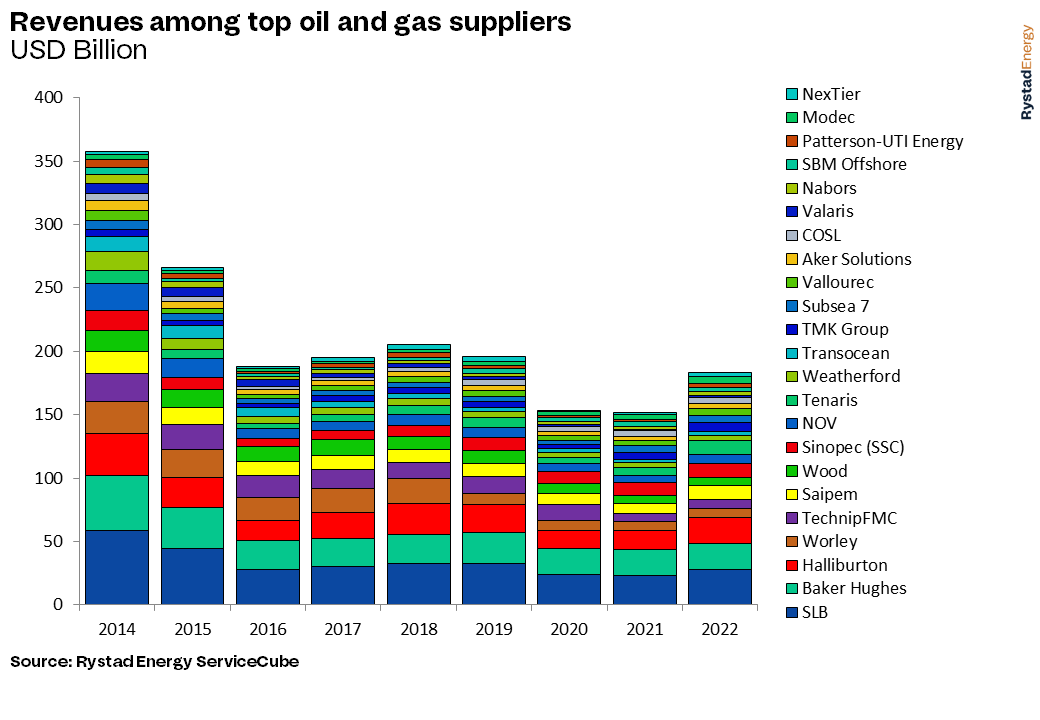
Some regions and segments saw pockets of lucrative markets in the 2014-21 period, but overall, on a corporate level, global players have not been able to turn the tide. Analyzing the largest publicly listed service players shows that it was not only revenues that were depressed for seven years: overall earnings, operational cash flow, margins, and stock performance have also been challenging.
Suppliers have not been able to cut costs, adjust capacity, and cope with their debt to a degree that would allow them to turn lower market activity into a profitable business. Companies have been clinging on to their assets, hoping to boost their market share quickly in a future market recovery. This recovery has been delayed – until now.



Related News.

5th CSN Greece ICT Conference, Athens 19th November 2026 “Intelligent Skies, Secure Seas: The AI Impact on ICT” – Save the date
About the Conference The 5th CSN Greece Shipping ICT Conference, titled “Intelligent Skies, Secure Seas: The AI Impact on ICT”, will take place on…
Maritime piracy incidents remain at historic lows despite Somali piracy concerns
The ICC International Maritime Bureau (IMB) has reported the lowest level (51) of piracy and armed robbery incidents since 1992 in the first nine…

Piraeus Port Authority main sponsor of Ferry Shipping Summit 2026
With the participation of more than 200 delegates from several European countries, the Ferry Shipping Summit 2026 took place on 8–9 October 2026 in…

EuroDry announces order for the construction of a third modern 82,000 DWT Kamsarmax Bulk Carrier
EuroDry , an owner and operator of drybulk vessels and provider of seaborne transportation for drybulk cargoes, announced that it has signed a…

India urges Russia, Ukraine to protect Black Sea shipping
India has urged both Russia and Ukraine to ensure safe passage for commercial shipping through the Black Sea as attacks on merchant vessels put…

PD Ports strengthens its commitment to the River Tees with multi-million pound Marine investment
PD Ports has officially opened a new multi-million-pound Marine facility on the banks of the River Tees, reinforcing its long-term commitment to the…

Maritime leaders head to Shanghai for the Annual Summit 2026
Shared seas, shifting horizons Maritime trade stands at a turning point. The rules-based order on which shipping has long depended is under…

Indian Register of Shipping grants type approval to Medha Energy’s 92 kWh LTO Lithium-Ion battery system
Indian Register of Shippinghas successfully completed the Type Approval process for the 92 kWh Lithium-Ion Battery System developed by M/s Medha…

KLine opens a Singapore New Hub for Consolidated Ship Management and Maritime Talenτ
Three Companies, One Roof — Singapore's New Hub for Consolidated Ship Management and Maritime Talenτ A ceremony for around 280 guests sets the stage…
ASA explores measures to Safeguard Free and Safe Navigation at Critical International Maritime Chokepoints
The Asian Shipowners’ Association which accounts for 56% of the world’s fleet capacity and consists of China, Cook Islands, Hong Kong, Japan, Korea…
Subscribe to our newsletter!
if you dont want to swim alone in the ocean of news, sign up for the newsletter, and you will receive daily all the important news of world shipping!
